

Cleanroom Airlock Design & Magnehelic Gauge Setup: Stopping Pressure Loss
Opening a cleanroom door without a properly engineered airlock instantly collapses differential pressure. When static pressure drops below specified limits, ambient air, moisture, and unmonitored particulates rush into your classified envelope.
For facility engineering teams across Canada and North America, maintaining certified zone separation relies on three physical defense layers: airlock pressure cascades, calibrated Magnehelic differential pressure monitoring, and seamless wall coving.
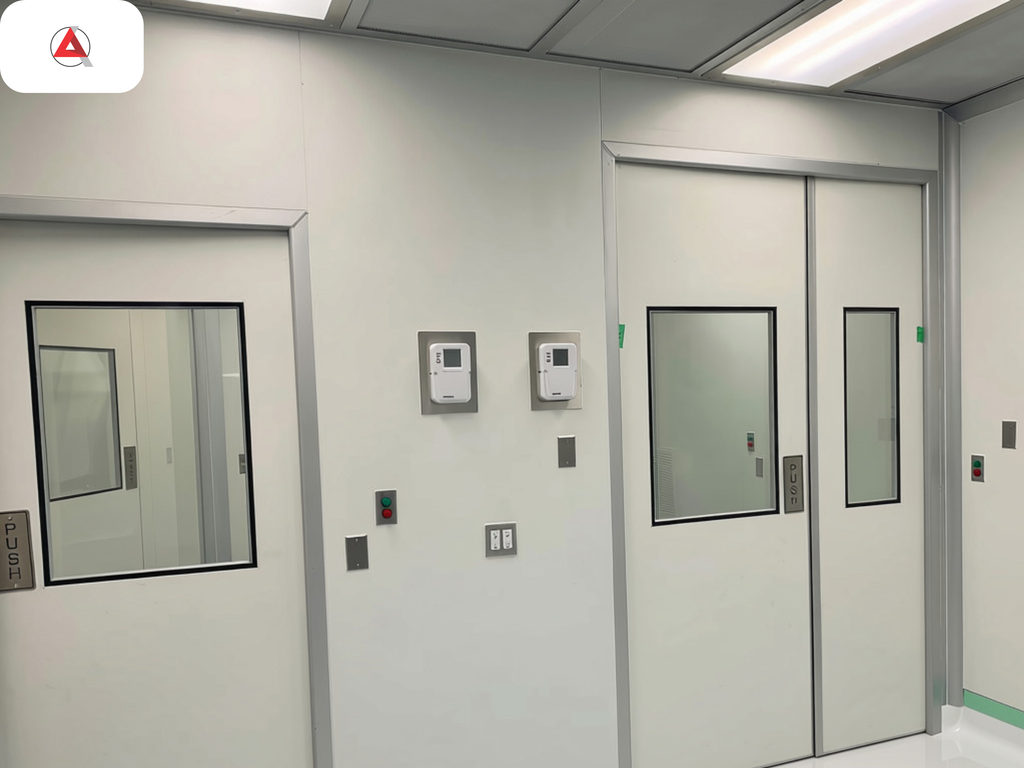
Cleanroom Airlock Design: Choosing the Right Pressure Regime
A cleanroom airlock serves as a transition buffer between unclassified corridors and ISO-rated suites. Selecting the wrong airlock pressure configuration leads to cross-contamination, particle migration, or active chemical containment breaches.
Three distinct airlock pressure regimes dictate contamination control:
- Cascade Airlock: Maintains high pressure on one side and lower pressure on the other. High-pressure air flows from the cleanest suite, through the airlock, and into the lower-grade corridor. Used widely in sterile pharmaceutical manufacturing.
- Bubble Airlock: Maintains higher static pressure inside the airlock than in both adjacent rooms. Air flows outward from the airlock into both spaces, creating a barrier against cross-contamination between two equally clean zones.
- Sink Airlock: Maintains lower static pressure inside the airlock than in surrounding rooms. Air flows inward from both adjacent spaces into the airlock, trapping airborne hazardous compounds – an absolute necessity for battery cleanrooms manufacturers handling lithium-ion chemical reactions or hazardous compounding suites.
“To determine whether your facility needs an active airlock or a static pass-through for material transfer, review our comparison on An Insider Look: Passbox vs Airlock.“
Setting Up Magnehelic Gauges for Reliable Differential Pressure
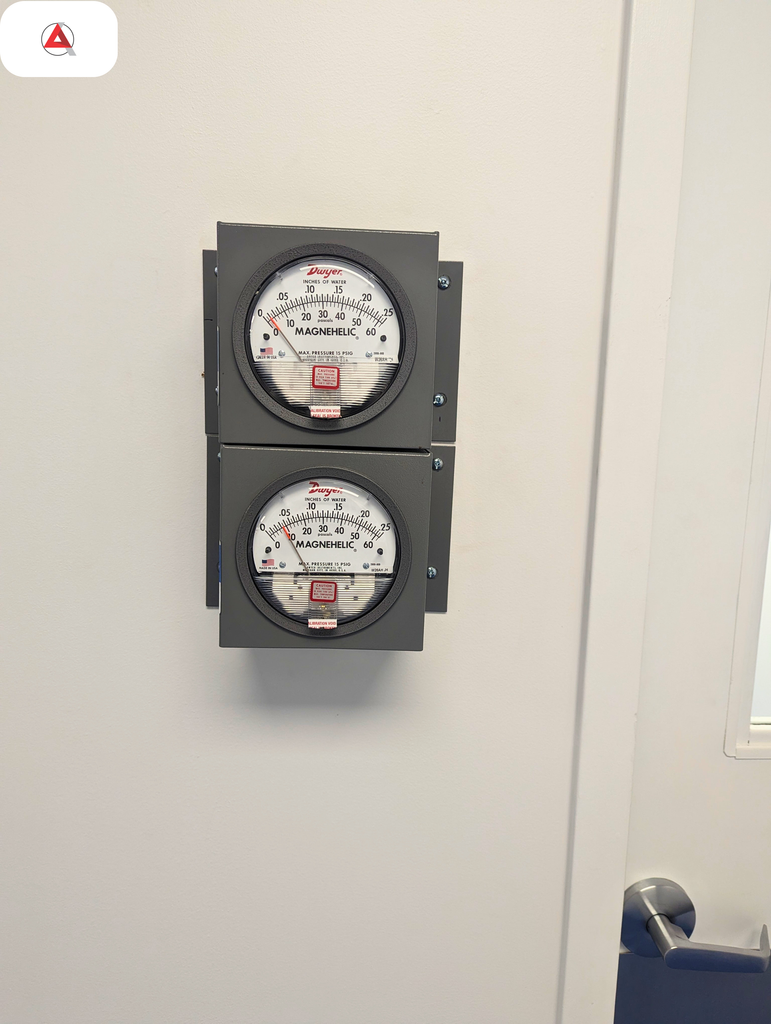
A Magnehelic differential pressure gauge provides direct visual evidence that your airlocks and processing rooms hold design pressure. Misinterpreting gauge readings or tapping pressure ports incorrectly creates false compliance alarms and invalidates environmental monitoring data.
Magnehelic Gauge Installation Best Practices
- Port Connections: Connect the high-pressure port (HIGH) to the cleaner zone and the low-pressure port (LOW) to the less-clean zone. For negative pressure sink airlocks, reverse this orientation.
- External Mounting: Mount Magnehelic gauges outside the cleanroom wall envelope on flush panels. This allows zeroing and recalibration without entering sterile zones or disrupting HVAC balance.
- Standard Thresholds: Maintain a minimum differential pressure of 10 to 15 Pascals (0.02 to 0.05 inches water gauge) across adjacent ISO classes to satisfy ISO 14644-4 cleanroom standards.
“For a deeper dive into static pressure sensor mechanics, see our technical breakdown of Manometers and Magnehelic Gauges and explore What is Differential Pressure?.”
Wall Coving and Critical Envelope Integration
Hardwall panels alone cannot maintain an air-tight seal under continuous pressure differentials. Particulates and moisture accumulate in 90-degree internal corners, leading to microbial growth and failed cleaning audits.
- Radius Wall Coving: Aluminum or PVC wall coving replaces sharp 90-degree floor-to-wall and wall-to-wall junctions with smooth, radiused curves that simplify wipe-downs and eliminate particle traps.
- Concealed Fasteners: Modular coving systems clip into place over hidden track assemblies, eliminating exposed screw heads or raw caulk joints that break down under sporicidal disinfectants.
- Sealed Penetrations: All Magnehelic pressure tubing penetrations through wall panels and coving must be sealed with non-outgassing silicone to prevent pressure leaks.
“When designing step-down cascades, ensure your HVAC handles dynamic opening events; learn more in our analysis on Why Cleanroom Pressure Cascades Collapse At Door Openings.“
Designing an ISO 7 Cleanroom Airlock Cascade
Achieving an ISO 7 cleanroom rating requires controlled air change rates (typically 30 to 60 ACH) paired with a strict step-down gowning airlock.
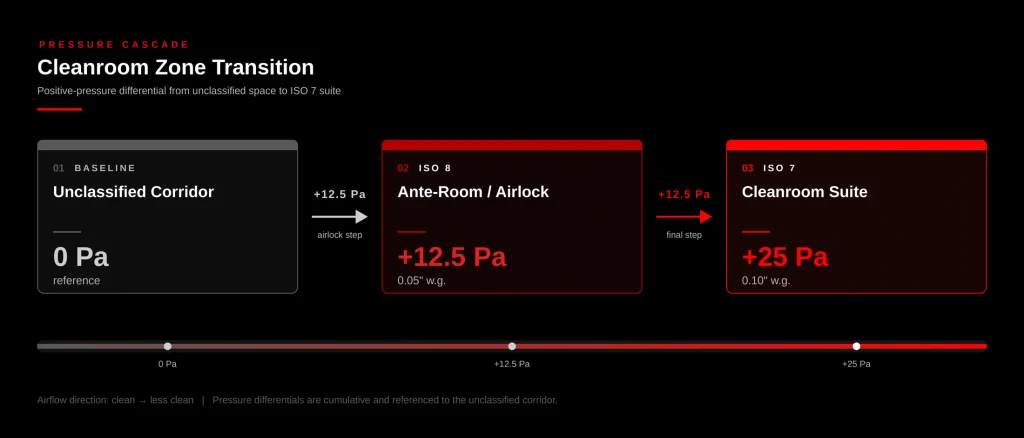
- Gowning Sequence: Operators enter the ISO 8 airlock, step across a sticky mat, gown up, and allow the airlock to recover particle counts before entering the main suite.
- Interlock Systems: Electromagnetic interlocks prevent both doors from opening simultaneously, ensuring the airlock maintains its pressure buffer during entry cycles.
- Return Air Risers: Position return air grilles near low-level wall coving in the airlock to sweep heavy particulates out of the doorway threshold during door swings.
Review full spatial layout parameters in our guide on key principles of effective cleanroom design.
Troubleshooting Common Cleanroom Pressure & Airlock Failures
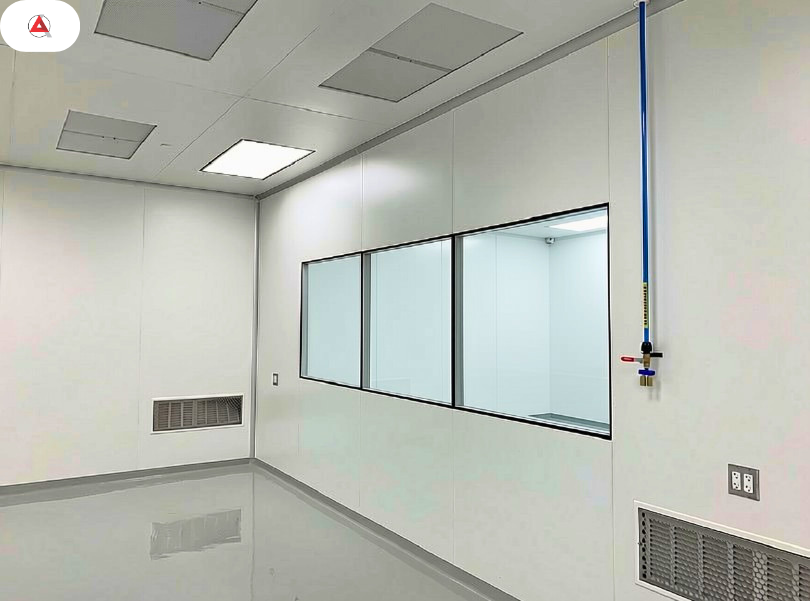
“If door gaskets or drop seals fail continuously, consult our breakdown on Cleanroom Doors & Hardware Considerations: Solving the #1 Source of Pressure Loss.“
| Problem Observed | Primary Root Cause | Engineering Solution |
|---|---|---|
| Magnehelic Gauge Fluctuates Rapidly | Transient pressure drops during door swings. | Install time-delayed alarm relays (15–30 sec) and door interlocks. |
| Pressure Loss Across Wall Joints | Unsealed coving or panel gaps. | Replace silicone caulk joints with snap-in aluminum coving track seals. |
| Air Migration into ISO 7 Suite | Incorrect airlock pressure cascade direction. | Rebalance HVAC damper settings to establish a minimum +12.5 Pa gradient. |
| Gasket Degradation on Airlock Doors | Frictional drag or chemical breakdown. | Install magnetic auto-drop seals and continuous silicone perimeter gaskets. |
Frequently Asked Questions
Why does my Magnehelic gauge fluctuate wildly when doors open?
Transient pressure drops occur naturally during dynamic door movements. Installing door interlock systems paired with time-delayed alarm relays prevents false HVAC alarms during routine personnel entry.
What is the difference between a bubble airlock and a sink airlock?
A bubble airlock keeps higher pressure inside the airlock to push air outward into both adjacent rooms. A sink airlock keeps lower pressure inside the airlock to pull air inward from both sides, trapping hazardous particles.
Is wall coving mandatory for cGMP compliance?
Yes. FDA cGMP regulations require smooth, easily cleanable transitions between walls, floors, and ceilings to eliminate 90-degree corners where contaminants accumulate.
Optimize Your Facility Pressure Control with ACH Engineering
From custom hardwall panel integration and wall coving to fully balanced airlocks, ACH Engineering delivers complete modular cleanroom Canada solutions engineered to meet strict ISO standards.
Whether you are evaluating parameters when planning a cleanroom project or need complete turnkey cleanroom design and installation, our team manages the complete scope. Explore our cleanroom solutions by industry or contact ACH Engineering today to review your airlock design, Magnehelic layout, or facility modification needs with an engineer.
GET IN TOUCH
Complete the form below to get in touch with our team.