

The Blueprint for Turnkey Cleanroom & Controlled Environment Integration
A cleanroom fails when its parts are bought separately. The HVAC plant, the wall panels, the ceiling grid, the doors – each perform to spec in isolation, then lose classification the moment they meet at a poorly sealed joint. This article explains how Turnkey integration solves that problem by engineering the mechanical systems and structural envelope as one unified system. You will learn how custom HVAC controls pressure and humidity, how modular walls and walkable ceilings hold airtight seals, and how a single design-build approach scales from battery dry rooms to pharmaceutical cold storage.
A turnkey cleanroom integrator designs, builds, and commissions the complete controlled environment as one coordinated system including HVAC, modular walls, walkable ceilings, vision doors, and coving: so, the facility meets its target ISO classification on first validation rather than after costly retrofits.
Key Takeaways: Engineering an Integrated Solution
- A cleanroom must be engineered as a single system. Mechanical performance and the structural envelope depend on each other.
- Clean room HVAC dictates pressure cascades, airflow velocity, and humidity. ISPE (2024) cites a typical 10–15 Pa differential between adjacent zones.
- Modular panels, walkable ceiling panels, flush doors, and coving eliminate particle traps and maintain airtight seals.
- One turnkey design-build method scales across industries-from EV battery dry rooms to pharmaceutical cold storage.
- An integrated approach reduces classification failures, shortens timelines, and lowers long-term operating cost.
Custom Clean Room HVAC and Environmental Control Engineering
A cleanroom is a single performance system, not a collection of products. Air pressure, particle count, temperature, and humidity all depend on how the mechanical plant, and the physical envelope work together. Break one connection and the whole environment falls out of classification.
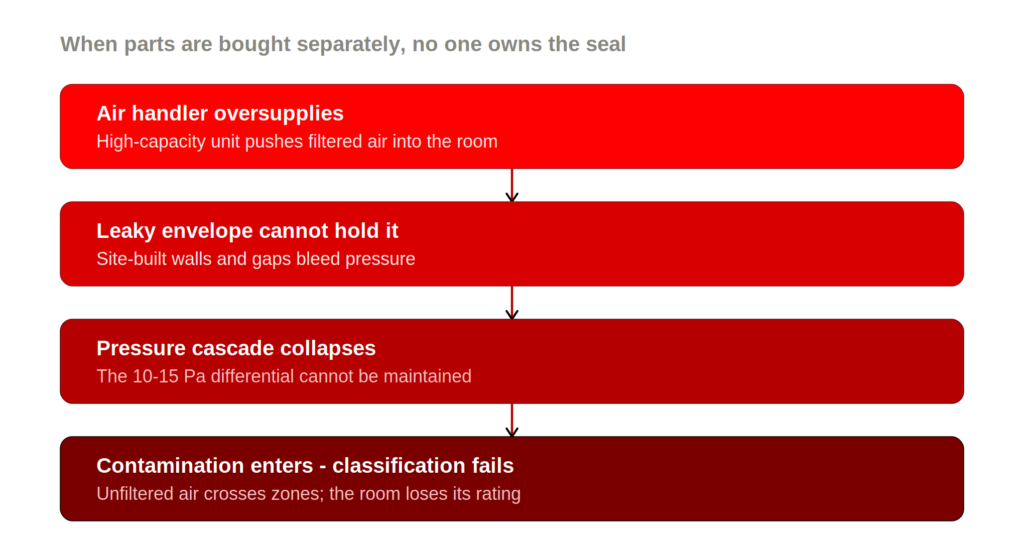
Consider the failure path. A high-capacity air handler pushes filtered air into a room. The room cannot hold that pressure because a wall joint leaks or a ceiling panel sits loose. Pressure cascades collapse. Contaminated air migrates from the dirty side to the clean side. The batch is compromised.
This is why component-by-component procurement creates risk. Each vendor optimizes for its own product. No one owns the interfaces – the seal between wall and floor, the gasket around a vision door, the connection between ductwork and a walkable ceiling. Those interfaces are where classification is won or lost.
Turnkey integration assigns ownership of the whole system to one engineering team. The team designs the HVAC and the envelope together, then commissions both as a unit. The result is a facility that validates against on the first attempt.
Turnkey Cleanroom Design, HVAC, and Construction
Executing an efficient cleanroom process requires end-to-end alignment between architecture and environmental controls.
- Cleanroom Design & Engineering: Our team develops tailored cleanroom design (or clean room design) blueprints that optimize personnel workflow, gowning zones, and material transfer.
- Clean Room HVAC System Integration: A high-performance clean room hvac system maintains precise air changes per hour (ACH), relative humidity, and temperature control.
- Cleanroom Construction: Prefabricated cleanroom construction methods drastically reduce on-site assembly time while meeting strict particulate standards.
Achieving Precise Pressure Cascades and Cross-Contamination Control
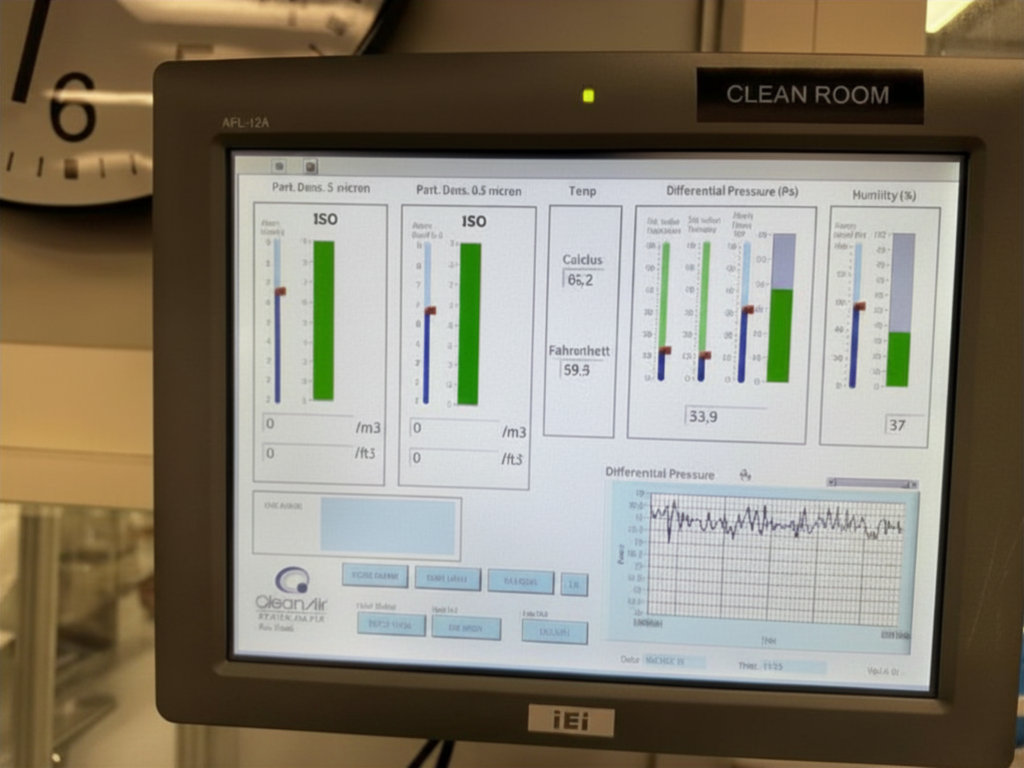
Pressure cascades create a controlled airflow direction between rooms. The cleanest space holds the highest pressure. Air always moves from clean to less clean, never the reverse.
According to ISPE (2024), the regulatory objective is a differential of 10–15 Pa across adjacent zones. Maintain that differential and contaminants cannot drift inward. Lose it and the cascade reverses.
The envelope makes the cascade possible. An air handler can supply the pressure, but only an airtight room can hold it. Leaking walls and unsealed ceilings bleed pressure and break the cascade. This is the direct link between mechanical design and structural integrity.
Optimizing Low-Humidity Dynamics for Specialized Dry Rooms
Air change rate and airflow velocity scale with the required ISO classification. Stricter classes demand more air, move faster, through more filtration.
Higher air change rates raise energy cost. The engineering goal is to lower fan, filtration, and conditioning cost without weakening airflow or pressure control. That balance comes from designing the HVAC and the room geometry together.
Engineering Continuous Thermal Control for Industrial Cold Rooms
Dry rooms and cold rooms add a second control target: moisture or temperature held to extreme tolerances.
A battery dry room controls dew point, not just particles. EV battery production requires ultra-low humidity to prevent moisture from degrading reactive lithium materials. This demands desiccant dehumidification – systems that deliver air far drier than conventional cooling can achieve. Climate by Design International notes that dedicated desiccant air-supply units produce the ultra-low-humidity discharge these environments require.
A cold room controls temperature across a wide range. According to IQS Directory, cold room temperature ranges run from −40°C to −2°C, supporting pharmaceutical storage and temperature-critical processes. The cold room refrigeration system must hold setpoint without thermal gradients that compromise stored product.
Each environment needs a purpose-built mechanical design. Our custom HVAC and environmental control solutions are engineered to the specific dew point, temperature, and pressure targets of your process.
Designing the Structural Envelope: Seamless Architectural Elements
The structural envelope holds the environment the HVAC creates. Every surface must be flat, sealed, and free of particle traps. The architectural elements are not finished – they are performance components.
Walkable ceilings, flush doors, and coving each remove a specific contamination risk while supporting the seal.
- Selecting High-Performance Walls for Structural Integrity: let maintenance crews access the plenum above the room without entering the clean space. According to ACH Engineering, well-built modular ceilings carry a 40-year lifespan and resist cleaning chemicals.
- Specifying Flush-Mount Vision Doors and Interlocking Airlocks: Sit level with the wall plain. No ledges, no recesses, no surfaces where particles collect.
- Eliminating Particle Traps with Coving and Walkable Ceiling Panels: rounds the joint between wall and floor. A coved corner sheds particles and wipes clean. A square corner traps them.
These elements work only when specified as part of the whole. Our specialized modular wall and walkable ceiling integrations are detailed against the HVAC design, so every seal aligns with the pressure plan.
ISO 7 Certification and Industry-Specific Standards
Whether operating as a specialized pharmacy cleanroom manufacturer or building an advanced semiconductor cleanroom (or semiconductor clean room), facilities must adhere to strict regulatory guidelines:
- ISO 7 Cleanroom Compliance: Designing an iso 7 cleanroom requires balanced HEPA filtration and pressure cascades to ensure passing cleanroom certification audits.
- Operations & PPE Protocols: Proper cleanroom cleaning schedules, ergonomic 316L stainless steel cleanroom furniture, and strict cleanroom ppe garbing routines are vital to preserving environmental purity over time.
Cross-Industry Applications: Turnkey Solutions in Action
A single design-build method scales across industries because the engineering principles stay constant. Pressure control, airtight envelopes, and validated commissioning apply everywhere. Only the targets change.
The contrast between sectors makes the point:
| Industry | Primary Control Target | Critical System |
| EV battery production | Ultra-low dew point | Desiccant dehumidification |
| Pharmaceutical | Particle count + sterility | Pressure cascades, HEPA filtration |
| Semiconductor | Particle count (ISO 1–5) | High air change rate HVAC |
| Cold storage | Temperature stability | Cold room refrigeration system |
| Biotechnology labs | Repeatable particle control | Sealed modular panels |
A battery dry room and a pharmaceutical cold room look different on the surface. The underlying method is identical. Both require an envelope that holds its seal and a mechanical system tuned to a precise setpoint. A turnkey integrator carries the same discipline from one project to the next.
This is the advantage of an engineered solutions provider over a component supplier. A panel manufacturer ships you a wall. A turnkey integrator delivers a validated environment – designed, built, and commissioned to your classification. Explore our turnkey cleanroom design and construction capabilities to see how the method applies to your facility.
Mitigating Project Risk with Turnkey Design-Build Execution
A cleanroom performs as a system, or it does not perform at all. The HVAC sets the pressure, airflow, and humidity. The envelope holds them. Separate these and you inherit the gaps between vendors – leaking joints, collapsed cascades, failed validations. Integrate them and you get a facility that meets classification on the first attempt and holds it for decades.
The next step is straightforward. Define your process requirements – your target ISO class, your dew point, your temperature range. Bring those targets to an engineering team that designs the mechanical and structural systems together. That single decision determines whether your facility passes validation or fights it.
A panel manufacturer supplies a single component – the wall or ceiling panels. A turnkey integrator designs, builds, and commissions the entire controlled environment, including HVAC, panels, doors, and coving, as one validated system. The integrator owns the interfaces between systems, which is where most classification failures occur.
According to ISPE (2024), the regulatory objective is a differential of 10-15 Pa between adjacent zones. The cleanest room holds the highest pressure, so air always flows from clean to less clean. Maintaining this cascade requires both adequate HVAC supply and an airtight structural envelope.
No. Battery dry rooms require desiccant dehumidification to reach the ultra-low dew points that protect reactive lithium materials. Standard cooling-based dehumidification cannot achieve these conditions. The envelope must also resist moisture infiltration to hold the dry condition.
Pharmaceutical, biotechnology, semiconductor, EV battery production, healthcare, and food processing all require controlled environments. Each has a different primary target – particle count, dew point, or temperature – but all rely on the same core engineering: an airtight envelope and a precisely tuned mechanical system.
GET IN TOUCH
Complete the form below to get in touch with our team.