

Cleanroom Doors: The Engineering Behind cGMP Pressure Control

Engineering high-integrity cleanroom doors is a vital step in maintaining room pressurization, securing cGMP compliance, and protecting your operational uptime. To meet rigorous cGMP design requirements, these systems require completely flush surfaces that eliminate particle traps, an automatic bottom drop seal that closes the floor gap, and full integration into the surrounding wall envelope rather than mismatched parts from separate vendors.
Component mismatches represent the single most common point of envelope failure in a controlled environment. The wall panels are sealed, the HVAC is balanced, and the ceiling grid is gasketed – but then a faulty door opens, and the pressure cascade you spent months validating collapses in seconds.
Room pressurization keeps contaminants out by forcing air to flow from cleaner spaces to less-clean ones. While EU GMP Annex 1 sets a minimum differential of 10 Pa, utilizing ISO 14644-4 international standards for design and construction provides the recommended 5 to 20 Pa gradient between rooms. That pressure boundary only holds if every opening in the envelope holds. Because doors are the largest moving opening in any cleanroom, they remain the largest variable in your facility’s pressure budget.
For facility managers and validation engineers, these stakes are operational, not theoretical. A leaking closure system compromises baseline efficiency, inflating fan energy, triggering low-pressure alarms, and allowing unfiltered air to back diffuse into a critical zone. This blueprint breaks down what makes a high-performance cleanroom door fit for cGMP service.
Sourcing cGMP Cleanroom Doors with True Flush Designs
A ledge is a particle trap. Every horizontal surface, recessed frame, and protruding fastener collects dust, holds moisture, and resists sanitization. In a cGMP environment, those traps become reservoirs for microbial growth and red-flag findings on your next audit.
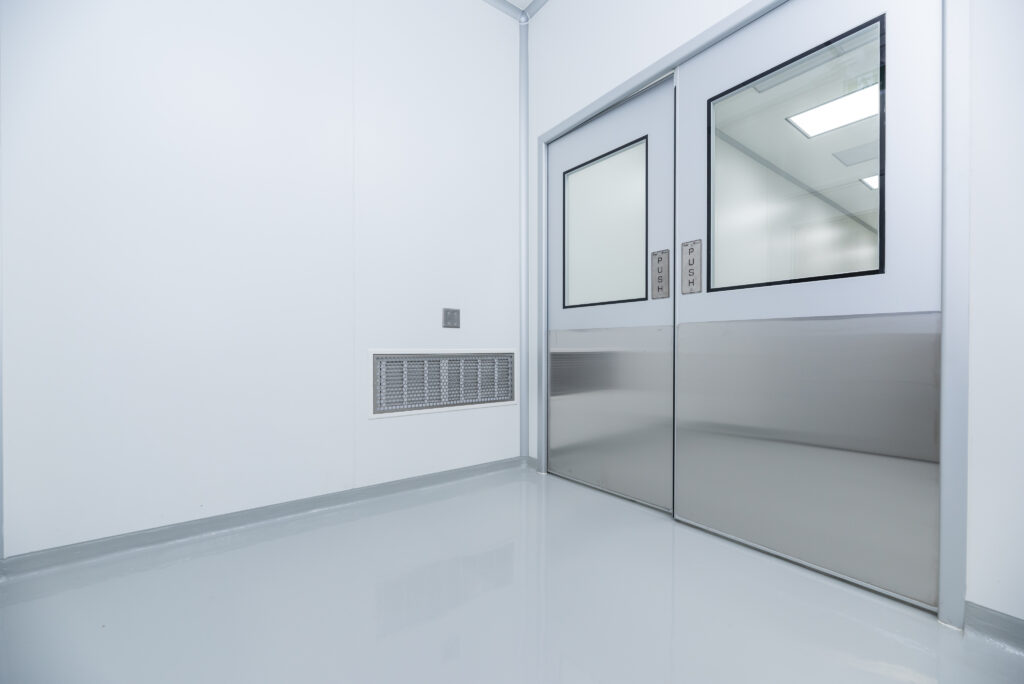
True flush designs completely remove these traps. The door leaf, frame, and vision panel sit on a single continuous plane with no raised edges to harbor contamination. That geometry optimizes your facility floor in three ways:
- Eliminates particle accumulation by removing the hidden ledges where dust and microbes settle.
- Supports chemical washdown because flat, sealed surfaces wipe clean in a single pass.
- Withstands process abuse through scratch- and impact-resistant facings rated for stringent applications.
Eliminating Crevices with Both-Side Flush Glass
Vision panels must follow the exact same rule. Both-side flush glass means the window is set perfectly level with the door surface on each face, leaving no recessed lips on either side. This layout provides clear sightlines into the room without creating a new contamination point. This is the baseline for cGMP design-a component that looks clean is not the same as one engineered to stay clean. For a full technical breakdown of structural options, review our dedicated flush design cleanroom doors capability guide.
Technical Mechanics of a Reliable Airtight Seal
The floor gap is where pressure control is won or lost. A static gap under a door leak continuously, and the leakage scales directly with the pressure differential-the higher your cascade, the faster clean air escapes. The fix is an automatic bottom drop seal.
The mechanism is purely mechanical. A spring-loaded seal sits in a groove morticed into the bottom edge of the door leaf. When the door closes, a plunger contacts the door jamb and presses the seal down against the floor, forming an airtight line across the threshold. When the door opens, the plunger releases and the seal retracts, lifting clear of the floor as soon as the leaf moves a few millimeters.
That sequence matters. The seal engages only when you need it and clears the floor the instant you open the door, so it never drags or wears against the slab. The result is a tight envelope when closed and clean operation when in use.
Maximizing Isolation with Automatic Bottom Drop Seal Technology
A well-built automatic bottom drops seal delivers:
- Self-leveling contact that conforms to minor floor variations.
- An ultra-soft silicone bubble that forms the airtight line.
- Lightweight spring action for smooth daily operation.
- Smoke and sound resistance as secondary benefits of a sealed threshold.
There is a second reason the threshold seal matters: the pumping effect. A swinging door in motion acts like a piston. Opening it creates a low-pressure wake that pulls unfiltered air inward, and closing it displaces a volume of air that can re-suspend settled particles. Research indicates a single door opening can exchange more air than a static gap leaks over several hours. You cannot eliminate the pumping effect, but a properly sealed door minimizes static baseline leakage, keeping environmental control aligned with ASHRAE guidelines for controlled environment HVAC design regarding transient pressure spikes.
Why Cleanroom Doors Must Be Part of a Single Integrated System
Doors fail when they are specified last. A team designs the wall envelope, validates the panels, then sources doors from a separate vendor on a separate timeline. The door arrives with a frame depth that does not match the panel thickness, a swing that fights the airflow direction, or a closer that cannot maintain seal pressure against the cascade. The envelope is now only as good as its weakest joint.
Implementing comprehensive turnkey cleanroom design and construction capabilities avoids this vulnerability by treating the door as an active component of the wall. The frame is detailed to the panel thickness, the seal is matched to the target differential, and the hardware is selected for the specific control logic you run. Specifying the closures alongside specialized modular wall and walkable ceiling integrations ensures all structural interfaces are solved before fabrication-not discovered on site.
Gasket Configurations for Swing and Sliding Options
Integration also means choosing the right door configuration for the opening:
- Single-swing doors for standard personnel and material access where space allows a full swing arc.
- Double-swing doors for high-traffic transfers and wider openings between process areas.
- Sliding cleanroom doors for tight corridors, equipment-heavy rooms, and airtight applications where a swing arc is not practical.
Each type carries the same cGMP requirements-flush surfaces, both-side flush glass, and an airtight seal-but the right choice depends on traffic, room layout, and how the door interacts with your custom HVAC and environmental control solutions.
Control Compatibility and Interlocking Access Systems
Cleanroom doors must adapt to your site’s automation strategy, relying on matched hardware:
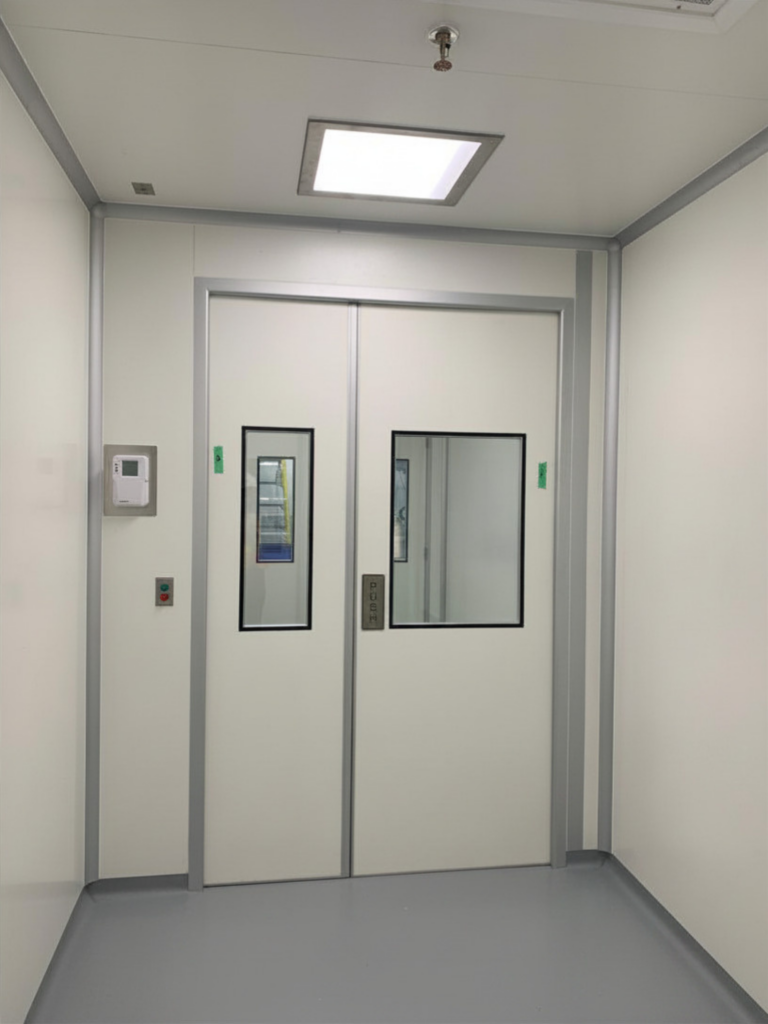
- Mortised locksets and strikers with magnetic interlocks to prevent two airlock doors from opening at once.
- Surface-mounted closers to maintain consistent seal pressure on every cycle.
- Surface-mounted electric operators for hands-free, automated access.
- Stainless steel handles, kick plates, and silicone gaskets rated for cleanroom service.
Magnetic interlocks deserve a specific note. They enforce the airlock sequence that prevents a direct wind-tunnel path between your dirtiest and cleanest spaces. That sequence is a core pressure-control measure, and it only works when the door hardware and the control system are specified as one package.
Mitigating Project Risk with Turnkey Design-Build Execution
Cleanroom doors are not simple architectural hardware items; they are active mechanical components that hold your pressure cascade, protect your product, and carry your cGMP design through every audit. Three distinct checks separate a compliant facility from a liability:
- Flush design with both-side flush glass to eliminate particle traps.
- An automatic bottom drop seal to close the floor gap when the door is shut.
- Full systems integration so the door, frame, seal, and hardware match the envelope and the control logic.
Get this right at the specification stage and the doorstops being your weakest joint. Get them wrong and no amount of HVAC capacity will fully compensate. If you are scoping a new building or correcting a problem envelope, specify your doors as part of the total wall system from day one.
Frequently Asked Questions
What pressure differential do cleanroom doors need to hold?
EU GMP Annex 1 sets a minimum of 10 Pa, and ISO 14644-4 recommends 5 to 20 Pa between rooms. In airlock cascades, guidance calls for at least 15 Pa across both doors, and 7.5 Pa per door, with differentials kept under 37 Pa to avoid difficult door operation. Your door seal and closer must maintain the gradient your specific cascade requires.
What is the difference between a flush design door and a standard door?
A flush design door places the leaf, frame, and vision panel on one continuous plane with no ledges, recesses, or protruding fasteners. A standard commercial door has raised frames and recessed panels that trap particles and resist cleaning. Only flush design meets cGMP contamination-control requirements.
How does an automatic bottom drop seal differ from a fixed sweep?
A fixed sweep drags against the floor constantly, wearing out and leaving gaps. An automatic bottom drop seal is spring-loaded: it drops to form an airtight line only when the door closes and retracts clear of the floor when it opens. This gives a tight seal without wear or drag.
Can sliding cleanroom doors meet the same cGMP standards as swing doors?
Yes. Sliding cleanroom doors carry the same requirements-flush surfaces, both-side flush glass, and an airtight seal. They suit tight corridors, equipment-heavy rooms, and airtight applications where a swing arc is impractical. The right choice depends on traffic, layout, and how the door interacts with the pressure cascade.
Why shouldn’t I source cleanroom doors from a separate vendor?
Doors sourced separately often arrive with frame depths, swings, or hardware that do not match the wall envelope or control logic. The mismatch creates leak paths and interlock failures discovered on site. Specifying doors as part of a single integrated system solves the interfaces before fabrication.
Do cleanroom doors need interlocks?
In airlocks, yes. Magnetic interlocks prevent two doors in a sequence from opening at the same time, which would create a direct path between clean and less-clean zones. This sequence is a core pressure-control measure and requires door hardware and the control system to be specified together.
GET IN TOUCH
Complete the form below to get in touch with our team.