


The MEP Integration Challenge: Solving the Thermal Density Gap in AI-Ready Data Centers
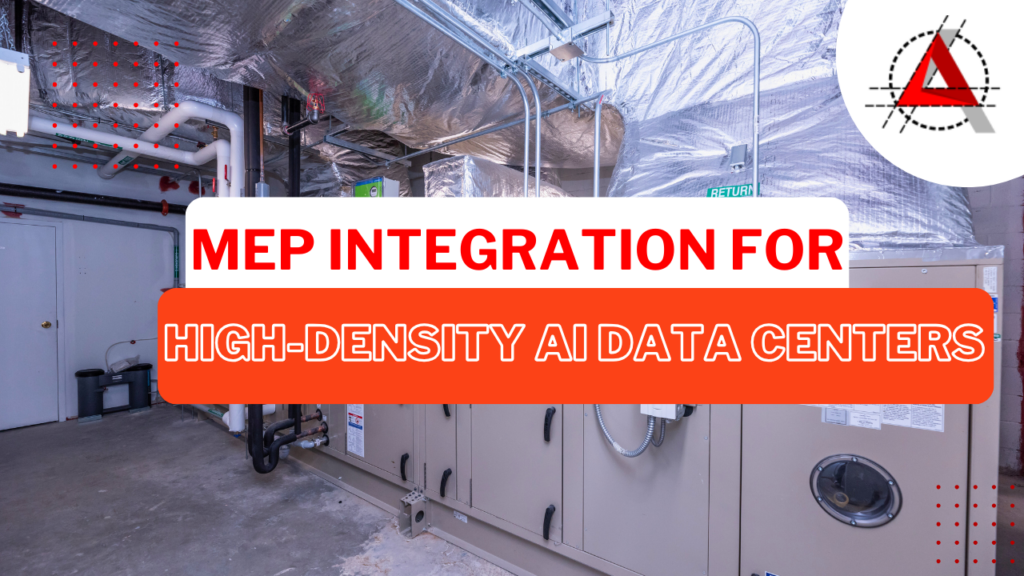
The MEP Integration Challenge: Solving the Thermal Density Gap in AI-Ready Data Centers
We are witnessing a fundamental shift in facility engineering. The rapid deployment of artificial intelligence and machine learning workloads has completely rewritten the rulebook for high-performance computing infrastructure. As hardware manufacturers push the thermal design power (TDP) of next-generation GPU clusters to absolute limits, facility engineers face a severe “thermal density gap.” Traditional mechanical layouts simply lack the capacity to extract the immense heat generated by these concentrated computing arrays. When a single rack easily surpasses 50 to 100 kilowatts, standard forced-air systems fail entirely.
To solve this paradox, industry must move beyond the mindset of basic general contracting. Facilities housing massive AI workloads require the expertise of a dedicated technical solution provider. These high-density computed environments demand pharmaceutical-grade precision. By applying advanced Cleanroom Air Handling principles to data hall design, we transform these spaces into hyper-controlled technical environments. Through our extensive leadership in building high-stakes technical facilities across Canada, we know exactly what it takes to engineer cooling architecture that bridges this density gap and protects vital infrastructure.
Beyond Air: Integrating Liquid-to-Chip and Rear-Door Cooling
You cannot solve a liquid-level heat problem with a traditional air-level cooling strategy. The physical properties of air make it a highly inefficient medium for transferring the extreme thermal loads produced by modern AI servers. To keep GPU clusters from throttling, the industry has rapidly adopted direct liquid-to-chip cooling alongside high-capacity rear-door heat exchangers. However, pumping coolant directly to the motherboard introduces a terrifying variable for facility operators: mechanical fluid risk.
Bringing secondary cooling loops into the white space requires absolute mastery of fluid dynamics and pressure control — the same rigor required when designing a Bubble Airlock for a sterile pharmaceutical facility.
We treat the management of these cooling distribution units (CDUs) and their associated pipework with the exact same rigor required when designing a Bubble Airlock for a sterile pharmaceutical facility. In a life sciences setting, a bubble airlock relies on flawless pressure differentials and absolute zero-leak containment to protect sterile suites. We apply this exact methodology to our liquid cooling infrastructure.
By strategically isolating the fluid mechanics from the sensitive server electronics, we eliminate the risk of catastrophic moisture exposure. We utilise sophisticated HVAC Integration techniques to control dew points and prevent micro-condensation along the chilled water lines. Furthermore, much like utilising a dedicated Airlock Room to manage the transition between distinct environmental zones in a laboratory, we engineer isolated corridors and segregated maintenance zones for cooling infrastructure. This allows engineers to service the mechanical loops without breaching the precise environmental parameters of the primary data hall.

Structural Modularity: Adapting the ‘Cleanroom Shell’ for Data Halls
Deploying highly complex AI architecture requires incredible speed, but you cannot sacrifice precision for the sake of an accelerated schedule. Traditional stick-built construction methods are simply too slow and produce far too much particulate matter for high-density computer environments. To deliver uncompromised scalability, we rely on advanced structural modularity.
By building the primary facility framework with heavy-duty Structural Steel Grids, we provide an ultra-rigid skeleton capable of supporting the massive weight of overhead cooling lines, dense power busways, and modular containment barriers. This robust structural baseline allows us to scale the facility footprint rapidly without redesigning the core support systems.
We then enclose this grid using the exact same non-shedding modular panel architecture deployed in our Modular Cleanroom Canada projects. Constructing the white space with pharmaceutical-grade materials creates a highly controlled “clean-build” environment from day one. This is critical because construction dust is highly abrasive. When ingested by high-velocity server fans, particulate matter degrades bearings and coats internal heat sinks, leading to premature hardware failure.

To combat this, we implement Coving in Construction throughout the data hall. Coving replaces sharp 90-degree corners where walls intersect with floors and ceilings, utilising a smooth, curved radius instead. This eliminates the dead zones where dust and debris naturally settle. When combined with optimised airflow pathways, coving ensures that any microscopic particles are quickly swept into the return filtration system, drastically reducing the wear and tear on your critical hardware investments.
The Uptime Integration: Commissioning for 24/7 Thermal Certainty
Designing a high-performance computer facility on paper is fundamentally different from proving its reliability under maximum load. When millions of dollars of AI hardware are on the line, operational resilience is non-negotiable. You need absolute thermal certainty, running 24 hours a day, 7 days a week. We deliver this certainty by fundamentally changing the commissioning process.
Standard building inspections do not go far enough. Instead, we subject our AI-ready data centers to rigorous ISO 14644 testing parameters. We utilise advanced particle counters, thermal imaging, and extreme synthetic heat load simulations to validate the mechanical systems down to a microscopic level.
By holding our data center builds to the exact same Compliance standards required by life-saving medical manufacturing, we guarantee flawless performance. We actively stress-test every redundant pump, analyse the vibration tolerances of the fluid loops, and map the precise airflow metrics across the white space. This exhaustive validation process ensures that your facility will easily maintain 99.999% uptime, no matter how hard you push your servers.
Pharmaceutical-grade MEP integration for your AI infrastructure.
Contact the ACH Engineering team to discuss how our ISO 14644 validation protocols and clean-build discipline can protect your high-density AI data center.
Talk to our team →Technical Comparison: Pharmaceutical Cleanroom Standards vs. AI-Ready Data Center Solutions
The crossover between life sciences engineering and high-density computer infrastructure is substantial. The table below outlines how these specialised methodologies translate directly to data center performance.
| Parameter | Pharmaceutical Cleanroom Standards | AI-Ready Data Center Solutions |
|---|---|---|
| Goal | Absolute elimination of biological and particulate contamination to ensure product sterility. | Elimination of thermal throttling and particulate abrasion to guarantee hardware uptime. |
| Airflow Strategy | Unidirectional laminar downflow with strictly mapped pressure cascading zones. | Highly targeted hot aisle/cold aisle containment combined with high-velocity precision cooling. |
| ISO 14644 vs Tier III | Mandatory adherence to specific ISO 14644 classifications (e.g., Class 5, Class 7) for allowable particle counts. | Strategic integration of ISO 14644 particle limits into Uptime Institute Tier III and Tier IV topology designs. |
| HVAC & Air Handling | HEPA/ULPA filtration systems paired with incredibly strict temperature and humidity bandwidths. | Advanced sensible cooling, isolated liquid-to-chip routing networks, and high-efficiency particulate filtration. |
Key topics covered in this article:
Technical FAQ
Common questions about MEP integration for AI-ready data centers.
GET IN TOUCH
Complete the form below to get in touch with our team.