
Modular Cleanroom Design: Reducing Long-Term Costs & Maximizing ROI
Introduction to Modular Cleanroom Design
When planning a new cleanroom, the initial construction costs are often the primary focus. However, long-term operational and maintenance expenses can significantly outweigh the upfront investment. This is where strategic engineering, specifically through modular cleanroom design, offers a powerful advantage.
By prioritizing efficiency, scalability, and foresight, a modular approach accelerates project timelines. It also delivers substantial cost savings over the entire life cycle of the facility.
Unlike traditional construction methods that are often rigid and disruptive, modular cleanrooms are built using prefabricated modular cleanroom panels and components. These are engineered and manufactured off-site in a controlled environment and then assembled at your location. This process provides a level of precision and quality control that is difficult to achieve with conventional builds. The result is a high-performance environment that is built for the future, adapting to your needs while keeping operational costs in check.
Reducing Long-Term Costs & Maximizing ROI
Faster Installation with Modular Cleanroom Design
Modular cleanrooms can be installed up to 20-30% faster than traditional builds. One of the most immediate benefits of modular design is the speed of installation. Traditional construction projects are notorious for delays caused by weather, on-site trade coordination issues, and unforeseen site conditions. Modular construction minimizes these variables.
For example, in a recent pharmaceutical manufacturing project, we leveraged these efficiencies to deliver a high-performance facility significantly ahead of schedule, demonstrating the real-world impact of modular speed.

Parallel Processing:
While your site is being prepared, the cleanroom components are simultaneously manufactured in a factory. This overlapping timeline drastically shortens the overall project duration.
Reduced On-Site Disruption:
Assembly is clean, quiet, and fast, causing minimal disruption to your existing operations. This is a critical advantage for facilities that need to remain functional during an expansion or upgrade.
Predictable Timelines:
Factory-controlled manufacturing leads to highly predictable schedules, allowing you to plan your operational launch with confidence.
By delivering cleanrooms 30–40% faster, modular construction enables facilities to become operational weeks or even months earlier.
Real-World Project Example
A typical 5,000 sq. ft. project can be completed in 18 months, accelerating ROI and providing a clear competitive advantage (see the full project details at ACH Engineering).
Key Data Points from the Source:
- Square Footage: 5,000 sq. ft.
- Project Duration: 18 Months
- Project Location: Richmond Hill, ON
Built-In Scalability for Future Growth
Modular cleanrooms can be expanded up to 20–30% faster than traditional builds, making them a practical solution for businesses facing evolving operational demands.
Businesses need to change. A research facility may need more space for a new project, or a manufacturing plant might need to increase its production capacity. With a traditionally built cleanroom, expansion is a costly, disruptive, and complicated process. It often involves significant demolition and downtime.
Modular cleanroom design, however, is inherently scalable. The same engineering principles that allow for quick initial assembly also make modifications straightforward.
Easy Expansion Without Major Downtime:
Adding more space can be as simple as unlatching existing panels, adding new structural components, and installing new wall systems.
Reconfiguration for Changing Workflows:
The layout of a modular cleanroom can be reconfigured to accommodate new equipment or workflow processes without requiring a complete teardown.
Relocation and Reusability:
In some cases, entire modular cleanrooms can be disassembled and relocated to a new facility, preserving your initial investment.
This adaptability means your cleanroom can grow and evolve with your business. You invest in what you need today, with the confidence that you can easily and cost-effectively adapt for tomorrow. Exploring our project portfolio at ACH Engineering can provide insight into the versatility of these systems.
Engineering Foresight in Modular Cleanroom Design
Achieving long-term cost efficiency in modular cleanrooms starts with deliberate engineering. Focusing on high-quality components and adaptable designs, these cleanrooms help facilities lower their overhead and avoid the frequent repair costs associated with traditional construction.
The materials used in modular construction are a key factor. High-quality, non-porous, and non-shedding surfaces are standard. These materials are not only compliant with strict industry regulations but are also incredibly durable and easy to clean. This reduces the time and cost associated with daily cleaning protocols and minimizes the risk of contamination.
Furthermore, the design itself incorporates features that lower maintenance needs:
Integrated Utilities for Seamless Maintenance:
Electrical, data, and mechanical services can be integrated directly into the wall panels. This creates a flush, seamless surface that is easy to wipe down and eliminates ledges where particles can accumulate. It also provides easy access for maintenance without compromising the cleanroom envelope.
Durable Components and Energy Efficiency:
The precision manufacturing of modular components ensures tight seals and robust joints. This reduces air leakage, making the HVAC system more efficient and lowering energy consumption.
Simplified Repairs and Panel Replacement:
If a panel is damaged, it can be individually replaced without affecting the rest of the structure. This is far simpler and less expensive than repairing a damaged hardwall in a traditionally built cleanroom.
Lifecycle Cost Advantage of Modular Classrooms
Modular cleanroom design ensures cost savings and operational efficiency for your facility. Modular cleanroom design also supports compliance with recognized cleanroom industry standards, ensuring long-term operational reliability. When you evaluate the total cost of ownership, the financial benefits of modular design become undeniable. While the initial material cost might sometimes seem comparable to traditional methods, the savings in other areas create a clear advantage.
Cost Comparison — Traditional vs Modular Construction
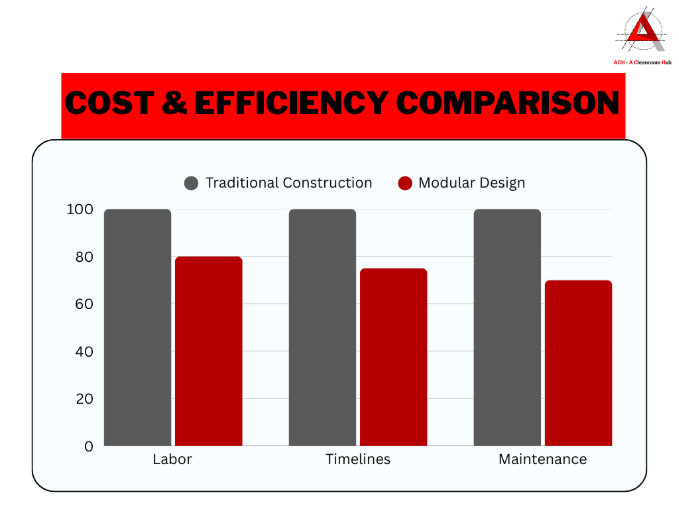
| Cost Factor | Traditional Construction | Modular Design |
| Labor | High on-site labor costs, subject to delays. | Labor costs were reduced by up to 20% due to faster assembly. |
| Timeline | Longer, leading to delayed revenue. | Shorter (20-30% faster), enabling faster ROI. |
| Downtime | Significant disruption to operations. | Minimal on-site disruption. |
| Adaptability | Low. Expansions are expensive and difficult. | High. Scalable and reconfigurable. |
| Maintenance | Higher cleaning and repair costs over time. | Lowered due to durable, engineered surfaces. |
| Energy | Potentially higher due to leaks. | Lower energy costs due to superior sealing. |
This holistic view shows that modular design is not just a construction method; it’s a long-term financial strategy. It reduces costs associated with labor, project duration, energy consumption, and future modifications.
Frequently Asked Questions (FAQ)
Is modular cleanroom construction faster than traditional methods?
Yes, significantly. Modular construction utilizes “parallel processing,” meaning the cleanroom components are manufactured off-site while your facility is simultaneously being prepared. This overlapping schedule can reduce project timelines by 20-30% compared to traditional construction.
Can I expand my modular cleanroom later without shutting down my facility?
One of the primary benefits of modular design is minimal disruption. Because the system utilizes pre-engineered panels that can be unlatched and reconfigured, expansions create far less dust and noise than demolishing drywall.
How difficult is it to repair a damaged wall in a modular cleanroom?
Repairs are straightforward and cost-effective. Unlike traditional walls that require patching, sanding, and repainting—processes that release particulates and require downtime—a damaged modular panel can simply be swapped out for a new one. This maintains the integrity of the cleanroom envelope with minimal effort.
Can a modular cleanroom be moved to a new building?
Yes. Unlike traditional construction, which is a sunk cost if you move, modular cleanrooms are considered capital equipment. They can be disassembled, transported, and reassembled at a new location, preserving a significant portion of your initial investment.
Conclusion: A Smarter Investment for Your Facility
Choosing the right construction method for your cleanroom has implications that extend far beyond the initial build. Modular cleanroom design ensures cost savings and operational efficiency for your facility through a forward-thinking solution that prioritizes long-term value.
Through intelligent engineering, this approach delivers:
- Rapid Deployment: Precision-engineered components allow for significantly faster installation compared to traditional methods.
- Unparalleled Scalability: The “Lego-like” nature of the panels means your facility can grow or be reconfigured as your production needs to evolve.
- Reduced Maintenance: High-quality, non-porous surfaces are designed for easy cleaning and durability, lowering long-term upkeep costs.
By reducing project timelines, minimizing operational disruptions, and providing the flexibility to adapt to future demands, a modular approach ensures your facility is both cost-effective and future-proof. It represents a strategic investment in efficiency and quality that pays dividends for years to come.
To learn more about how our custom-engineered solutions can benefit your next project, contact ACH Engineering.
GET IN TOUCH
Complete the form below to get in touch with our team.