
Cleanroom Structural Integrity: The Ultimate 2026 Guide
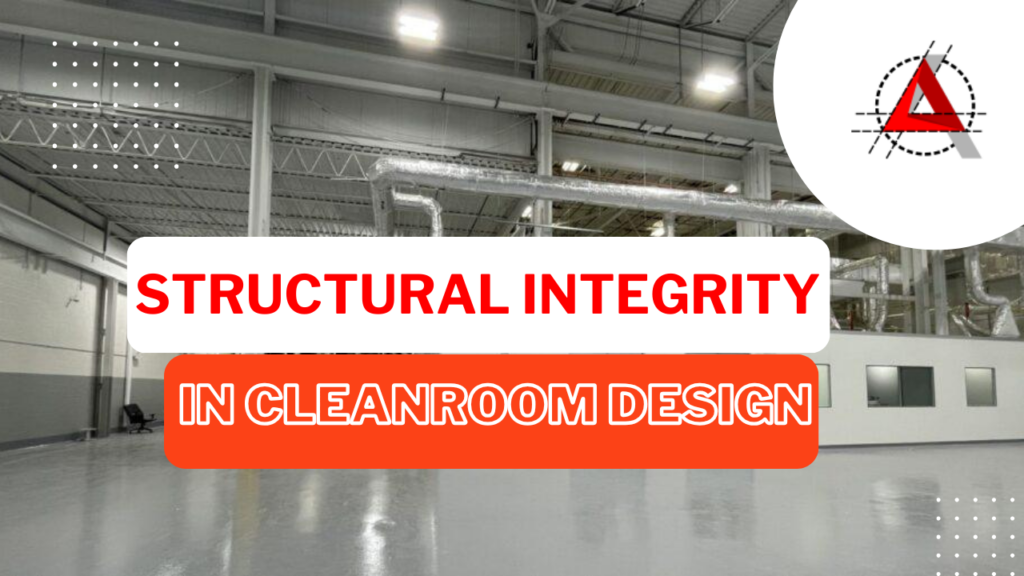
Cleanroom Structural Integrity plays a critical role in maintaining ISO compliance and contamination control. Building a cleanroom isn’t just about walls or HEPA filters; the modular and structural framework itself dictates performance and compliance. It is an exercise in precision engineering where the very skeleton of the room dictates its success. Structural integrity is often the unsung hero of cleanroom performance. If the framework shifts, vibrates, or settles unevenly, even the most advanced HVAC system cannot maintain the required ISO classification.
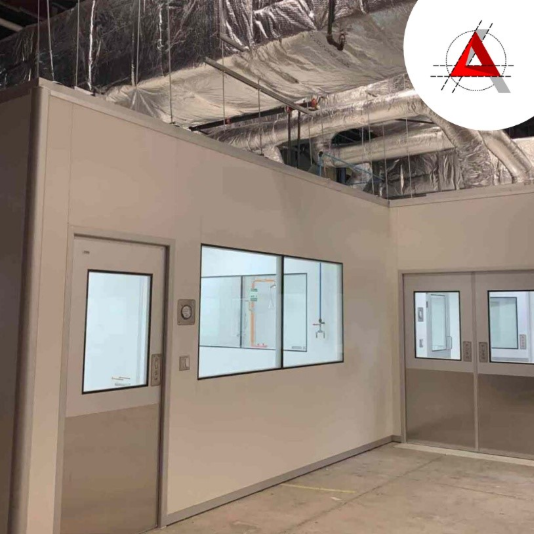
What is Cleanroom Structural Integrity?
Structural integrity in cleanroom engineering refers to the strength, rigidity, and stability of the physical framework that supports cleanroom walls, ceilings, and modular panels. It ensures that the controlled environment remains airtight, vibration-resistant, and capable of maintaining required ISO classifications over long operational periods.
In high-performance cleanrooms, structural integrity directly impacts contamination control, airflow balance, and pressure differentials. Even minor structural shifts or ceiling deflection can create microscopic gaps that allow particles to bypass HEPA filtration systems, resulting in compliance failures and costly downtime.
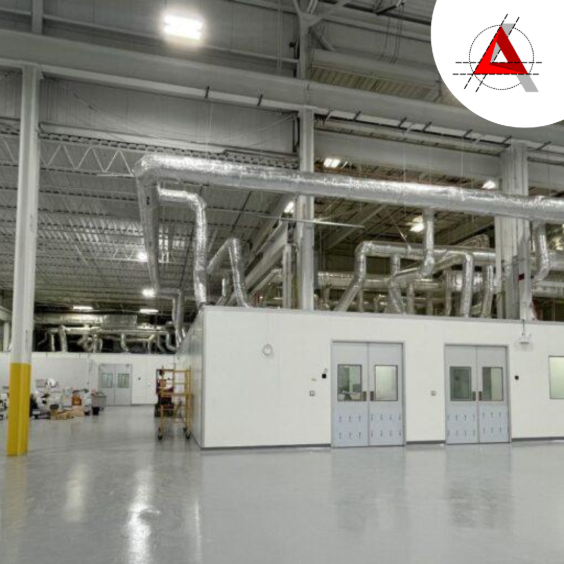
Modern cleanroom facilities achieve structural stability through load-bearing steel frameworks, reinforced modular panel systems, seismic bracing, and precise engineering calculations. These design elements work together to maintain envelope integrity, support heavy HVAC equipment, and ensure consistent laminar airflow across pharmaceutical, semiconductor, and medical manufacturing environments.
Key Factors for Cleanroom Structural Integrity
How Structural Design Supports Contamination Control and Airflow Integrity
When we talk about contamination control, we usually think of air changes per hour or filtration efficiency. However, the physical structure is what makes those systems work effectively. A rigid, well-engineered structure ensures that the cleanroom maintains its envelope integrity over time.
Engineering for Airtight Seals and Load Support
Preventing Micro-Cracks and Leaks
Cleanrooms operate under specific pressure differentials (positive or negative). If the structure is weak or flexible, minor movements can create gaps at joints or seams. These microscopic openings allow contaminants to bypass filters or disrupt pressure cascades. A robust structural design minimizes deflection, ensuring that seals remain airtight year after year.
Supporting Heavy HVAC Loads
Air handling units and Fan Filter Units (FFUs) are heavy. A ceiling grid that sags under the weight of these components can compromise the seal between the filter and the grid. This bypass leakage is a common cause of cleanroom failure. ACH Engineering prioritizes structural calculations to support these static and dynamic loads without compromising the ceiling plane’s flatness. structural calculations to support these static and dynamic loads without compromising the ceiling plane’s flatness.
Facilitating Laminar Airflow
Structural columns and beams must be placed strategically. Poorly placed supports can create “dead zones” or turbulence where air stagnates, allowing particles to settle. Structural engineering works together with airflow modelling to ensure obstructions are minimized, and air returns are positioned for optimal sweeping action.
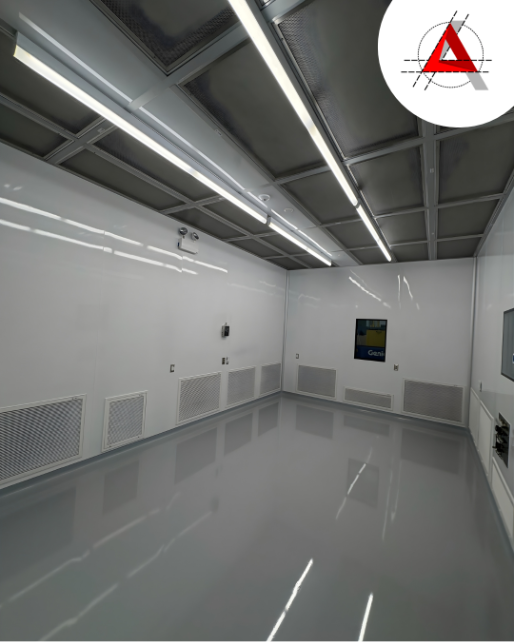
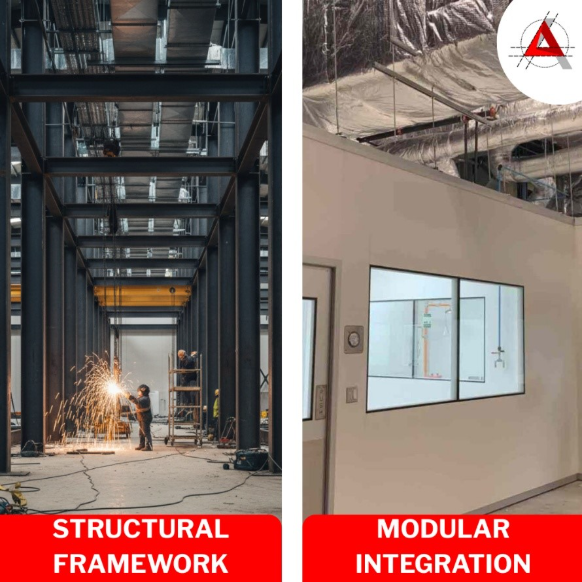
Load-Bearing Frameworks vs. Modular Panels: Benefits and Tradeoffs
Choosing the right structural system is one of the earliest and most impactful decisions in cleanroom design. The two primary approaches—load-bearing frameworks and modular panel systems—serve different needs.
Load-Bearing Capacity of Modular Panels
These systems typically use a steel skeleton to support the roof, ceiling grid, and mechanical equipment. Walls are infilled, designed to meet ISO cleanliness standards without carrying structural loads.
- Benefits: This approach offers immense flexibility for large open spans without internal columns. It is ideal for facilities that anticipate heavy ceiling loads or require extensive walkability above the ceiling for maintenance.
- Tradeoffs: Construction time is generally longer, and the initial cost can be higher due to the steel tonnage required.
Modular Panel Systems
In this design, the wall panels themselves are structural. They support the ceiling grid and lighter mechanical loads directly.
- Benefits: These are faster to install and often more cost-effective for smaller to medium-sized cleanrooms. They offer a flush, clean finish that is easy to sanitize, making them a favourite in pharmaceutical applications.
- Tradeoffs: There are limits to span widths and ceiling loads. If you need to hang heavy automated tracks or conveyors from the ceiling, a modular wall system might require additional structural reinforcement.
Understanding these tradeoffs is a core part of our expertise in Controlled Environments, helping clients match the build method to their operational goals.
Seismic, Load, and Vibration Considerations for Controlled Environments
Cleanrooms often house sensitive equipment, electron microscopes, lithography machines, or precision scales—that react poorly to movement. Structural engineering must account for more than just gravity; it must account for movement.
Vibration Isolation for Cleanroom Structural Integrity
Mechanical systems generate vibrations. If the cleanroom structure is not sufficiently isolated or stiff, these vibrations travel through the floor and walls. For nanotechnology or semiconductor facilities, even micro-vibrations can ruin product yield. To minimize vibration transmission and maintain envelope stability, ACH Engineers implement:
- Stiffer structural members to dampen mechanical forces.
- Isolated slab foundations for critical nanotechnology or semiconductor facilities.
- Modular wall panel systems specifically engineered for micro-vibration control.
Seismic Compliance for Industrial Facilities
In seismically active zones, cleanrooms have unique challenges. The suspended ceiling grid is particularly vulnerable during an earthquake. If it sways and hits the walls, it can collapse, destroying millions of dollars in equipment and products. Essential seismic structural requirements include:
- Extensive bracing systems to secure the suspended ceiling grid.
- Specialized sway wires to prevent independent movement during an earthquake.
- Single-unit movement design to preserve the cleanroom envelope’s integrity.
Dynamic Loading
Cleanrooms are not static. People walk, carts roll, and robotic arms move. The structure must withstand these dynamic loads without deflecting. A floor that bounces when a forklift drives by can disrupt sensitive calibration equipment nearby.
For more technical guidelines on cleanroom standards and structural safety, you can refer to the resources provided by IEST (Institute of Environmental Sciences and Technology), a leading authority in the field.
Implementation of Structural Reinforcements in Richmond Hill
In a recent cleanroom deployment, ACH Engineering delivered a turnkey ISO 7 cleanroom solution utilizing modular cleanroom panels for an electronic vaporizer and liquid device manufacturing facility in Richmond Hill, ON. The project included full engineering design, modular cleanroom structure manufacturing, construction, execution, and commissioning — all completed within an 18-month schedule and constructed to meet stringent GMP standards.
The facility spans approximately 5,000 sq ft and was engineered to support critical process workflows with features such as modular walls, walk-on ceilings, cleanroom doors, coving, and custom laboratory furniture, all components designed to meet ISO 7 classification and GMP compliance while maintaining structural integrity and airflow performance. All components were designed to meet ISO 7 classification and GMP compliance while maintaining structural integrity and airflow performance.
This real-world example illustrates how comprehensive cleanroom engineering — from URS development and permitting structural execution and commissioning — can help manufacturers maintain performance, quality, and operational resilience in controlled environments.
Conclusion
Structural integrity is the silent guardian of cleanroom compliance. Whether it is preventing microscopic leaks, supporting heavy filtration units, or dampening vibrations for sensitive equipment, the engineering behind the walls is just as important as the technology inside them. By carefully considering load-bearing options and seismic requirements during the design phase, you ensure your facility remains compliant and efficient for its entire lifecycle.
Need structurally certified cleanroom panels? Contact our engineering team today.
Cleanroom Structural Integrity FAQs
Under the 2026 Ontario Building Code (OBC), mandatory for all 2026 projects, cleanrooms are classified into Seismic Categories (SC1 to SC4) based on their Importance Category (e.g., “High” for pharmaceutical or medical manufacturing). Structural integrity must now meet updated seismic hazard values that account for lateral earthquake loads. This requires specific, engineered seismic restraints for suspended ceilings, heavy HVAC filtration units, and modular wall partitions to prevent collapse and ensure airtight seals remain intact during a seismic event.
For 2026 compliance, modular panels provide a superior structural advantage because they are pre-engineered to meet specific Seismic Category requirements. Unlike traditional “stick-built” drywall, which is prone to cracking and particulate shedding under seismic stress, modular systems use interlocking mechanisms and materials like aluminum honeycomb. These are engineered to maintain a monolithic, airtight environment that resists environmental loads and pressure differentials more effectively during building movement.
To maintain ISO certification and meet 2026 safety protocols, a semi-annual (every 6 months) inspection is recommended for ISO Class 1 to 5 environments, while an annual inspection is the standard for ISO Class 6 to 9. Maintenance must focus on the integrity of chemical cold welds and seismic joints. In 2026, digital documentation of these inspections is increasingly required to prove that air leakage hasn’t compromised pressure differentials or structural safety.
Yes. A key benefit of modular engineering in 2026 is extensibility. Because the systems are composed of independent, pre-certified panels, facility managers can relocate or add sections without compromising the existing airtight envelope. This “plug-and-play” capability allows for rapid expansion with minimal downtime, provided that the new configuration is re-validated to meet the 2024 OBC seismic bracing requirements for the expanded footprint
GET IN TOUCH
Complete the form below to get in touch with our team.