Key Takeaways
- Post-installation support turns installed equipment into compliant, production-ready systems
- Commissioning validates that systems meet ISO 14644 standards and regulatory requirements before go-live
- Use the first 30–90 days to catch performance gaps and lock in baseline metrics before full production begins
- Comprehensive training prevents operator errors that could compromise cleanroom classification
- The right support partner reduces risk and gets your lab operational faster
What Is Post-Installation Support for Clean Air Equipment
Post-installation support covers all services and activities that occur after equipment installation is physically complete but before your facility assumes full operational responsibility. Cleanroom validation services are a critical part of this handover process, confirming that the system meets ISO classification requirements before production begins. This transition period validates that your investment will deliver the performance, compliance, and reliability you require.
Commissioning and System Verification
Commissioning is the systematic process of verifying that all clean air system components function according to design specifications and meet regulatory requirements. Rigorous performance testing produces documented proof your system works as intended — not just during installation, but under your actual operating conditions.
Core commissioning tests include:
- Airflow verification at supply points and throughout the cleanroom confirms design air changes per hour (ACH)
- Pressure differential testing confirms pressure cascades between cleanroom zones meet minimum requirements (typically 10 Pascals between adjacent grades)
- HEPA/ULPA filter integrity testing uses aerosol photometry to detect leaks in filter media, frames, or seals before they cause contamination bypass
- Particle count verification measures airborne particles at 0.5 µm and 5 µm in both "at rest" and "in operation" states to confirm ISO classification
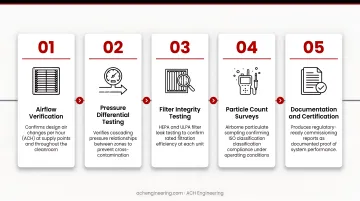
According to EU GMP Annex 1 (2022), these tests must be documented with specific acceptance criteria, and the results become part of your facility's permanent compliance records.
Training and Knowledge Transfer
Comprehensive training ensures your staff can monitor systems correctly, respond to alarms appropriately, and handle routine maintenance safely — regardless of how advanced the equipment is.
Operator training typically covers:
- System controls and monitoring dashboards
- Alarm interpretation and response protocols
- Basic troubleshooting procedures
- Proper gowning and cleanroom behavior (since human activity is the dominant contamination risk)
Maintenance staff training includes:
- Filter change procedures and safety protocols
- Routine inspection checklists
- Preventive maintenance schedules
- Equipment-specific service requirements
Training at least two to three staff members per shift prevents knowledge gaps from disrupting operations during absences or turnover.
Documentation and Handover
Your documentation package is the operational roadmap for your clean air systems — and the primary evidence auditors examine during regulatory inspections.
A complete documentation package includes:
- As-built drawings showing final system configuration
- Equipment specifications and performance data
- Test and balance reports with actual vs. design comparisons
- Calibration certificates for monitoring instruments
- Operation and maintenance (O&M) manuals
- Warranty documents and terms
- Recommended spare parts lists
- Emergency contact information
These records must be maintained throughout the facility lifecycle for compliance audits, troubleshooting, and future modifications.
Initial Monitoring Period
The first 30–90 days after installation are a critical validation window. Scheduled check-ins during this period catch issues that only surface under actual operating conditions — not during installation testing with an empty room.
Initial monitoring activities include:
- Scheduled site visits or remote monitoring check-ins
- Performance verification under actual loading conditions
- Optimization adjustments based on real-world usage patterns
- Establishment of baseline performance metrics for ongoing trending
- Documentation of any seasonal variations or operational anomalies
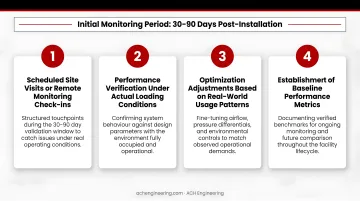
By the end of this window, your team should have baseline data, documented procedures, and confidence in day-to-day operations.
Why Post-Installation Support Matters for Lab Clean Air Systems
Comprehensive post-installation support directly shapes your facility's regulatory compliance, operational costs, and long-term system reliability. Skipping this phase creates risks that can take months or years to surface — and they rarely appear at a convenient time.
Ensures Compliance with Regulatory Standards
Clean air systems in pharmaceutical, biotech, and medical device facilities must meet strict regulatory requirements. EU GMP Annex 1 (2022) explicitly requires cleanrooms to be qualified according to established methodology, with clear differentiation between qualification testing and routine monitoring.
Proper commissioning documentation is required for regulatory audits and certifications — not optional. Without documented proof that your system meets ISO 14644 standards and industry-specific regulations, you cannot demonstrate compliance to auditors or certifying bodies.
Prevents Costly Downtime and Contamination Events
Undetected performance issues during commissioning can lead to contamination incidents that shut down production and require expensive investigations. Well-commissioned systems with optimized airflow can deliver 20-30% efficiency gains compared to poorly configured installations, reducing energy costs while maintaining superior contamination control. Early detection through proper commissioning prevents the far greater costs of contamination events, product recalls, or regulatory enforcement actions.
Maximizes Return on Investment
Your clean air equipment represents a significant capital investment. Studies show commissioning delivers measurable ROI across multiple cost categories:
- Extends equipment lifespan through correct operation and maintenance practices
- Reduces troubleshooting time with comprehensive documentation already in place
- Lowers energy consumption and lengthens intervals between major component replacements
Facilitates Smooth Operational Transition
Post-installation support reduces the learning curve for facility staff, minimizing disruption to laboratory operations during the transition to full production. Clear communication channels established during this period ensure your team knows exactly who to contact for different types of issues, preventing delays when problems arise.
Validates System Performance Under Real Conditions
Installation testing in an empty room differs dramatically from operational performance with equipment running, personnel present, and doors opening. Issues that only appear during actual use — such as pressure fluctuations when doors open, airflow disruption from equipment heat loads, or seasonal HVAC variations — are identified and resolved during the initial monitoring period before they impact production or compliance.
Key Components of Post-Installation Support
Post-installation support isn't a single handoff — it's a structured set of activities that keep your clean air systems performing reliably and in compliance with regulatory requirements long after the installation crew leaves.
System Commissioning and Performance Verification
Commissioning verifies that every system component performs to its design specification — not as a checkbox exercise, but as documented performance testing against defined acceptance criteria.
Critical commissioning tests include:
HEPA/ULPA filter integrity (DOP testing) — Aerosol photometry detects leaks in filter media, frames, and seals. Retesting is required every 6 months for ISO Class 5 areas, annually for lower classifications. IEST-RP-CC034 provides the standardized methodology.
Airflow velocity and uniformity — Multi-point velocity measurements confirm design air changes per hour. Smoke studies visualize air patterns and expose dead zones or turbulent flow areas.
Pressure cascade verification — Differential pressure between adjacent zones must meet minimum thresholds (typically 10 Pa). Continuous monitoring systems are calibrated during this phase and alarm setpoints are configured.
Particle counts (at rest and in operation) — "At rest" testing runs with no personnel present; "in operation" testing runs at maximum occupancy with equipment active. Both states must meet the specified ISO classification.
Each test produces documented results measured against acceptance criteria, creating a permanent compliance record for audits and regulatory submissions.
Operator and Maintenance Training
Training must be competency-based, not just attendance-based. Human behavior is the dominant contamination risk in cleanroom environments — a well-commissioned system can still fail if operators don't know how to use it correctly.
Operator training covers:
- System monitoring dashboards and control interfaces
- Normal operating parameters and acceptable ranges
- Alarm interpretation and appropriate response protocols
- Basic troubleshooting procedures before escalating to maintenance
- Proper cleanroom behavior, gowning, and material transfer
Maintenance training includes:
- Filter change procedures with proper containment protocols
- Routine inspection checklists and documentation requirements
- Preventive maintenance schedules and service intervals
- Safety protocols for working with HEPA systems and cleanroom equipment
- When to contact the installation partner versus handling issues in-house
Training multiple staff members ensures coverage during absences and shift changes, preventing knowledge gaps that could compromise system performance.
Documentation Package and Record Keeping
Incomplete or unclear documentation leads directly to operator errors, missed maintenance, and audit findings. A complete documentation package is both your operational roadmap and your compliance evidence.
Essential documentation includes:
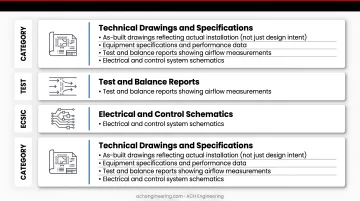
Technical drawings and specifications:
- As-built drawings reflecting actual installation (not just design intent)
- Equipment specifications and performance data
- Test and balance reports showing airflow measurements
- Electrical and control system schematics
The technical package should be supplemented by performance records that support ongoing compliance verification:
- Commissioning test results with acceptance criteria
- Calibration certificates for monitoring instruments
- Filter integrity test reports and particle count data with ISO classification confirmation
Finally, operational guidance keeps day-to-day management consistent:
- Operation and maintenance (O&M) manuals
- Preventive maintenance schedules with specific service intervals
- Recommended spare parts lists with part numbers
- Emergency contacts, escalation procedures, warranty documents, and regulatory compliance certificates
Keep these records organized and accessible throughout the facility's operational life — disorganized documentation is one of the most common reasons facilities fail regulatory audits.
Initial Monitoring and Optimization Period
Commissioning with an empty room tells you the system works. The 30-90 day monitoring period tells you it works under real conditions — with personnel, equipment, and process variability in play.
Monitoring activities include:
- Scheduled site visits to observe system performance during normal operations
- Remote monitoring of key parameters (if applicable) with trend analysis
- Performance optimization adjustments based on actual usage patterns
- Resolution of minor issues before they become major problems
- Documentation of baseline metrics for ongoing monitoring
This period establishes normal operating ranges for temperature, humidity, pressure differentials, and particle counts — reference points that make future troubleshooting faster and more accurate.
Warranty Support and Issue Resolution
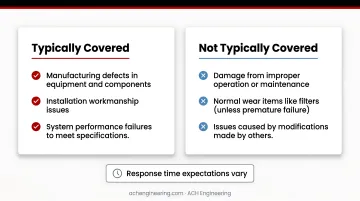
Knowing what your warranty covers — and what it doesn't — before an issue occurs prevents delays when a response is urgent.
Warranty typically covers:
- Manufacturing defects in equipment and components
- Installation workmanship issues
- System performance failures to meet specifications
Not typically covered:
- Damage from improper operation or maintenance
- Normal wear items like filters (unless premature failure)
- Issues caused by modifications made by others
Response time expectations vary by severity:
- Critical failures affecting cleanroom classification: immediate response
- System alarms or performance degradation: same or next business day
- Routine questions or minor issues: 2-3 business days
Clear escalation procedures ensure critical issues receive appropriate urgency.
Integration with Facility Management Systems
Modern clean air equipment can integrate with building management systems (BMS) for centralized monitoring and control.
Integration capabilities include:
- Real-time monitoring of pressure differentials, airflow, and filter status
- Alarm notifications sent to facility management platforms
- Data logging for trend analysis and predictive maintenance
- Remote monitoring capabilities for off-site oversight
When a pressure differential trends downward over two weeks rather than dropping suddenly overnight, BMS integration catches it — giving your team time to investigate and correct before a cleanroom classification event occurs.
Common Issues Identified During Post-Installation Period
The post-installation monitoring period serves as an early warning system, catching issues before they compromise cleanroom classification or compliance. Most problems detected during this phase are correctable through commissioning adjustments.
Airflow and Pressure Differential Issues
Common airflow problems and their causes:
- Pressure differentials below 10 Pa between zones — typically traced to incorrect damper settings, door seal gaps, or return air imbalances; corrected by adjusting supply/return airflow or sealing penetrations
- Supply velocity outside specification — results from incorrect fan speeds, duct restrictions, or filter loading; resolved through system rebalancing
- Uneven air distribution — dead zones or turbulent areas create contamination risks; addressed by adjusting diffusers or adding supplemental air devices
- Ductwork configuration errors — often the root cause of multiple airflow issues and correctable before the facility goes live
Most airflow problems originate from damper settings or initial filter loading—straightforward fixes during commissioning.
Filtration System Performance Gaps
Filtration issues caught during commissioning fall into three main categories:
- Filter media or seal leaks — detected during integrity testing; allows contamination bypass and must be resolved through filter replacement or seal repair before certification
- Improper installation or inadequate gasket compression — identified through visual inspection; corrected by reinstallation with proper sealing techniques
- Excessive pressure drop — may signal a manufacturing defect or installation error; reduces airflow below design specifications and requires investigation before sign-off
Catching these during commissioning is critical. A filter leak that makes it past certification becomes a contamination event—not a commissioning note.
Control System and Monitoring Challenges
Control system problems are often subtle but carry real compliance risk:
- Sensor calibration drift — pressure, temperature, or humidity sensors reading incorrectly lead to false alarms or missed excursions; resolved through recalibration or replacement
- Alarm setpoints misconfigured — set too tight, they generate nuisance alarms; set too loose, they miss real problems; final setpoints should reflect actual operating conditions and regulatory requirements
- BAS integration failures — communication gaps between clean air equipment and building automation systems can block monitoring or data logging entirely, requiring protocol configuration or interface troubleshooting
Documentation and Training Gaps
Documentation and training gaps are among the most preventable post-installation issues:
- Incomplete operating procedures — unclear instructions drive operator errors and inconsistent practices, increasing contamination risk; addressed by revising SOPs and delivering targeted training
- Missing or vague maintenance schedules — undefined service intervals lead to deferred maintenance and early equipment failure; corrected by building a comprehensive preventive maintenance calendar before handover
- Insufficient troubleshooting training — staff who can't resolve common issues generate avoidable service calls, adding downtime and cost; resolved through hands-on sessions and quick-reference guides
These gaps are fully preventable with structured handover protocols built into the project close-out process.
Working with Your Installation Partner for Ongoing Success
The quality of your post-installation support depends heavily on choosing a partner committed to long-term success. ACH Engineering provides comprehensive post-installation support as part of their turnkey cleanroom solutions, serving clients across Canada — from Ontario to Alberta — and throughout the broader North American market.
Establishing Clear Communication Channels
Start by identifying specific individuals on both sides — yours and your partner's — for routine questions versus emergency escalations. Make sure backup contacts exist for coverage during absences.
From there, align on response time expectations:
- Clarify availability windows (business hours versus extended support)
- Define response times by issue severity — a filter alarm versus a full system failure warrant different urgency levels
- Understand the escalation path for critical failures before one occurs
For communication methods, use phone for urgent issues, email for routine requests and documentation, and online portals (where available) for service tracking. Getting these protocols in writing before handoff prevents confusion when it matters most.
Transitioning from Installation Support to Ongoing Maintenance
Post-installation support generally runs 30–90 days, depending on system complexity. The goal is stable, verified operation before your team takes the lead on routine maintenance. Transition happens once baseline performance is confirmed and staff training is complete.
Once that handoff occurs:
- Facility staff own day-to-day maintenance and monitoring
- Your installation partner stays available for complex troubleshooting and periodic service visits
- Completed documentation and training records give your team a foundation to operate independently
One decision worth making before the transition: a preventive maintenance agreement. Scheduled service visits reduce the risk of gradual performance degradation, extend equipment lifespan, and keep specialized support accessible when you need it — rather than scrambling to find it after something goes wrong.
Conclusion
Post-installation support determines whether your clean air equipment delivers on its promise. Commissioning confirms systems meet design specifications and regulatory requirements. Training gives your staff the skills to operate and maintain equipment correctly. Documentation keeps that knowledge accessible for every maintenance cycle ahead.
The partner you choose for installation shapes all three. ACH Engineering's turnkey approach covers design through commissioning across North America, ensuring a smooth handover to full operational capability and years of reliable, compliant cleanroom performance.
Frequently Asked Questions
What are the ISO guidelines for clean rooms?
ISO 14644 series standards define cleanroom classifications based on airborne particle counts at specific sizes (0.5 µm and 5 µm). Post-installation verification testing confirms your facility meets the specified ISO class through particle counting in both "at rest" and "in operation" states, with documented results required for compliance.
What is an important step in the routine maintenance of laboratory instruments?
Regular calibration and performance verification are critical for maintaining instrument accuracy and reliability. Post-installation support establishes baseline performance metrics and maintenance schedules that guide ongoing care — giving your team a clear framework for all routine upkeep.
How long does post-installation support typically last?
Post-installation support typically lasts 30-90 days depending on system complexity and facility requirements. The goal is to ensure stable operation and establish baseline performance before transitioning to routine maintenance.
What is included in system commissioning for clean air equipment?
Commissioning covers airflow velocity and volume, pressure differential verification, HEPA/ULPA filter integrity testing, and particle count verification. All results are documented against acceptance criteria confirming the system meets design specifications and regulatory requirements.
Who is responsible for maintenance after the post-installation period ends?
Responsibility typically transfers to facility staff for routine maintenance tasks like filter changes and inspections. However, the installation partner can provide ongoing support through service agreements for complex issues, periodic recertification, or specialized troubleshooting beyond in-house capabilities.
When should I call my installation partner versus handling an issue in-house?
Contact your installation partner for system performance issues affecting cleanroom classification, alarm conditions that persist after basic troubleshooting, or anything impacting regulatory compliance. Handle routine maintenance, filter changes, and minor adjustments in-house following established procedures and training.