Introduction
A single cleanroom door with inadequate sealing can compromise an entire facility's classification — and industry data shows over 30% of contamination incidents trace back to door seal failures or improper operation. Cleanroom door specifications aren't peripheral construction details; they're compliance-defining requirements that directly affect regulatory approval and operational safety.
Understanding ISO standards, material requirements, sealing parameters, and performance thresholds is essential for proper door selection and maintaining cleanroom classification integrity.
The numbers make the stakes clear: a door with just a 0.5 mm continuous gap can leak up to 0.3 m³/h of air at a 15 Pa pressure differential. That's enough to disrupt localized airflow patterns, destabilize pressure cascades, and trigger classification failure during certification testing.
This guide breaks down must-know specification categories, regulatory frameworks, and validation methods that ensure your cleanroom doors function as effective contamination barriers while meeting stringent regulatory requirements from ISO, FDA, and EU GMP standards.
Key Takeaways
- Door specs are governed by ISO 14644-1, ISO 14644-7, FDA, and EU GMP standards
- Key parameters: material (stainless steel 304/316L, FRP), air leakage rates (≤0.1–0.5 m³/h), and sealing mechanisms
- ISO 5 requires ≤0.1 m³/h leakage; ISO 7–8 allow ≤0.3–0.5 m³/h
- Non-compliance risks classification failure, regulatory violations, and $100,000+ in contamination losses per incident
What Cleanroom Door Specifications Represent in Controlled Environments
Cleanroom door specifications are measurable performance criteria and design parameters that ensure doors function as effective contamination barriers. Unlike standard commercial doors, cleanroom doors must simultaneously maintain pressure differentials, prevent particle ingress, support cleanroom classification, and ensure regulatory compliance—all while accommodating frequent human and material traffic.
Door specifications serve several critical functions. They act as the movable interface of the pressure boundary, control airflow between zones of different cleanliness levels, and prevent cross-contamination during opening cycles. They also generate the documented compliance evidence inspectors look for during regulatory audits—making specification decisions far more consequential than a typical door purchase.
Specifications are both design constraints (what must be built into the door during manufacturing) and operational parameters (how the door must perform throughout its service life). This dual nature means that procurement decisions must consider not just initial compliance, but long-term performance under repeated cleaning cycles, pressure fluctuations, and operational stresses.
Specifications as Multi-Layered Requirements
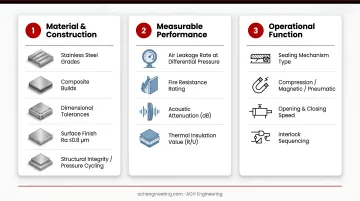
Cleanroom door specifications address three distinct layers:
- Material and construction: Stainless steel grades, composite builds, dimensional tolerances, surface finish (Ra ≤0.8 μm), and structural integrity under pressure cycling
- Measurable performance: Air leakage rates at specified differentials, fire resistance ratings, acoustic attenuation, and thermal insulation values
- Operational function: Sealing mechanism type (compression, magnetic, pneumatic), opening/closing speed, interlock sequencing, and emergency egress compliance
- Cleanability and maintenance: Hardware mounting flush to the frame, elimination of horizontal ledges, and surface materials compatible with scheduled chemical disinfection
Door leakage has a direct, quantifiable impact on operating costs. Cleanroom HVAC systems already consume 50–75% of facility electricity; every cubic metre per hour of air leakage forces the system to compensate with additional makeup air, driving up energy costs and accelerating filter replacement cycles. Tight door specifications reduce that compensation load—so specification quality shows up in utility bills, not just compliance records.
That performance-cost link also explains why regulatory standards are written the way they are. Specifications translate ISO 14644 series requirements, Health Canada GMP guidelines, and EU GMP Annex 1 expectations into actionable design and procurement criteria. For example, Annex 1's requirement that "doors should be designed to avoid recesses that cannot be cleaned" maps directly to flush-mounted hardware, seamless window integration, and the elimination of horizontal surfaces where particles settle between cleaning cycles.
Critical Specification Parameters for Cleanroom Doors
Material Composition and Surface Properties
Acceptable cleanroom door materials are limited to those that are non-porous, non-shedding, and compatible with aggressive cleaning agents:
- Stainless steel: Grades 304 and 316L are industry standards, with 316L preferred for pharmaceutical applications due to its lower carbon content that resists "rouging" and corrosion from chlorinated disinfectants
- Molded fiberglass composite (FRP): Produced as single, solid, homogeneous pieces that are void-free and non-porous, offering high chemical resistance including compatibility with vaporized hydrogen peroxide (VHP)
- Powder-coated steel: Used in lower-classification cleanrooms (ISO 7-8) where cost is the primary driver over stainless steel performance
- Aluminum: Acceptable for specific applications but requires proper anodizing or coating to prevent oxidation
Surface finish requirements are critical for both cleanability and particle control. For stainless steel surfaces, a roughness average (Ra) of ≤0.8 μm is the standard requirement, with electropolished surfaces achieving Ra ≤0.38 μm for the most critical applications. Smoother surfaces reduce microbial retention and facilitate effective cleaning.
Wood and certain plastics are explicitly prohibited under GMP and pharmaceutical standards due to porosity, particle shedding, and incompatibility with sterilization protocols. EU GMP Annex 1 requires surfaces to be "smooth, impervious and unbroken" to minimize particle shedding and permit repeated application of cleaning agents.
Air Leakage and Pressure Integrity
Maximum allowable air leakage rates vary by cleanroom classification and are typically measured at 50 Pa test pressure:
| Cleanroom Class | Max Leakage Rate (@ 50 Pa) | Typical Application |
|---|---|---|
| ISO 5 (Grade A) | ≤0.1 m³/h | Sterile filling, isolators |
| ISO 6-7 (Grade B/C) | ≤0.3 m³/h | Pharmaceutical intermediates, biotech |
| ISO 8 (Grade D) | ≤0.5 m³/h | General clean zones, packaging |
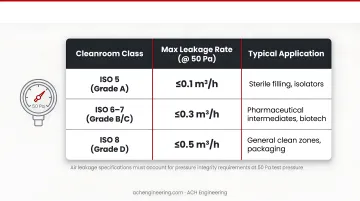
Air leakage specifications must account for the pressure differential requirements between adjacent cleanroom zones. FDA guidance recommends a minimum positive pressure differential of 10-15 Pa between adjacent rooms of differing classification, while EU GMP Annex 1 specifies a minimum of 10 Pa. USP <797> requires at least 0.02 inch water column (approximately 5 Pa) between each ISO-classified area.
Three primary methods verify air leakage performance:
- Pressure decay testing — measures the rate of pressure loss in a sealed chamber over time
- Smoke visualization — reveals airflow patterns and bypass paths during door operation
- ISO 14644-7 Annex E — outlines standardized pressure change methods for formal leak rate measurement
Sealing Systems and Gasket Specifications
Gasket materials and compression seal designs are critical for achieving airtight performance:
- Silicone: Platinum-cured silicone is tasteless, odorless, and toxicologically inert, with certification to USP Class VI and European Pharmacopoeia standards
- EPDM: Compliant with FDA 21 CFR 177.2600, offering resistance to water, steam, and mild chemicals
- Neoprene: Used in less critical applications where cost is the deciding factor
Double-gasket systems are specified for critical applications, providing redundant sealing and enhanced pressure maintenance. These systems typically feature one gasket on the door leaf and another on the frame, creating two independent seal lines.
Gasket durability requirements cover three key performance areas:
- Chemical resistance — compatibility with chlorinated disinfectants and VHP is mandatory for pharmaceutical environments
- Compression set — high-quality gaskets maintain ≥80% compression recovery; materials that drop below this threshold risk seal failure over time
- Service life — expect 3-5 years under normal operating conditions, with inspection intervals defined in the facility's maintenance schedule
Dimensional Tolerances and Frame Requirements
Standard dimension ranges for cleanroom doors vary by manufacturer:
- Single doors: 800-1,200 mm width
- Double doors: 1,300-2,400 mm width
- Maximum height: Typically 2,700 mm
- Door leaf thickness: 44-60 mm (nominal)
Frame flush-mounting requirements ensure seamless integration with cleanroom walls, eliminating ledges and crevices. Wall integration specifications typically require frames to be installed flush with the interior wall surface, with all gaps sealed with non-shedding caulk compatible with cleanroom cleaning agents.
Threshold details are critical—raised thresholds can create trip hazards and complicate material transport, while flush thresholds require more sophisticated sealing mechanisms to prevent air leakage at the bottom of the door. Custom sizing is available from specialized manufacturers, though custom dimensions typically add 2-4 weeks to lead times and 15-30% to costs.
Fire rating and dimensional compliance are closely linked in practice — the door's construction method directly affects whether it can meet both requirements simultaneously.
Fire Rating and Safety Compliance
Fire rating requirements (Class A, Class B, UL ratings) are determined by facility fire safety codes and must be balanced with cleanroom performance requirements. Doors are tested to UL 10C (Positive Pressure Fire Tests) in North America and EN 1634-1 in Europe, with typical ratings of 30-60 minutes.
Emergency egress requirements include panic hardware, breakaway features, and exit signage integration. However, these requirements must be balanced with contamination control — airlocks leading to critical areas typically feature interlocked doors that cannot be opened simultaneously, requiring override mechanisms for emergency situations.
The challenge with fire-rated cleanroom doors is that traditional fire door construction (with exposed hardware, recessed latches, and vision panel frames) conflicts with cleanroom requirements for smooth, crevice-free surfaces. Specialized manufacturers use insulated double stainless steel walls or composite cores to achieve fire ratings while maintaining hygienic flush surfaces.
ISO Standards Framework for Cleanroom Door Specifications
ISO 14644-1: Cleanroom Classification and Door Implications
ISO 14644-1:2015 establishes cleanroom classes (ISO 3-9) based on maximum allowable concentrations of airborne particles. The standard defines specific particle concentration limits at various particle sizes:
| ISO Class | ≥0.5 μm | ≥1.0 μm | ≥5.0 μm |
|---|---|---|---|
| ISO 5 | 3,520 | 832 | Not specified |
| ISO 6 | 35,200 | 8,320 | 293 |
| ISO 7 | 352,000 | 83,200 | 2,930 |
| ISO 8 | 3,520,000 | 832,000 | 29,300 |
Door specifications must support the cleanroom's target classification. ISO 5 environments require near-zero leakage doors (≤0.1 m³/h at 50 Pa) with double-gasket systems and hermetic sealing mechanisms. ISO 7-8 cleanrooms allow slightly higher leakage tolerances (≤0.3-0.5 m³/h) and may use single-gasket compression seals.
The relationship between door leakage and particle count is direct: a door leaking 0.3 m³/h introduces unfiltered air that bypasses the HVAC system's HEPA filtration. In an ISO 5 cleanroom where the maximum allowable particle concentration at ≥0.5 μm is just 3,520 particles/m³, even small amounts of unfiltered air can cause classification failure.
Selecting door specifications that align with particle count limits requires understanding the cleanroom's air change rate and total air volume. Higher air change rates — 60-90 per hour in ISO 5 cleanrooms — provide more dilution capacity. Lower air change rates leave less margin for error, demanding tighter door specifications to compensate.
ISO 14644-7: Separative Devices and Door-Specific Requirements
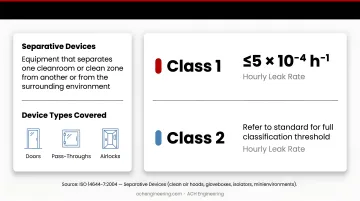
ISO 14644-7:2004 specifically addresses separative devices — including doors, pass-throughs, and airlocks — as critical contamination control points. The standard defines these devices as equipment that "separates one cleanroom or clean zone from another or from the surrounding environment."
ISO 14644-7 establishes leakage classifications for separative devices based on hourly leak rate:
- Class 1: Hourly leak rate ≤5 × 10⁻⁴ h⁻¹
- Class 2: Hourly leak rate <2.5 × 10⁻³ h⁻¹
- Class 3: Hourly leak rate <10⁻² h⁻¹
- Class 4: Hourly leak rate <10⁻¹ h⁻¹
The standard mandates specific testing protocols — differential pressure testing in both "at-rest" and "operational" states, plus leak testing where appropriate. Door installation must be verified through commissioning tests that confirm pressure compliance and sealing performance.
Ongoing qualification requires regular door integrity checks. Annual verification covers most applications; critical ISO 5-6 environments call for quarterly re-testing. These intervals feed directly into the broader requalification schedules that GMP and FDA regulations formalize.
GMP and FDA Alignment
EU GMP Annex 1 (2022) and FDA guidance reinforce ISO standards with additional requirements specific to pharmaceutical manufacturing:
EU GMP Annex 1 requirements:
- Non-wood construction for all cleanroom surfaces
- Doors designed to avoid recesses that cannot be cleaned
- Interlocked airlocks for Grade A/B areas where both doors cannot open simultaneously
- Pressure differentials of minimum 10 Pa between adjacent grades
- Periodic requalification every 6 months for Grade A/B, annually for Grade C/D
FDA expectations:
- Material documentation and certificates of compliance
- Validation protocols demonstrating door performance under operational conditions
- Change control procedures for any door modifications or repairs
- Maintenance records documenting gasket replacement and seal integrity verification
- Continuous monitoring of pressure differentials throughout each shift
Industry-specific standards add further requirements. USP <797> for compounding pharmacies specifies minimum pressure differentials of 0.02 inch water column between ISO-classified areas and requires anteroom/buffer room separation through fixed walls and doors. EU GMP Annex 1 for sterile manufacturing adds requirements for surface finish documentation and compatibility with sterilization methods.
How Cleanroom Door Specifications Are Validated and Documented
Specification Documentation in Design and Procurement
Each specification sheet should include:
- Material certifications: Mill test reports for stainless steel (confirming grade 304/316L), certificates of compliance for composite materials, documentation of surface finish (Ra values)
- Performance test data: Air leakage test results at multiple pressure differentials, fire rating certificates, acoustic test reports if applicable
- Dimensional drawings: Detailed CAD drawings showing frame dimensions, leaf thickness, hardware locations, and integration details
- Compliance statements: Written confirmation of ISO 14644-7 compliance, GMP suitability, FDA material compliance (21 CFR citations)
Always request third-party testing documentation. A manufacturer may claim "cleanroom suitability," but without independent leakage test results, ISO 14644-7 compliance records, and material certifications from accredited bodies, that claim carries no verifiable weight.
Installation Verification and Commissioning Tests
Commissioning tests required to verify installed door performance include:
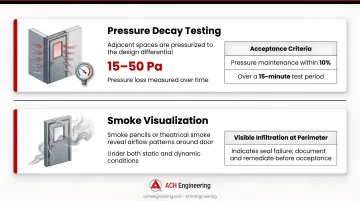
Pressure decay testing: Adjacent spaces are pressurized to the design differential (typically 15–50 Pa) and pressure loss is measured over time. Acceptance criteria generally require pressure maintenance within 10% over a 15-minute test period.
Smoke visualization: Smoke pencils or theatrical smoke reveal airflow patterns around door perimeters under both static and dynamic conditions. Visible infiltration at the perimeter indicates a seal failure or insufficient pressure differential.
Particle count monitoring: Counters positioned near the door track particle concentrations through operation cycles. For ISO 7 cleanrooms, counts must return to baseline within 30–60 seconds — tighter classifications require faster recovery.
Documentation requirements for cleanroom qualification follow the IQ/OQ/PQ protocol:
- Installation Qualification (IQ): Confirms the door is installed per design specifications — dimensions, surface finish, and material documentation all checked against approved drawings
- Operational Qualification (OQ): Tests functional performance: interlock sequencing, opening/closing speeds, seal compression, and pressure differential maintenance under operating conditions
- Performance Qualification (PQ): Validates containment under real process conditions, with particle count studies and continuous pressure monitoring confirming performance against spec
Implications of Operating with Non-Compliant Door Specifications
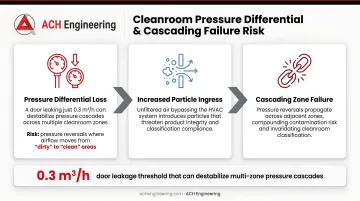
Operating with doors that fail to meet specifications creates a chain of measurable problems. Inadequate air sealing leads to pressure differential loss—the most immediate and measurable impact. A door leaking just 0.3 m³/h can destabilize pressure cascades across multiple cleanroom zones, potentially causing pressure reversals where airflow moves from "dirty" to "clean" areas.
Increased particle ingress follows pressure loss. Unfiltered air bypassing the HVAC system introduces particles that can exceed ISO classification limits. During certification testing, even brief exceedances during door operation cycles can result in classification failure, requiring extensive remediation before retesting.
Regulatory consequences are severe and well-documented. A 2025 FDA warning letter cited a manufacturer for "large, partially dirty gaps between wall panels and the floor" that caused "insufficient separation" and pressure differential failures.
A 2016 MHRA inspection similarly found that "the door seal on the coating machine was not intact and had sections missing." Both cases resulted in regulatory citations and mandatory corrective actions.
The financial impact extends beyond immediate remediation costs. One documented case study revealed that a failed door seal led to over $100,000 in losses due to batch contamination, product disposal, investigation costs, and associated energy waste from compensating HVAC loads. Production holds during remediation compound these losses through lost manufacturing time and delayed product deliveries.
Ongoing operational impacts add up quickly:
- Higher HVAC costs as systems cycle more frequently to maintain pressure setpoints
- More frequent filter changes as makeup air volume increases to compensate for leakage
- Intensified environmental monitoring to manage elevated contamination risk
- Undetected product quality issues that surface only at final testing or customer complaints
Common Misinterpretations of Cleanroom Door Specifications
Five specification errors account for the majority of cleanroom door compliance failures. Each one is avoidable—but only if you know what to look for before purchasing.
Marketing claims don't equal ISO compliance. Descriptions like "cleanroom suitable" or "designed for controlled environments" carry no regulatory weight. Without documented leakage test results, ISO 14644-7 compliance statements, and material certifications, a door is unverified—regardless of what the brochure says. Always request specific performance data matched to your required cleanroom class.
Low upfront cost often means high total cost. A door priced 30% below alternatives may have sealing systems that leak 0.5 m³/h compared to 0.1 m³/h for a better-specified unit. Over a 10-year service life, that gap compounds: energy losses, more frequent gasket replacements, contamination risk, and earlier door replacement can easily exceed ten times the original cost savings.
Nominal specs are not guaranteed minimums. A listing of "0.3 m³/h leakage" may reflect average performance under ideal lab conditions—not worst-case field scenarios. Proper specifications define tolerance ranges (for example, "0.3 m³/h maximum, 0.1 m³/h typical") and state the exact test conditions—pressure differential, temperature, gasket condition—under which performance is guaranteed.
Fire ratings and cleanroom ratings measure completely different things. Fire ratings address structural integrity and flame spread; they say nothing about air leakage or surface cleanability. A door with a 60-minute fire rating can still have exposed hardware, recessed latches, and leakage exceeding 2 m³/h—making it wholly unsuitable for cleanroom use despite passing fire code.
EU GMP Annex 1 doesn't prohibit sliding doors. The clause stating sliding doors "may be undesirable" due to recesses is frequently misread as a blanket ban. Sliding doors are permitted when designed without uncleanable recesses. Hermetic sliding doors with flush-mounted tracks and sealed mechanisms can fully satisfy GMP requirements while offering real space-saving advantages.
Conclusion
Cleanroom door specifications determine whether a door can maintain controlled environment integrity and meet regulatory compliance. These specifications must align with the cleanroom's ISO classification across several dimensions:
- Material composition and non-shedding surface performance
- Air leakage rates and sealing mechanisms
- Dimensional tolerances for flush installation
- Fire safety and emergency egress requirements
Getting this right requires balancing ISO 14644-1 classification limits against real-world sealing performance, material cleanability, and operational demands. The stakes are significant — inadequate specifications lead to energy waste, increased maintenance burden, regulatory violations, and contamination events that can exceed $100,000 per incident. Partnering with cleanroom engineering services specialists ensures specification decisions are grounded in your ISO classification and operational requirements.
Working with a specialized cleanroom solutions provider helps ensure specifications match both the technical requirements and the regulatory environment. ACH Engineering designs and supplies flush cleanroom doors built for GMP-compliant environments — designed to hold pressure differentials, support contamination control, and facilitate smooth personnel and material flow across pharmaceutical, biotech, and other regulated facilities throughout North America.
Frequently Asked Questions
What is ISO 14644-1 and how are cleanrooms classified (for example, ISO 7)?
ISO 14644-1:2015 classifies cleanrooms by airborne particle concentration limits. ISO 7 allows a maximum of 352,000 particles (≥0.5 μm), 83,200 particles (≥1.0 μm), and 2,930 particles (≥5.0 μm) per cubic meter. This class is standard in pharmaceutical manufacturing, medical device assembly, and electronics production.
What does ISO 14644-7 say about separative devices like cleanroom doors?
ISO 14644-7:2004 designates cleanroom doors as critical control points requiring documented leakage classifications (Classes 1–4 by hourly leak rate) and regular integrity testing via pressure decay and leak tests. Documentation must confirm that doors maintain pressure differentials in both at-rest and operational states.
What are the most important specifications to verify when procuring cleanroom doors?
Key specifications to verify before procurement:
- Air leakage rates at rated pressure differentials (≤0.1 m³/h for ISO 5; ≤0.3 m³/h for ISO 6–7)
- Material certifications confirming non-shedding, GMP-compliant construction
- Fire ratings where required by facility or building codes
- Third-party test documentation from accredited labs confirming ISO 14644-7 compliance
- Mill test reports for stainless steel and surface finish records (Ra ≤0.8 μm)
How do door specifications differ between ISO 7 and ISO 8 cleanrooms?
ISO 7 cleanrooms require tighter air leakage specifications (typically ≤0.3 m³/h at 50 Pa) with double-gasket or hermetic sealing systems, surface finish requirements of Ra ≤0.8 μm, and more frequent requalification (annually). ISO 8 cleanrooms allow slightly higher leakage tolerance (≤0.5 m³/h), may use single-gasket compression seals, and can accommodate less stringent surface finishes. Pressure differential requirements are similar (10-15 Pa), but ISO 7 demands more rigorous validation.
Can standard commercial doors be used in cleanrooms with proper sealing upgrades?
No, standard commercial doors cannot meet cleanroom specifications even with gasket additions. Commercial doors typically have wood-based cores (prohibited under GMP), porous surface materials that shed particles, exposed hardware with crevices that harbor contaminants, and lack validated air leakage performance. Cleanroom doors require purpose-built construction with stainless steel or FRP materials, flush-mounted hardware, seamless surfaces, and documented leakage test results from accredited laboratories.
How often should cleanroom door specifications be re-verified after installation?
Annual pressure decay testing is recommended for ISO 7–8 environments; ISO 5–6 environments require quarterly checks per EU GMP Annex 1. Re-verification is mandatory after any maintenance, gasket replacement, or repair that could affect sealing. Continuous pressure differential monitoring helps detect seal degradation between scheduled tests.