Introduction
A single contamination event in a cleanroom can cost manufacturers anywhere from $1 million to $550 million — and most incidents trace back to gaps in routine maintenance, not equipment failure. For pharmaceutical, semiconductor, biotech, and medical device facilities, a controlled environment is only as reliable as the program keeping it that way.
Neglecting cleanroom maintenance introduces compounding risks:
- Contamination events that trigger product recalls or batch failures
- Failed regulatory audits leading to production shutdowns
- Unplanned downtime that disrupts delivery schedules
- Shortened facility and equipment lifespan
- Compromised product quality with downstream safety implications
This guide covers what facility managers and operations teams need to build a maintenance program that holds up under audits and daily pressure:
- The four maintenance types and when each applies
- Warning signs that need immediate attention
- Scheduling guidelines by ISO classification and usage intensity
- Best practices for sustained compliance
- Common mistakes that compromise cleanroom integrity
- Cost considerations that frame maintenance as an investment, not an overhead
Key Takeaways
- Documented maintenance programs are required by FDA, EMA, and ISO 14644 — and directly prevent contamination events
- Four maintenance strategies—preventive, corrective, predictive, and major overhaul—work together to minimize failures and optimize costs
- Early warning signs include particle count trends, pressure differential changes, equipment behavior shifts, and energy consumption increases
- Maintenance frequency scales with ISO class: ISO 5 requires daily interventions while ISO 8 needs weekly attention
- Avoid improper cleaning agents, inadequate training, and deferred preventive work — emergency repairs cost 5–7x more than scheduled maintenance
Why Cleanroom Maintenance Is Critical
Cleanrooms represent significant capital investments requiring proactive care to protect their value and functionality. The financial and regulatory stakes make maintenance a necessity — not a line item to defer.
A single contamination event at TSMC resulted in a $550 million loss due to scrapped wafers and delayed shipments. In biopharmaceutical manufacturing, contaminated batches cost $1–2 million per incident in lost materials alone — before factoring in downtime, regulatory investigations, or reputational damage.
Preventive maintenance directly reduces these risks. Industry data shows that well-executed preventive programs prevent 70–80% of equipment failures that would otherwise lead to contamination events or production disruptions. Partnering with a cleanroom services provider that offers ongoing maintenance support helps facilities stay ahead of these risks.
Regulatory frameworks require documented maintenance programs, not just good practice. The FDA's 21 CFR Part 211.67(b) mandates written procedures for equipment cleaning and maintenance, while 21 CFR 211.42(c)(10)(vi) requires systems for maintaining aseptic conditions. The revised EMA Annex 1 (2022) goes further — explicitly requiring "planned maintenance" for all equipment and documented assessment of unplanned maintenance impact on sterility.
The enforcement data reinforces why this matters: in 2025, quality system issues — often tied to inadequate maintenance — accounted for over 30% of all FDA warning letter citations.
The financial case for prevention is equally clear. Emergency repairs cost 5–7 times more than scheduled maintenance, driven by overtime labor, expedited parts, and unplanned downtime. Beyond cost savings, consistent maintenance extends cleanroom lifespan, preserves ISO classification compliance, and prevents the audit failures that trigger production shutdowns. In one documented case, mold contamination in HEPA filters led to $18.2 million in combined criminal and civil penalties.
Types of Cleanroom Maintenance
Effective cleanroom maintenance requires a multi-layered approach combining different strategies based on equipment criticality, failure patterns, and operational requirements.
Routine/Preventive Maintenance
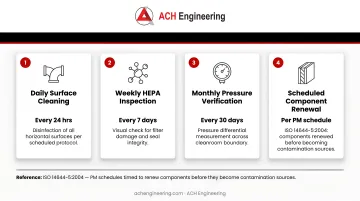
Preventive maintenance consists of scheduled, proactive tasks performed at regular intervals regardless of equipment condition. ISO 14644-5:2004 states that PM schedules must be "timed to renew and replace components before the components become contamination sources."
Typical preventive tasks include:
- Daily surface cleaning and disinfection of all horizontal surfaces
- Weekly HEPA filter visual inspection for damage or seal integrity
- Monthly pressure differential verification across cleanroom zones
- Quarterly deep cleaning of walls, ceilings, and hard-to-reach areas
- Gowning room protocol verification and consumable replacement
- Regular calibration of environmental monitoring equipment
Preventive maintenance is most effective for maintaining baseline cleanliness standards, catching gradual degradation before it escalates, meeting regulatory documentation requirements, and building consistent operational baselines for trend analysis.
Preventive maintenance typically represents 15-25% of annual operating budget but prevents 70-80% of potential failures. That ratio makes it the most cost-effective strategy — avoiding contamination events and emergency repairs far outweighs the scheduled investment.
Corrective/Reactive Maintenance
Corrective maintenance is unplanned work performed in response to equipment failure or contamination events. While unavoidable for unexpected failures, over-reliance on reactive maintenance indicates inadequate preventive programs.
Risks of reactive maintenance:
- Unplanned downtime disrupting production schedules
- Rush repair costs with premium pricing for emergency service
- Potential product loss if contamination occurs during failure
- Cascade failures where one system failure stresses related equipment
Emergency repairs carry a premium of 5-7 times the cost of scheduled maintenance, plus additional costs from production loss, expedited shipping, overtime labor, and potential product disposal. Repeated failures also create regulatory risk, signaling to auditors that the facility lacks adequate environmental control.
Predictive/Condition-Based Maintenance
Predictive maintenance uses real-time monitoring to anticipate when equipment will need servicing based on actual condition rather than fixed time-based schedules — intervening only when the data says it's necessary.
Monitoring approaches include:
- Continuous particle counters tracking contamination trends
- Differential pressure sensors detecting filter loading
- Filter loading indicators measuring pressure drop increases
- Environmental monitoring systems tracking temperature and humidity
- Vibration analysis identifying mechanical wear in air handlers
Key advantages over time-based schedules:
- Reduces unnecessary maintenance on equipment still performing well
- Detects problems early, before failures occur
- Optimizes technician scheduling around actual equipment condition
- Builds a historical dataset for identifying recurring failure patterns
The upfront investment in sensors and monitoring infrastructure is higher than preventive programs, but most facilities see a 25-30% reduction in overall maintenance costs over the long term through fewer emergency repairs and better-timed interventions.
Major Overhaul/Deep Maintenance
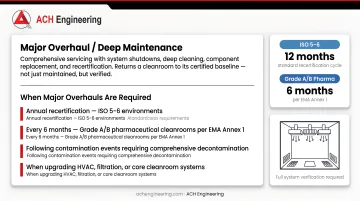
Major overhaul maintenance involves comprehensive servicing with system shutdowns, deep cleaning, component replacement, and recertification. It's the mechanism that brings a cleanroom back to its certified baseline — not just maintained, but verified.
When major overhauls are required:
- Annual recertification for ISO 5-6 environments (every 6 months for Grade A/B pharmaceutical cleanrooms per EMA Annex 1)
- Following contamination events requiring comprehensive decontamination
- When upgrading cleanroom classification to meet new requirements
- After 5-7 years of operation to refresh aging components
Scope of major overhauls:
- Complete surface decontamination using validated sporicidal agents
- HVAC system deep servicing including coil cleaning and motor inspection
- Filter bank replacement and integrity testing
- Seal integrity testing at all penetrations and joints
- ISO classification testing to verify continued compliance
Major overhauls typically run 1-3% of original construction cost annually, with comprehensive recertification every 12-24 months depending on ISO class. For a facility with $500,000 in original cleanroom construction costs, expect $5,000-15,000 annually for major maintenance activities.
Signs Your Cleanroom Needs Maintenance
Early detection of maintenance needs prevents contamination events and maintains compliance. Monitoring these warning signs enables proactive intervention before minor issues become major failures.
Performance or Output Changes
Subtle performance shifts often signal developing problems before they trigger alarms or failures.
Key indicators to monitor:
- Gradual upward particle count trends (even within limits) suggest filter loading, seal deterioration, or gaps in cleaning protocol
- Slower recovery to target cleanliness after disturbances — such as material transfers or personnel movement — points to reduced system capacity
- Inconsistent readings across different zones indicate airflow imbalances or localized contamination sources
Temperature should remain within ±2°F (±1°C) of setpoint, while humidity should stay within ±5% of target. Deviations outside these ranges indicate HVAC system issues requiring maintenance attention.
Unusual Equipment Behavior
Catching mechanical problems early means the difference between a scheduled repair and an unplanned shutdown.
Warning signs requiring immediate investigation:
- Abnormal noise from HVAC systems (grinding, squealing, or rattling)
- Vibration in air handlers indicating bearing wear or fan imbalance
- Pressure differential fluctuations suggesting filter loading or seal leaks
- Unexpected fan speed variations or inability to maintain setpoints
These symptoms often indicate filter loading, seal deterioration, or mechanical wear. HEPA filter pressure drop typically ranges from 0.5-1.5 inches w.g. initially, with replacement needed when pressure reaches 2.0-3.0 inches w.g.
Visible Wear, Damage, or Contamination
Visual inspections reveal problems that monitoring systems may miss.
What to look for during inspections:
- Surface discoloration indicating chemical exposure or microbial growth
- Seal gaps at wall-ceiling junctions or around penetrations
- Ceiling tile sagging suggesting structural stress or moisture accumulation
- Wall panel damage from impact or material handling
- Floor coating wear exposing substrate materials
- Residue buildup on surfaces despite regular cleaning
A stained ceiling tile, for example, can signal HEPA filter leakage or condensation — issues that require immediate investigation to prevent contamination events.
Increased Resource Consumption
Shifts in resource usage are often the first measurable sign of system degradation.
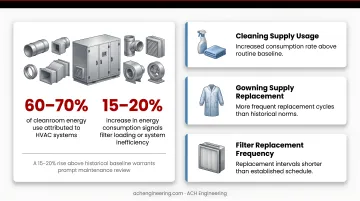
HVAC systems account for 60-70% of cleanroom energy use. A 15-20% increase in energy consumption often signals filter loading or system inefficiency requiring maintenance. Other consumption indicators include increased cleaning supply usage, more frequent gowning supply replacement, and higher filter replacement frequency than historical baselines.
Recurring Issues or Failed Tests
When the same problem keeps reappearing, it's not bad luck — it's a systemic gap.
Red flags requiring root cause investigation:
- Repeated particle count excursions in the same location
- Failed pressure differential tests despite corrective actions
- Contamination events occurring in the same area
- Increasing non-conformances during production operations
These patterns signal maintenance deficiencies that need a thorough root cause review — not repeated band-aid corrections. Resolving the underlying issue protects both compliance standing and production continuity.
Cleanroom Maintenance Schedule and Best Practices
Maintenance frequency depends on cleanroom class (ISO 5 requires more frequent maintenance than ISO 8), usage intensity (24/7 operation versus intermittent use), and process type (sterile pharmaceutical versus electronics assembly). The table below provides baseline frequencies that should be adjusted based on specific operational conditions.
Maintenance Frequency Guidelines
| Task Category | Daily/Per-Use | Weekly/Monthly | Quarterly/Annual |
|---|---|---|---|
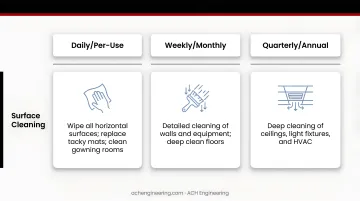
| Surface Cleaning | Wipe all horizontal surfaces; replace tacky mats; clean gowning rooms | Detailed cleaning of walls and equipment; deep clean floors | Deep cleaning of ceilings, light fixtures, and HVAC grilles |
| Inspections | Visual inspection for damage or contamination; waste removal | Filter visual inspection; seal integrity checks; lighting verification | Comprehensive facility audit; structural integrity assessment |
| Testing & Monitoring | Review environmental monitoring data; verify pressure differentials | Particle count verification; pressure differential documentation | HEPA filter integrity testing; ISO recertification; airflow visualization |
| Equipment Maintenance | Empty waste containers; restock consumables | Clean air handlers; inspect motors and fans | Major equipment servicing; calibration of monitoring systems |
Usage scenario adjustments: High-usage environments operating 24/7 (pharmaceutical manufacturing, semiconductor fabrication) require 30-50% more frequent maintenance than low-usage facilities (R&D labs with intermittent operation). Continuous operation increases bioburden, particulate loading, and equipment wear.
Best Practices for Effective Maintenance
Knowing how often to maintain a cleanroom is only half the equation — how you perform that maintenance determines whether your facility stays in compliance. These practices apply across ISO classifications and industry types.
Clean from ceiling to floor, cleanest area to dirtiest. Particles dislodged from upper surfaces settle onto floors where they can be removed, rather than recontaminating already-cleaned surfaces. Reversing this sequence is one of the most common — and costly — mistakes in cleanroom upkeep.
Use only approved cleaning agents. Sterile 70% isopropyl alcohol, pharmaceutical-grade cleaners, and non-residue-forming detergents are appropriate. Avoid ammonia-based products, household cleaners, and anything that leaves residue or generates particles. EMA Annex 1 (2022) requires periodic use of sporicidal agents and rotation of disinfectants to prevent microbial resistance.
Procedural discipline matters just as much as product selection. Three non-negotiable habits keep compliance on track:
- Maintain a detailed maintenance log — record dates, personnel, procedures, results, and deviations. This paper trail satisfies regulatory auditors and surfaces contamination trends early.
- Train personnel before entry — staff must understand contamination control principles, proper gowning, approved techniques, and documentation requirements. General janitorial training is not sufficient.
- Control the environment during maintenance — work during non-production hours when possible, maintain positive pressure and HEPA filtration throughout, and run 20-30 air changes after work concludes before resuming production.
Facility design also affects how efficiently maintenance gets done. ACH Engineering's modular cleanroom systems include removable panels, accessible filter housings, and walkable ceiling structures — features that cut maintenance time and allow component replacement without reconstruction of the surrounding environment.
Common Cleanroom Maintenance Mistakes to Avoid
Even well-intentioned maintenance can compromise cleanroom integrity if not performed correctly. Avoiding these critical mistakes protects your investment and maintains compliance.
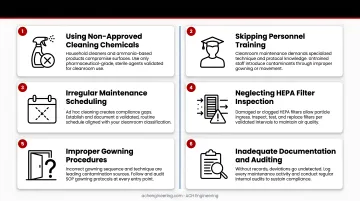
Using non-approved cleaning chemicals: Household cleaners, ammonia-based products, and solutions that leave residue compromise cleanroom surfaces and introduce contaminants. Only use pharmaceutical-grade, sterile cleaning agents validated for cleanroom use.
Skipping personnel training: Cleanroom maintenance requires specialized knowledge that exceeds general janitorial training. Personnel must understand invisible contamination, proper gowning sequences, behavioral protocols (slow movements, minimizing talking), and documentation requirements. Industry data consistently links a significant share of contamination events directly to improper maintenance procedures.
Inconsistent documentation: Failing to document maintenance activities creates direct regulatory risk. FDA 21 CFR 211.182 requires retention of all maintenance records — and incomplete records fail audits regardless of actual maintenance quality.
Delaying preventive maintenance to "save costs": Deferred maintenance typically results in 5–7x higher emergency repair costs, plus contamination events costing millions in remediation and lost production. Preventive maintenance is cost avoidance, not cost generation.
Errors in maintenance sequencing: Sequence errors are among the most common — and preventable — causes of contamination. Watch for these specific missteps:
- Cleaning floors before ceilings, which recontaminates already-cleaned surfaces
- Introducing non-cleanroom equipment without prior decontamination
- Blocking HEPA airflow during maintenance, compromising environmental control
- Resuming production before adequate air changes complete after maintenance
Frequently Asked Questions
How often should HEPA filters be replaced in a cleanroom?
HEPA filters in well-designed systems with effective pre-filtration typically last 3-5 years, but schedules should follow annual testing rather than fixed timelines. Replace filters when efficiency drops below 99.97%, pressure drop exceeds manufacturer specifications (typically 2.0–3.0 inches w.g.), or integrity testing reveals leaks above 0.01% of upstream concentration.
What are the most common cleanroom maintenance mistakes?
The top mistakes include using improper cleaning agents (household cleaners instead of pharmaceutical-grade products), inadequate personnel training in contamination control principles, poor documentation that fails regulatory requirements, and delaying preventive maintenance in favor of reactive repairs that cost 5-7x more when equipment fails.
Can regular janitorial staff perform cleanroom maintenance?
No, cleanroom maintenance requires specialized training that exceeds general janitorial competencies. Personnel must complete comprehensive training in contamination control principles, proper gowning procedures, approved cleaning techniques, behavioral protocols, and documentation requirements before accessing cleanrooms. FDA 21 CFR 211.25 explicitly requires training specific to assigned functions.
How much does cleanroom maintenance typically cost?
Annual preventive maintenance typically runs 15–25% of the operating budget, with major recertification adding 1–3% of original construction cost. For a CAD $500,000 build, that translates to roughly $5,600–$15,000 annually for routine upkeep, plus periodic recertification.
What cleaning agents are safe to use in cleanrooms?
Use sterile 70% isopropyl alcohol, pharmaceutical-grade cleaners validated for cleanroom use, and non-residue forming detergents. EMA Annex 1 requires periodic use of sporicidal agents and rotation of disinfectants. Avoid ammonia-based products, household cleaners, and anything that leaves residue or generates particles. All disinfectants used in Grade A/B areas must be sterile.
How do you maintain cleanroom classification during maintenance activities?
Keep HEPA filtration and positive pressure running throughout all maintenance work, and schedule activities during non-production hours whenever possible. After work is complete, allow 20–30 air changes before running particle count testing to confirm classification. Any shutdown requiring full system downtime must follow documented decontamination and recertification procedures before the room returns to use.