
Introduction
Cleanroom environments demand both rigorous contamination control and worker safety, yet many facilities overlook ergonomic access in equipment design until operational problems emerge. While cleanrooms prioritize particle counts and airflow, the daily reality of staff reaching, bending, and accessing equipment determines both productivity and compliance sustainability.
Poor equipment placement forces operators into awkward postures that generate particles, increase injury risk, and slow task completion—undermining the very contamination control strategies cleanrooms exist to maintain.
This article explains why ergonomic access matters through measurable outcomes: reduced injury rates, maintained cleanroom classification, and improved equipment uptime. These aren't theoretical benefits—they're quantifiable impacts on worker safety, product quality, and your bottom line.
Key Takeaways
- Reduces operator fatigue and repetitive strain injuries by 40-60% while preventing workers' compensation claims
- Proper equipment placement minimizes particle-generating movements, maintaining cleanroom classification and reducing contamination excursions
- Well-designed access improves task efficiency by 10-27%, shortening cycle times and increasing throughput
- Design-phase ergonomic integration prevents costly retrofits and ensures regulatory compliance
What Is Ergonomic Access in Cleanroom Equipment Design
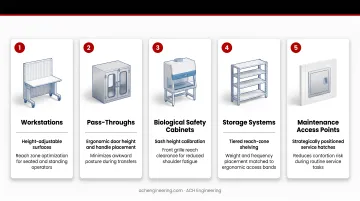
Ergonomic access refers to the strategic placement, height, reach zones, and accessibility features of cleanroom equipment that minimize physical strain while maintaining contamination control. Properly designed cleanroom engineering services incorporate these ergonomic principles from the earliest planning stages. This applies to workstations, pass-throughs, biological safety cabinets, storage systems, and maintenance access points.
These design considerations apply across multiple touchpoints:
- Equipment layout planning and spatial arrangement
- Workstation height specifications (typically 28-45 inches for standing work)
- Reach distances for controls, materials, and samples
- Maintenance access points for service and cleaning
- Integration with gowning and de-gowning protocols
Ergonomic access achieves two outcomes: protecting workers while protecting product quality and cleanroom integrity.
When equipment sits within optimal reach zones—primary zone at 0-16 inches, secondary zone at 16-24 inches—operators complete tasks with minimal body movement. This reduces both physical strain and particle generation from gown friction and air turbulence.
Gowning Constraints Change the Equation
Standard ergonomic models don't account for cleanroom realities. Protective gowning changes how workers interact with equipment:
- Reduces effective reach by 2-4 inches compared to street clothes
- Decreases tactile sensitivity and dexterity through double-donning gloves
- Increases task time due to reduced mobility
- Generates 2.0-3.5 times higher particle counts with split-type garments versus integrated coveralls during movement
These constraints make strategic equipment placement critical for both worker comfort and contamination control.
Key Advantages of Ergonomic Access in Cleanroom Equipment Design
The advantages below focus on measurable impacts across three domains: worker health and safety, contamination control, and operational performance. Each advantage connects to metrics that cleanroom managers and quality teams actively track—injury rates, particle counts, cycle times, and maintenance costs.
Reduced Operator Fatigue and Injury Risk
Ergonomic access design minimizes awkward postures, repetitive reaching, and forceful exertions during routine cleanroom tasks like material transfer, equipment operation, and sample handling.
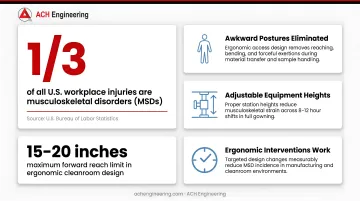
Proper equipment height, forward reach limits of 15-20 inches, and adjustable features reduce musculoskeletal strain over 8-12 hour shifts in full gowning.
Impact on worker health:
Musculoskeletal disorders (MSDs) account for one-third of workplace injuries in the U.S. Ergonomic interventions in manufacturing reduce MSDs by 40-60%, with cleanrooms showing similar or better results when gowning constraints are addressed.
In medical device assembly—a precision task comparable to cleanroom work—ergonomic workstation redesigns reduced MSDs by 80% and lost workdays by 99% over one year.
Financial impact:
According to OSHA's Safety Pays data, a single carpal tunnel injury costs an average of $64,953 USD when direct and indirect costs are combined. A strain injury averages $67,248 USD.
Preventing one serious injury can save $30,000-$50,000 in direct costs plus productivity loss from replacement staff training and workflow disruption.
KPIs impacted:
- Worker injury rates and days away from work
- Workers' compensation costs and insurance premiums
- Employee turnover and training costs for replacement staff
- Absenteeism and productivity loss
When this advantage matters most:
- High-volume operations with repetitive tasks
- Facilities with aging workforce demographics
- Operations requiring extended gowning periods (4+ hours)
- Processes involving heavy material handling or precision assembly
Improved Contamination Control and Cleanroom Classification Maintenance
Ergonomic access design reduces unnecessary operator movements, reaching, and compensatory motions that generate particles through gown contact, air turbulence, and material disturbance. Equipment positioned within optimal reach zones allows workers to complete tasks with minimal body movement.
Contamination data:
Human activity accounts for approximately 80% of all contamination in biological cleanrooms. Particle emission rates fluctuate dramatically based on movement intensity—from 50,000 particles/person/minute when sedentary to 180,000 particles/person/minute during active movement.
Rapid arm motions or deep knee bends in split-type garments can spike emission rates to 654,603 particles/minute for 0.5 μm particles.
Research validates that ergonomic furniture maintains cleanroom classification. A study in ISO Class 6 and Class 8 facilities confirmed that height-adjustable worktables (70-110 cm) did not compromise cleanroom classification.
Maximum observed particle concentration during table adjustment was only 0.007% of the classification limit in ISO Class 8 environments—demonstrating a robust safety margin.
By constraining operator movement to primary reach zones, ergonomic design maintains consistent particle counts, prevents classification excursions, reduces product rejection rates, and supports continuous compliance with ISO 14644 or GMP requirements.

KPIs impacted:
- Particle count trends and monitoring data
- Cleanroom classification excursions and recovery time
- Environmental monitoring failures
- Product batch rejection rates and sterility assurance levels
- Regulatory inspection findings
When this advantage matters most:
- ISO Class 5-7 cleanrooms where particle budgets are tight
- Aseptic processing areas and sterile manufacturing
- Pharmaceutical manufacturing under GMP guidelines
- Operations with frequent regulatory inspections
- Facilities approaching classification limits
Enhanced Operational Efficiency and Equipment Uptime
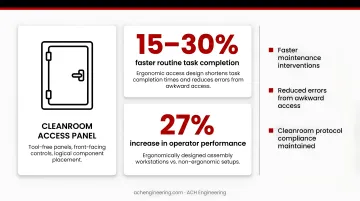
Ergonomic access design shortens task completion times, reduces errors from awkward access, and enables faster maintenance interventions without compromising cleanroom protocols. Well-designed access features—tool-free panels, front-facing controls, logical component placement—allow operators to complete routine tasks 15-30% faster.
Performance improvements:
Ergonomically designed assembly workstations demonstrate a 27% increase in operator performance compared to non-ergonomic setups. In precision manufacturing settings, ergonomic interventions resulted in 36% labour savings. These gains compound significantly—reducing average task time by 2-3 minutes per cycle translates to substantial throughput gains over thousands of annual cycles.
Maintenance access matters equally. Equipment designed with maintenance personnel in mind enables faster diagnostics. Poor access to critical components leads to inadequate maintenance, which is a primary cause of sterility assurance failure and unplanned downtime.
KPIs impacted:
- Cycle time per operation and throughput rates
- Equipment utilization rates and overall equipment effectiveness (OEE)
- Mean time to repair (MTTR) and planned vs. unplanned downtime
- Labour cost per unit produced
- Maintenance efficiency and service intervals
When this advantage matters most:
- High-throughput production environments
- Facilities operating near capacity constraints
- Operations with tight production schedules and delivery commitments
- Cleanrooms with frequent equipment maintenance requirements
- Environments where downtime costs exceed $1,000/hour
What Happens When Ergonomic Access Is Missing or Ignored
Poor ergonomic design creates cascading operational problems that impact safety, productivity, and costs:
Increased musculoskeletal disorders drive up workers' compensation claims, raising insurance premiums by 10-20% and creating staffing gaps. Hospital housekeepers performing physically demanding tasks show injury rates of 35.9 per 100 FTE, compared to 13.64 for other employees.
This demonstrates how physical strain translates directly to injury frequency.
Higher particle generation from awkward movements leads to more frequent contamination events and potential batch losses. Every 6 inches of vertical reach beyond the neutral zone adds approximately 0.2 seconds of wasted time per motion—accumulating into significant lost capacity in high-repetition environments.
Extended task completion times and operator errors result from awkward access angles, poor visibility, or excessive reach distances. Fatigue from poor posture causes technique drift and operational errors, particularly in biosafety cabinets where precision matters.
Delayed maintenance work occurs when technicians cannot safely or efficiently access equipment components. Equipment that should take 30 minutes to service requires 2 hours when access is poor, leading to unplanned downtime.
Difficulty recruiting and retaining skilled cleanroom staff increases when working conditions create physical discomfort or injury risk. Manufacturing facilities have reported 100% turnover every 3 weeks in extreme cases—effectively mitigated to near-zero through ergonomic engineering controls.
How to Get the Most Value from Ergonomic Access Design
Start with early planning. Integrate ergonomic access considerations during the cleanroom design phase rather than retrofitting after construction. Working with experienced cleanroom designers like ACH Engineering ensures both contamination control and human factors requirements are addressed from the start, delivering optimal functionality and reducing costly modifications later.
Design for gowned operators using anthropometric data and reach zone standards. ANSI/HFES 100 and ISO 14738 guidelines provide the foundation, but account for the 2-4 inch reach reduction caused by cleanroom garments.
Structure your workspace around these zones:
- Primary reach (0-16 inches): Frequently used tools and critical process steps
- Secondary reach (16-24 inches): Occasional access items that don't require bending forward
Assess high-frequency tasks before finalizing equipment placement. Tools like REBA (Rapid Entire Body Assessment) or strain index calculations identify problem areas early.
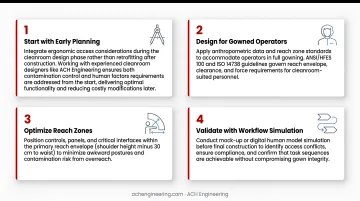
A "taped-footprint dry run" before equipment installation validates reach, posture, and sightlines. This simple step catches configuration issues while they're still easy to fix.
Monitor and adjust as processes evolve. Operator feedback and injury data reveal problem areas before they escalate into serious incidents. Near-miss reports and minor discomfort complaints are early warning signs worth tracking.
Where appropriate, adjustable features provide flexibility without compromising cleanliness. Research confirms that height-adjustable worktables (700-1100 mm) maintain ISO Class 6-8 cleanroom classifications, addressing common concerns about airflow disruption.
Conclusion
Ergonomic access in cleanroom equipment design delivers measurable value across worker safety, contamination control, and operational efficiency. Facilities that integrate ergonomic principles from initial design through ongoing operations see compounding advantages across reduced injury rates, sustained cleanroom performance, and lower operational costs.
The data supports a compelling business case:
- Ergonomic interventions reduce MSDs by 40-60%
- Proper access design maintains cleanroom classification by minimizing particle-generating movements
- Task efficiency improves by 10-27% with optimized equipment access
- Single injury costs exceed $60,000
- Downtime costs reach $1,000+ per hour
Ergonomic access should be integrated into facility planning, equipment specification, and continuous improvement programs from the start—not retrofitted as an afterthought. Regulatory bodies including EU GMP Annex 1 now explicitly mandate minimizing direct operator intervention through facility and equipment design, making ergonomic access both a compliance requirement and a competitive advantage. Companies like ACH Engineering build ergonomic access principles into their cleanroom design process, ensuring facilities meet both regulatory requirements and operational efficiency goals from day one.
Frequently Asked Questions
What are the ergonomics for a clean room?
Cleanroom ergonomics involves designing equipment placement, workstation heights, reach distances, and access points to minimize operator strain while maintaining contamination control. Gowned conditions reduce effective reach by 2-4 inches compared to standard workstations, requiring adapted equipment positioning.
Why is it important to use ergonomic equipment in cleanrooms?
Ergonomic equipment reduces worker injuries by 40-60%, minimizes particle-generating movements that compromise classification, and improves task efficiency by 10-27%. Preventing a single serious injury saves $30,000-$50,000 in direct costs while making regulatory compliance easier to maintain.
What are optimal reach zones for cleanroom workstations?
The primary reach zone (0-16 inches) should contain frequently accessed items and critical process steps, while the secondary zone (16-24 inches) accommodates occasional access. Gowned operators lose 2-4 inches of effective reach, requiring closer equipment placement than conventional workstations.
How does ergonomic design reduce contamination in cleanrooms?
Proper ergonomic access reduces unnecessary operator movements, minimizing particle generation from gown friction and air turbulence. Optimal equipment positioning reduces particle emission rates from 180,000 particles/minute (active movement) to 50,000 particles/minute (sedentary work).
What standards apply to ergonomic design in cleanrooms?
Key standards include ANSI/HFES 100 for ergonomic guidelines, ISO 14738 for anthropometric requirements, and OSHA's General Duty Clause for MSD prevention. EU GMP Annex 1 (2022) explicitly mandates minimizing direct operator intervention through equipment and procedural design.
When should ergonomic access be considered in cleanroom projects?
Ergonomic access should be integrated during initial design and layout planning, equipment specification, and mock-up validation. Retrofitting ergonomic improvements after construction costs 3-5 times more than integrating them from the start.