Introduction
A pharmaceutical manufacturer recently faced a critical contamination event that halted production for three weeks. The root cause? Improper cleanroom door selection that failed to maintain pressure differentials during shift changes. This scenario isn't uncommon. Cleanroom doors represent one of the most vulnerable points in contamination control, yet they're often selected based on cost or convenience rather than performance requirements.
Every door opening creates contamination risk and pressure disruption. Cleanroom doors directly impact air quality, pressure differentials, and contamination prevention—making proper selection essential to your contamination control strategy.
This article examines three main door types—swinging, sliding, and hermetic—and how to choose the right option for different ISO classifications. Understanding these differences prevents costly mistakes and ensures regulatory compliance.
Key Takeaways
- Swinging doors offer versatility and cost-effectiveness for ISO Class 6-8 environments with low-to-moderate traffic
- High-traffic applications benefit from sliding doors, which reduce air disturbance by up to 70% compared to hinged options
- Hermetic doors provide absolute containment for ISO Class 3-5 and BSL-3/4 facilities, maintaining pressure differentials up to 250+ Pascals
- ISO classification, traffic patterns, space constraints, and pressure requirements all drive proper door selection
- Choosing the wrong door matters: leakage accounts for 70-90% of total air infiltration in active facilities
What Are Cleanroom Doors?
A single contamination breach can compromise an entire production batch or research cycle. Cleanroom doors serve as critical barriers, preventing particle infiltration while allowing personnel and material movement. Unlike standard commercial doors, these specialized units feature advanced seals, non-shedding materials, and precise mechanisms to maintain pressure differentials between classified spaces.
Regulatory compliance drives door specifications across industries. Key standards include:
- ISO 14644 – Defines air cleanliness classifications and performance requirements
- EU GMP Annex 1 – Governs sterile pharmaceutical manufacturing, mandating interlocking systems for Grade A/B areas
- USP <797> – Requires smooth, impervious, non-shedding surfaces to support cleaning and prevent contamination in sterile compounding
Meeting these standards requires careful material selection. Traditional painted steel or aluminum doors often fail under aggressive cleaning regimes like Vaporized Hydrogen Peroxide (VHP). This leads to surface degradation and particle generation. Glass Reinforced Polyester (GRP) or 316L stainless steel provide the chemical resistance and durability required for long-term performance in regulated environments.
Why Cleanroom Doors Matter in Controlled Environments
Cleanroom doors fail more often than any other component in maintaining environmental integrity. Research shows that personnel entry can increase particle concentrations by 45%, and even with positive pressure differentials of 5-25 Pa, smoke invasion occurs during normal door operation.
Improper door selection creates:
- Contamination events leading to batch failures and product recalls
- Failed regulatory audits and compliance violations
- Compromised research integrity in laboratory settings
- Excessive HVAC energy consumption from air leakage
- Shortened cleanroom operational life from system overwork
These failures carry significant financial consequences beyond the door's purchase price. A single door with a 0.5 mm continuous gap can leak 0.3 m³/h at 15 Pa pressure differential, forcing HVAC systems to work harder and reducing HEPA filter lifespan.
Infiltration through door movement can account for 70-90% of total air infiltration in facilities with high traffic.
Proper door selection supports efficient workflow, reduces energy costs, and maximizes facility lifespan.
The right door type maintains pressure cascades that protect both product and personnel while enabling smooth material and personnel flow.
Types of Cleanroom Doors
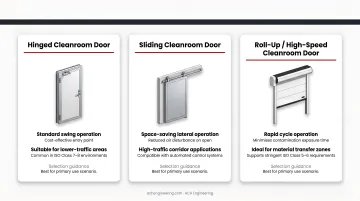
Cleanroom doors fall into three primary categories, each designed for specific operational requirements and contamination control levels.
Understanding the distinctions between these types enables informed selection that balances performance, cost, and operational needs.
Swinging Doors (Hinged Doors)
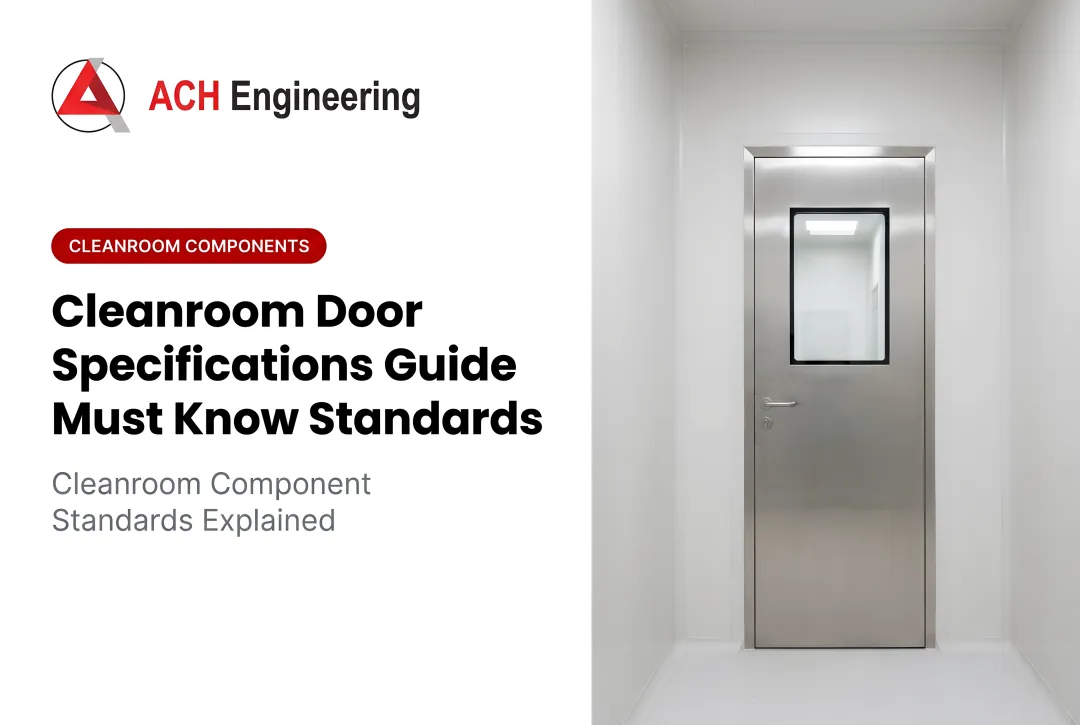
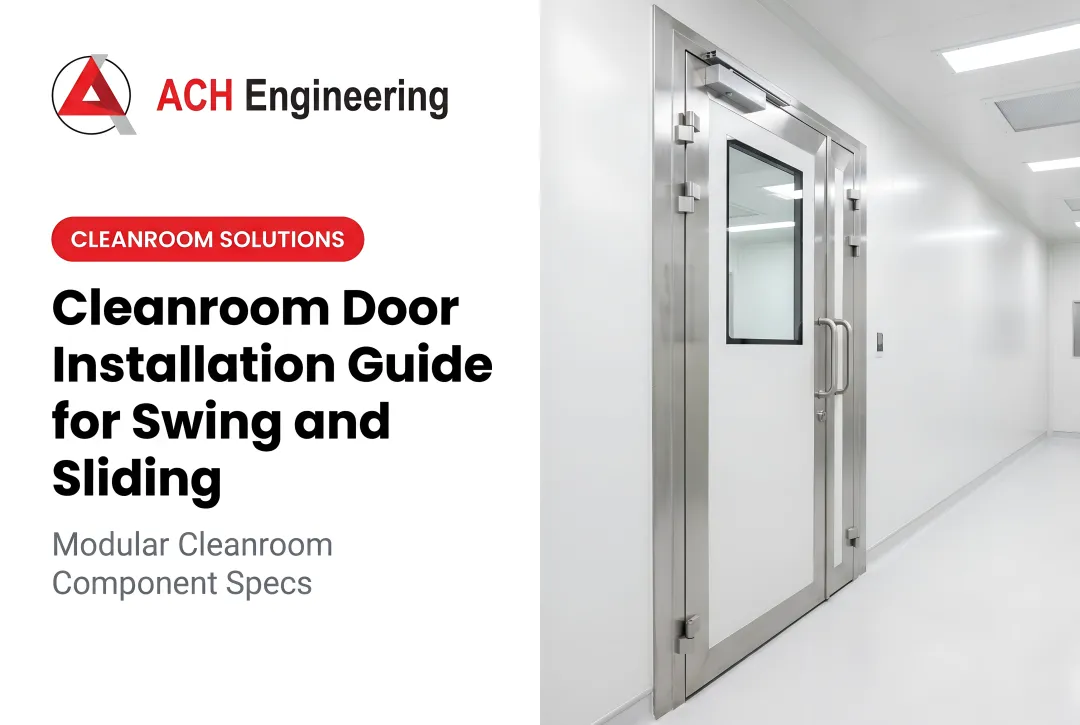
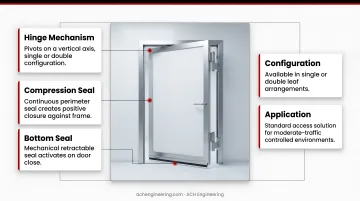
Swinging cleanroom doors are hinged units that open inward or outward on a vertical axis, available in single or double configurations. They represent the most common access solution for controlled environments with moderate traffic and standard pressure requirements.
Operation Mechanism
The hinge mechanism allows the door to pivot on a vertical axis. When closed, continuous compression seals around the perimeter create a positive seal against the frame.
A mechanical retractable bottom seal ensures tight contact with the floor without dragging contaminants. The compression force increases seal effectiveness as pressure differential rises.
Primary Features
Key design elements include:
- Compression seals that provide reliable pressure maintenance
- Flush-mounted vision panels for smooth, cleanable surfaces
- Compatibility with automatic operators or manual operation
- Flush design that eliminates particle-trapping ledges
Best Applications
Swinging doors suit ISO Class 6-8 cleanrooms, low-to-moderate traffic laboratories, compounding pharmacies, and spaces requiring occasional equipment passage. They work well where personnel movement is predictable and space allows for the door swing radius.
Advantages
- Strong seal integrity with compression gaskets
- Simple operation requiring minimal training
- Lower initial cost compared to sliding or hermetic options
- Easy maintenance with straightforward seal replacement
- Emergency egress compliance with panic hardware
- Installation in standard door frames without complex track systems
Limitations
Space requirements for door swing radius reduce usable floor area. High-traffic applications create bottlenecks as personnel wait for the door to clear. Air disturbance during opening can resuspend settled particles. Very large equipment passage requires oversized doors or alternative access points.
Sliding Doors
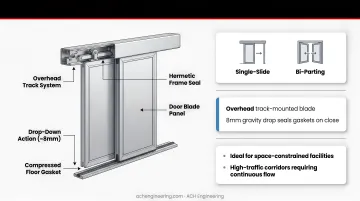
Sliding cleanroom doors are horizontally-moving panels that travel along tracks, available in single-slide or bi-parting configurations. They excel in space-constrained facilities and high-traffic corridors where continuous flow matters.
Operation Mechanism
Modern cleanroom sliding doors use overhead track systems where the door blade drops down approximately 8mm upon closing.
This drop-down action uses the door's weight to compress gaskets against the floor and frame, creating a hermetic seal without floor tracks that collect debris.
Primary Features
Design advantages include:
- Space efficiency with no swing radius requirement
- Up to 70% less air disturbance than swinging doors
- Wider openings for equipment and material carts
- Automated systems with touchless sensors to minimize contact
Best Applications
ISO Class 5-8 cleanrooms benefit from sliding door technology, particularly high-traffic corridors, manufacturing floors with frequent material transfer, and space-constrained facilities where every square foot matters. They're ideal where smooth traffic flow prevents operational bottlenecks.
Advantages
- Minimal floor space requirements maximize usable area
- Reduced air turbulence during operation limits particle resuspension
- Excellent for wide openings (up to 2+ meters)
- Smooth traffic flow prevents congestion
- Compatibility with automated systems and touchless activation
- Fast cycle times minimize duration of opening
Limitations
More complex track systems require specialized maintenance. Track contamination can occur if not properly sealed and cleaned regularly. Higher initial cost than swinging doors due to automation and track components. Achieving true hermetic seals requires precision installation and high-quality gasket systems.
Hermetic Doors (Airtight Sealed Doors)
Hermetic doors are specialized units designed to create completely airtight seals, preventing any air exchange between environments. They represent the highest level of contamination control and pressure maintenance.
Operation Mechanism
Two primary sealing systems deliver airtight performance:
- Inflatable gaskets: Compressed air (2-2.5 bar) inflates a rubber seal against the frame, compensating for irregularities
- Mechanical compression: Extreme force compresses seals for similar airtight results
Pressure monitoring systems verify seal integrity continuously.
Primary Features
Critical performance characteristics include:
- Extreme pressure differential capability—up to 250+ Pascals for standard hermetic doors and up to 2000 Pascals for specialized Air Pressure Resistant (APR) designs
- Complete air containment preventing cross-contamination in both directions
- Ultra-low leakage rates as low as 10 L/h at 250 Pa
- Protection for both product sterility and personnel safety
Best Applications
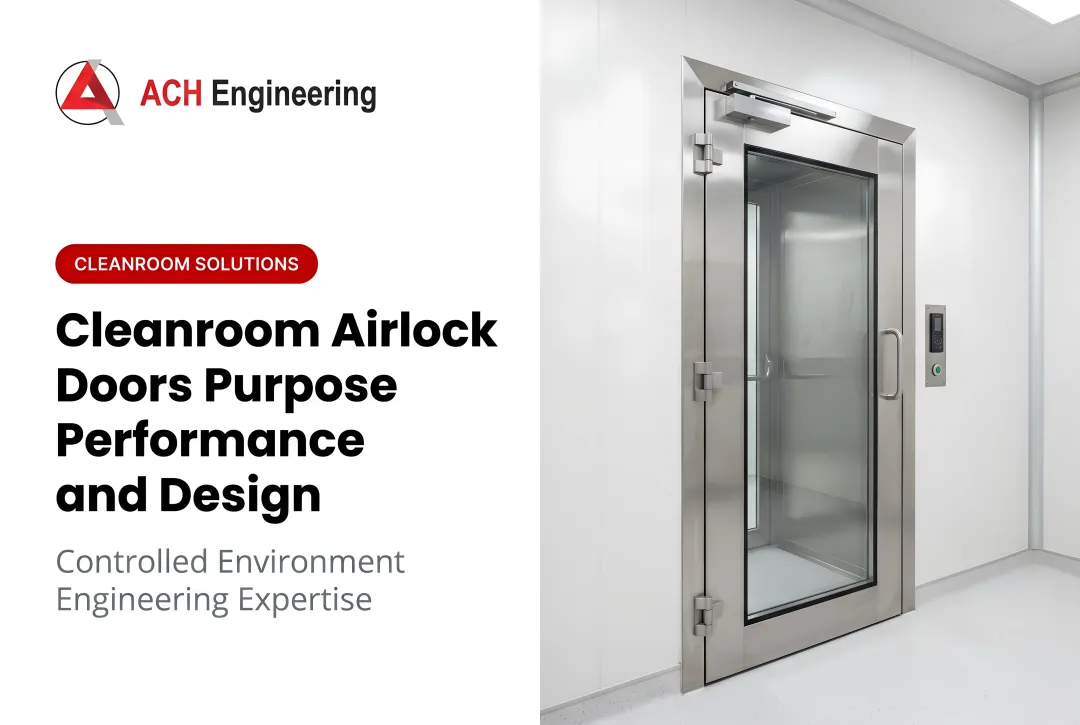
ISO Class 3-5 cleanrooms require hermetic doors, particularly sterile manufacturing suites producing injectable pharmaceuticals. BSL-3 and BSL-4 biosafety laboratories handling dangerous pathogens mandate airtight doors. Containment facilities, nuclear medicine areas, and hazardous material handling spaces depend on absolute seal integrity.
Advantages
- Absolute contamination control with near-zero leakage
- Ability to maintain critical pressure cascades under all conditions
- Compliance with strictest regulatory standards (EU GMP Annex 1, BSL-4)
- Protection for both product sterility and personnel safety
- Verification through pressure decay testing
- Suitable for gaseous decontamination rooms (VHP - Vaporized Hydrogen Peroxide)
Limitations
Significantly higher cost—USD $15,000-$40,000+ per door compared to USD $2,000-$5,000 for swinging doors. Complex installation requires structural support and precise alignment. Specialized maintenance for inflatable seals, pneumatic systems, and pressure monitoring. Slower operation due to seal/unseal cycles. Typically requires automatic operation rather than manual use.
Slower operation due to seal/unseal cycles. Typically requires automatic operation rather than manual use.
For cleanroom projects requiring any of these door types, ACH Engineering provides integrated door solutions as part of turnkey controlled environment systems across North America, ensuring proper selection and installation for your specific contamination control requirements.
How to Choose the Right Cleanroom Door Type
Choose cleanroom doors based on cleanroom classification, operational workflow, and regulatory requirements—not just initial cost or architectural preference. A systematic approach ensures the door supports contamination control objectives while enabling efficient operations.
ISO Classification and Pressure Requirements
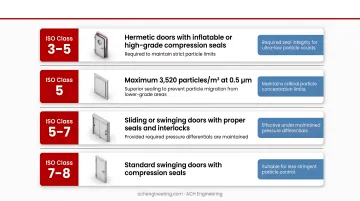
ISO Class 3-5 environments typically require hermetic doors with inflatable or high-grade compression seals to maintain strict particle limits. ISO Class 5 allows maximum 3,520 particles/m³ at 0.5 µm, demanding superior sealing to prevent particle migration from lower-grade areas.
ISO Class 5-7 can use sliding or swinging doors with proper seals and interlocks, provided they maintain required pressure differentials. ISO Class 7-8 environments work with standard swinging doors with compression seals.
Pressure differential requirements matter equally. FDA and EU GMP Annex 1 recommend 10-15 Pascals positive pressure between adjacent rooms of differing classification.
Match door sealing capability to required pressure maintenance—hermetic doors for critical cascades, compression seals for standard differentials.
Traffic Patterns and Workflow
Personnel and material movement frequency directly influences door type selection:
- High-traffic corridors (50+ passages/hour): Automatic sliding doors minimize bottlenecks and reduce cumulative air disturbance
- Moderate-traffic areas (20-50 passages/hour): Automatic swinging doors or manual sliding doors balance flow and cost
- Low-traffic zones (<20 passages/hour): Manual swinging doors provide adequate performance at lowest cost
Equipment size and passage frequency also matter. Large carts, process equipment, or material pallets require wider openings that sliding doors accommodate more easily than swinging alternatives.
Space Constraints and Layout
Available floor space impacts door viability:
- Swinging doors need clearance radius equal to door width plus swing arc—typically 1.2-1.5 meters of unusable floor space
- Sliding doors require only door thickness, maximizing usable area
- Hermetic doors need substantial wall thickness for frame support and precise alignment
Ceiling height affects sliding door track mounting. Overhead track systems need adequate clearance above the door opening.
Budget and Lifecycle Costs
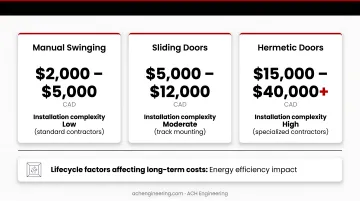
Total cost of ownership extends beyond purchase price and varies significantly based on door complexity.
Initial Investment Comparison:
| Door Type | Price Range (CAD) | Installation Complexity |
|---|---|---|
| Manual Swinging | $2,000-$5,000 | Low (standard contractors) |
| Sliding Doors | $5,000-$12,000 | Moderate (track mounting) |
| Hermetic Doors | $15,000-$40,000+ | High (specialized contractors) |
Lifecycle factors affecting long-term costs:
- Energy efficiency impact (door leakage drives HVAC operating costs)
- Maintenance requirements (inflatable seals need regular inspection and service)
- Expected operational life (GRP and stainless steel outlast painted steel by 10-15 years)
For projects across North America, ACH Engineering's turnkey approach integrates door selection with HVAC design, pressure cascade planning, and workflow optimization to balance regulatory compliance with budget realities.
Common Mistakes When Selecting Cleanroom Doors
Avoid these frequent errors that compromise cleanroom performance and increase total cost of ownership:
Choosing based on initial cost alone ignores lifecycle expenses. A C$3,000 swinging door that leaks air costs thousands annually in wasted HVAC energy.
A C$20,000 hermetic door that prevents contamination events saves far more than its premium.
Incompatible door types for your required ISO classification lead to failed certifications. Manual hinged doors rarely achieve the tight seals needed for ISO Class 5 environments, resulting in costly retrofits after initial certification attempts fail.
Traffic patterns matter more than most facility managers realize. A manual swinging door in a high-traffic corridor causes congestion, excessive air disturbance from repeated openings, and premature door failure from overuse.
Overlooking HVAC integration causes pressure imbalances throughout your facility. Specify doors in coordination with air handling capacity, since excessive leakage overwhelms HVAC systems and prevents proper pressure control between rooms.
Failing to plan for emergency egress creates safety violations. All cleanroom doors must comply with local building codes for emergency exit, panic hardware, and evacuation routes.
Specialized cleanroom doors require careful specification to meet both contamination control and life safety requirements.
Conclusion
Cleanroom door selection represents a critical decision affecting contamination control, operational efficiency, and regulatory compliance.
The three main door types serve distinct purposes: swinging doors offer versatility and cost-effectiveness for ISO Class 6-8 environments; sliding doors excel in high-traffic and space-constrained applications; hermetic doors provide absolute containment for critical ISO Class 3-5 and biosafety facilities.
Choosing the right door requires careful evaluation of:
- ISO classification requirements and contamination control needs
- Traffic patterns and space constraints
- Lifecycle costs including maintenance and energy efficiency
- Integration with HVAC systems and pressure cascade design
The right door maintains pressure differentials, minimizes air disturbance, and withstands aggressive cleaning protocols—protecting products, personnel, and processes while supporting efficient operations.
Success depends on integrated cleanroom design where door selection coordinates with HVAC systems, pressure cascade requirements, and workflow optimization. ACH Engineering specializes in this holistic approach, delivering turnkey cleanroom solutions that meet regulatory standards while enabling productive operations across pharmaceutical, biotech, medical device, and other controlled environment applications.
Frequently Asked Questions
What is the difference between hermetic and non-hermetic cleanroom doors?
Hermetic doors create completely airtight seals using inflatable gaskets or extreme compression systems, preventing any air exchange. Non-hermetic doors use compression seals that minimize but don't eliminate air leakage, suitable for most cleanroom applications. Hermetic doors are required for BSL-3/4 laboratories and critical pharmaceutical sterile manufacturing.
Which cleanroom door type is best for ISO Class 5 environments?
ISO Class 5 cleanrooms typically require hermetic doors for sterile manufacturing or high-quality sliding/swinging doors with superior seals for other applications. Sterile injectable production demands hermetic sealing, while general ISO 5 environments can use precision-sealed sliding or swinging doors with proper interlocks.
How do automatic vs. manual cleanroom doors affect contamination control?
Automatic doors reduce contamination by minimizing touch points and controlling opening speed, which limits air exchange and particle infiltration. They're especially beneficial in high-traffic areas and when personnel wear full gowning that makes manual operation difficult.
What are the typical costs for different cleanroom door types?
Manual swinging doors are most economical ($2,000-$5,000), sliding doors mid-range ($5,000-$12,000), and hermetic doors most expensive ($15,000-$40,000+). Costs vary based on size, automation level, materials (GRP vs. stainless steel), and specifications. Remember that lifecycle costs including energy efficiency and maintenance often justify higher initial investment.
Can cleanroom doors be retrofitted into existing facilities?
Yes, retrofit is possible but requires careful assessment of structural support, space availability, HVAC integration, and pressure cascade impact. Pre-hung door systems simplify retrofit installation by providing complete frame and door assemblies. Coordinate with your cleanroom provider to ensure proper integration with existing environmental control systems.
What maintenance is required for hermetic seal cleanroom doors?
Hermetic doors require regular seal integrity testing (pressure decay or tracer gas methods), gasket inspection and replacement, and pressure monitoring system calibration. Establish a preventive maintenance schedule with quarterly inspections and annual comprehensive testing to ensure continued regulatory compliance.