Introduction
Pharmaceutical expansions, semiconductor fab buildouts, and tightening regulatory standards are pushing cleanroom construction demand higher — and partition systems sit at the center of every new facility decision. Yet many project teams still underestimate how rapidly wall system technology, materials, and compliance requirements are evolving.
Cleanroom partitions are specialized wall systems that maintain strict air quality, temperature, humidity, and pressure parameters to protect contamination-sensitive processes across pharmaceuticals, semiconductors, biotechnology, and medical device manufacturing. With the global cleanroom partition panel market valued at $2.1 billion in 2026 and climbing, facility teams need a clear picture of where the market is heading to make smarter investment decisions, reduce construction timelines, and stay ahead of compliance requirements.
TLDR
- The market grows at 6% CAGR, reaching $3.8 billion by 2036, driven by pharma and semiconductor expansion
- Modular pre-fabricated cleanroom construction systems hold 59% market share, cutting installation time by 30–50% vs. traditional builds
- Advanced materials like aluminum honeycomb and PIR cores deliver superior fire resistance (Class A ratings) and thermal efficiency
- IoT-enabled smart partitions cut contamination incidents by 20% and energy use by 15% for early adopters
- EU GMP Annex 1 and FDA cGMP requirements are pushing demand for antimicrobial coatings and compliance-ready designs
Rise of Modular and Pre-Fabricated Partition Systems
Modular cleanroom partitions represent a fundamental shift from traditional "stick-built" construction methods. Unlike conventional drywall and epoxy approaches that require extensive on-site fabrication, modular systems use factory-designed panels with standardized components designed for rapid assembly.
How Modular Systems Differ
Factory-built panels arrive on-site ready for installation, eliminating weather delays and reducing coordination complexity. The manufacturing process occurs in controlled environments, ensuring consistent quality while site preparation happens simultaneously. This parallel processing cuts project timelines significantly — often by weeks, not days.
Real-World Adoption Examples
The NRC-CNRC Biologics Manufacturing Centre demonstrates modular efficiency: a 14,000 sq. ft. GMP-certified cleanroom was delivered in less than 5 months, with the entire facility completed just 10 months after breaking ground. Pharmaceutical facilities that previously required 6 months for construction now complete projects in 6-8 weeks. For biotech operations under regulatory pressure, that compression in schedule can be the difference between hitting a product launch window and missing it.
Cost and Time Benefits
Research shows modular construction delivers measurable advantages:
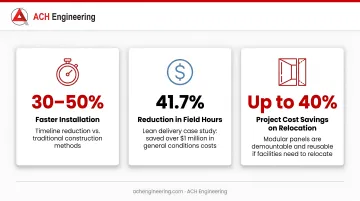
- Timeline reduction: 30-50% faster installation compared to traditional methods
- Cost savings: A lean delivery case study demonstrated 41.7% reduction in field hours, saving over $1 million in general conditions costs
- Relocation value: Modular systems save up to 40% on project costs if facilities need to relocate, as panels are demountable and reusable
Flexibility Advantages
Modular partitions support business agility through reconfiguration capabilities. Companies can expand capacity, adjust layouts, or relocate entire cleanrooms as needs change. This flexibility aligns with just-in-time manufacturing principles and reduces facility downtime during modifications. In pharmaceutical and semiconductor environments, where production schedules rarely accommodate extended shutdowns, that matters.
Advanced Materials Driving Performance and Sustainability
Cleanroom partition materials have shifted decisively toward high-performance composites — driven by stricter ISO classifications, FDA compliance requirements, and growing pressure to cut facility energy costs.
Performance Comparison of Key Materials
Each material serves distinct performance requirements. The table below outlines how the four most common partition materials compare across critical specifications:
| Material | Fire Rating | Thermal Conductivity | Primary Application |
|---|---|---|---|
| Aluminum Honeycomb | Class A, 1.0-hr resistance | 0.73 W/m²·K | Semiconductor fabs (ISO 3–5), electronics |
| PIR Core | Class B | 0.022 W/m·K | Pharma cold storage, HVAC load reduction |
| Rockwool | Class A1 non-combustible | ~0.037 W/mK | GMP pharma, biotech fire-safety requirements |
| High-Pressure Laminate (HPL) | Class B | Varies by substrate | Healthcare, high-frequency chemical cleaning |
Aluminum honeycomb's non-outgassing, anti-static properties make it the default choice for wafer fabrication environments. PIR's thermal performance — with cold storage stability within ±0.5°C — directly reduces HVAC operating costs in pharmaceutical facilities. Rockwool is the go-to where GMP fire compliance is non-negotiable. HPL handles aggressive cleaning cycles that would degrade other surfaces.
Sustainability Trends
Environmental considerations are reshaping material selection:
- Recycled content: Aluminum lightweight panels now feature up to 75% recycled content and are designed for reuse and refurbishment
- Carbon reduction: Manufacturers are releasing Environmental Product Declarations (EPDs) showing 35% reduction in Global Warming Potential
- PIR transition: New PIR formulations offer 40% drop in GWP compared to previous materials
For facilities planning long-term, material selection is no longer just a performance decision — EPD documentation is becoming a procurement requirement for LEED-targeting projects and government-funded lab construction across North America.
Smart Technology Integration in Partition Systems
IoT sensors and monitoring systems embedded within cleanroom partition designs are shifting contamination control from reactive responses to early intervention — catching problems before they become production stoppages.
Real-World Applications
Smart partition systems now incorporate:
- Continuous pressure differential monitoring that tracks cascade levels and flags potential contaminant ingress
- Integrated particle counters that trigger immediate alerts when counts exceed acceptable thresholds
- Predictive maintenance signals from IoT devices that identify equipment issues before they cause unplanned downtime
These capabilities extend across pass-through systems, partition walls, and entry points — giving facility teams a live view of environmental conditions at every critical boundary.
Measurable Impact
A global pharmaceutical company reported 20% reduction in contamination incidents and 15% decrease in energy consumption in the first year after implementing IoT sensors. One biotech firm avoided a multi-week shutdown by identifying an air handling issue early via predictive alerts.
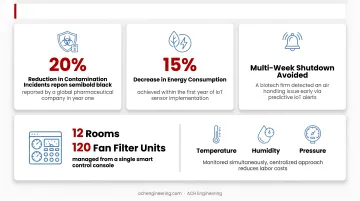
Smart control panels can now manage up to 12 rooms and 120 Fan Filter Units from a single console, monitoring temperature, humidity, and pressure simultaneously. This centralized approach reduces labor costs while improving compliance documentation.
For pharmaceutical and biotech manufacturers under increasing regulatory scrutiny, smart partitions also automate compliance tracking and generate audit-ready documentation — reducing the manual burden of demonstrating environmental control to inspectors.
Industry-Specific Customization and Specialized Designs
With EPC integrators controlling 59% of the cleanroom partition sales channel, the market has clearly shifted toward customized, turnkey solutions over generic builds.
Growing Customization Demand
Industry data suggests 65-70% of cleanroom projects now require industry-specific modifications. Standard, off-the-shelf panels simply can't meet the diverging regulatory and operational demands across sectors.
Sector-Specific Requirements
Each sector brings a distinct set of wall, seal, and pressure requirements:
- Compounding Pharmacies (USP <797>/<800>) — Surfaces must be smooth, impervious, and coved at junctures for cleanability. Hazardous drug rooms require negative pressure and specific airlock designs to control containment.
- Semiconductor Fabs — ISO Class 3–5 environments demand strict ESD control. Aluminum honeycomb panels with conductive finishes prevent static buildup and outgassing that could damage wafers.
- Battery Dry Rooms — Lithium-ion production requires extremely low humidity. Panels must deliver airtight sealing and superior moisture resistance to hold precise dew point specifications.
- Hospital Compounding — Interlocking pass-through mechanisms prevent simultaneous door opening, preserving pressure differentials during material transfers between classified zones.
Why Customization Matters
Regulatory requirements diverge sharply across industries — and so do the physical consequences of getting partition design wrong. A wall panel spec acceptable in food processing can cause a compliance failure in a compounding pharmacy. This gap between sectors is precisely where engineering expertise and tailored design create measurable value, both in regulatory outcomes and long-term operational reliability.
Regulatory Compliance as an Innovation Driver
Evolving regulations are pushing manufacturers to innovate partition designs that embed compliance features directly into the infrastructure.
Key Regulatory Drivers
EU GMP Annex 1 (2022 Revision): Now fully applicable, this standard emphasizes a documented Contamination Control Strategy (CCS). It mandates barrier technologies and strict environmental monitoring, directly influencing partition layout and integration of monitoring ports.
FDA cGMP & 21 CFR Part 11: FDA inspection data reveals over 20% of 483 observations relate to design or construction deficiencies. For facilities with integrated electronic monitoring, compliance with 21 CFR Part 11 for electronic records is essential.
ISO 14644-4: This standard provides specific guidance on design and construction, advocating for materials that support appropriate airflow direction and cleanability.
Compliance-Driven Innovations
Each of these standards creates specific design obligations. Manufacturers are responding by building compliance directly into partition systems:
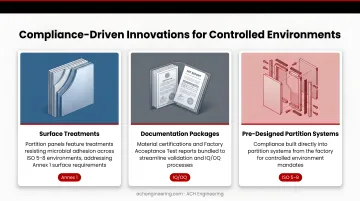
- Partition panels now feature surface treatments that resist microbial adhesion across ISO 5-8 environments, directly addressing Annex 1 surface requirements
- Documentation packages bundling material certifications and Factory Acceptance Test reports streamline validation and IQ/OQ (Installation and Operational Qualification) processes
- Pre-designed monitoring ports built into partition panels accommodate pressure sensors, particle counters, and environmental monitors without retrofit drilling or structural compromise
The result is faster validation cycles and fewer 483 observations — compliance baked into the build, not addressed during audits.
What's Driving These Cleanroom Partition Trends
Several distinct forces are reshaping the cleanroom partition market — and each one has data behind it.
Technology Advances and Innovation
Building Information Modeling (BIM) and automated manufacturing for modular components increase efficiency and reduce errors. New construction projects are adopting AI-based environmental monitoring as standard, enabling predictive maintenance and real-time optimization.
Market Demand and Customer Expectations
Demand signals are stacking up across North America and beyond:
- The modular cleanroom market reached $4.3 billion in 2024 and is forecast to reach $6.4 billion by 2030
- U.S. semiconductor reshoring through the CHIPS Act is channeling billions into domestic manufacturing, driving demand for high-specification modular cleanrooms
- The UK biotech sector recorded a 94% increase in investment in 2024, a signal of the global wave of new facility construction underway
Cost Pressures and Efficiency Needs
Businesses are pushing for measurable efficiency gains, and modern partition solutions are delivering:
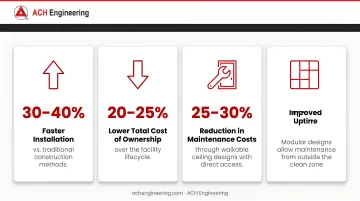
- 30–40% faster installation times compared to traditional construction methods
- 20–25% lower total cost of ownership over the facility lifecycle
- 25–30% reduction in maintenance costs through walkable ceiling designs that provide direct access
- Improved uptime, as modular designs allow maintenance from outside the clean zone
Regulatory and Compliance Pressures
Tighter oversight is accelerating facility upgrades. The 2022 EU GMP Annex 1 revision has prompted a wave of pharmaceutical manufacturing improvements across Europe, and audit frequency continues to rise globally. Partition systems with built-in compliance features — documented cleanability, traceable materials, validated sealing — have shifted from premium option to baseline requirement.
Competitive Dynamics and Market Consolidation
Competitive pressure in pharmaceutical and tech sectors drives companies to invest in advanced cleanroom facilities to attract clients and meet quality expectations. Market consolidation is accelerating — Equans U.S. Inc. acquired AdvanceTEC LLC in September 2025, for example, specifically to strengthen modular cleanroom capabilities. Integrated solution providers are becoming the dominant model.
How These Trends Are Impacting Industries Using Cleanroom Partitions
Across pharmaceutical, biotech, and semiconductor sectors, these market shifts are changing how facilities are built, staffed, and operated — with measurable consequences at every level.
Operational Impact
Quantifiable operational changes include:
- Cuts installation timelines by 40-50% compared to traditional construction
- Reduces maintenance costs 25-30% through optimized access designs
- Eliminates shutdown requirements for routine service via interstitial maintenance access
- Lowers contamination incidents by 20% through real-time IoT monitoring
Business Impact
Modular infrastructure is reshaping capital decisions across the industry:
- Proven ROI is driving increased investment in modular over traditional builds
- Faster facility completion accelerates product launches — a critical edge in pharmaceutical and biotech markets
- Reconfigurable cleanrooms protect capital investments as business needs evolve
- Built-in compliance features reduce audit failures and the remediation costs that follow
Workforce Impact
Technology adoption is reshaping who builds and maintains cleanrooms:
- Demand for technicians trained in smart systems and IoT monitoring is rising, with 37,800 annual job openings projected through 2032
- Prefabrication shifts construction work to factory environments, reducing reliance on traditional trades
- Validation engineers and compliance specialists who understand both technology and regulation are increasingly sought after
- General contractors unfamiliar with strict cleanroom protocols are being replaced by specialized installation teams
Future Signals for Cleanroom Partitions in the Next 3 Years
Six technologies are already moving from lab bench to procurement conversations. Here's what facility planners and cleanroom designers should track through 2028.
Emerging Technologies Reshaping Cleanroom Partitions
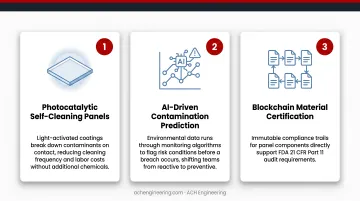
- Photocatalytic self-cleaning panels use light-activated coatings to break down contaminants on contact, reducing cleaning frequency and labor costs without additional chemicals
- AI-driven contamination prediction runs environmental data through monitoring algorithms to flag risk conditions before a breach occurs — shifting teams from reactive to preventive
- Blockchain material certification creates an immutable compliance trail for panel components, directly supporting FDA 21 CFR Part 11 audit requirements
- Nanoscale surface coatings deliver stronger antimicrobial performance and easier wipe-downs with less chemical exposure for maintenance staff
- Phase-change thermal materials embedded in partition panels could reduce HVAC loads in pharmaceutical and semiconductor environments where temperature precision is non-negotiable
- AR-guided installation overlays real-time instructions during build and maintenance, cutting training time and installation errors as cleanroom configurations grow more complex
Likely Scenarios for 2026-2028
Market projections indicate:
- Continued growth: The cleanroom partition panel market will advance toward USD $3.8 billion by 2036 at 6% CAGR
- Circular economy adoption: Increased focus on partition reuse, refurbishment, and recycling as sustainability pressures mount
- Building management integration: Cleanroom partitions will integrate more seamlessly with facility-wide building management systems, enabling centralized control of energy, airflow, and contamination response
- Regional concentration: Asia-Pacific semiconductor expansion and North American/European pharmaceutical retrofits will drive regional specialization
Conclusion
Cleanroom partition market trends—modular construction, advanced materials, smart technology, and regulatory-driven customization—are changing how contamination-sensitive industries approach controlled environments. The shift from traditional stick-built construction to factory-designed modular systems delivers 30-50% faster installation, significant cost savings, and operational flexibility that traditional approaches cannot match.
Early adopters gain measurable advantages: faster facility deployment, lower total cost of ownership, and the compliance flexibility needed to support long-term growth.
As pharmaceutical and biotech investment accelerates, semiconductor manufacturing expands, and regulatory requirements tighten, the market will continue shifting toward smarter, more sustainable, and more reconfigurable solutions.
ACH Engineering designs and manufactures modular cleanroom solutions in Canada, serving pharmaceutical, biotech, semiconductor, and other regulated industries across North America. Their process starts with understanding each client's specific controlled environment requirements, then engineering a tailored solution—turnkey, end-to-end, and built to meet both current compliance standards and future expansion needs.
Frequently Asked Questions
How much does a cleanroom cost per square foot?
Cleanroom costs vary widely from $100 to $1,000+ per square foot depending on ISO classification level, partition materials, and industry requirements. ISO 8 basic cleanrooms typically cost $100-$250 per sq. ft., while ISO 1-4 advanced semiconductor cleanrooms can exceed $600-$1,000 per sq. ft. Modular partition systems typically reduce costs by 20-30% compared to traditional construction.
Who builds cleanrooms?
Specialized cleanroom contractors and engineering firms design and build cleanrooms, delivering turnkey solutions from design through installation and certification. ACH Engineering, for example, handles design, modular component manufacturing, construction management, and validation for pharmaceutical, biotech, and semiconductor clients across North America.
What are ISO 9 cleanroom requirements?
ISO Class 9 (formerly Class 100,000) allows a maximum of 35,200,000 particles (≥0.5 μm) per cubic meter, applying only to the "in-operation" state. Partition systems must maintain required air quality and pressure differentials through appropriate filtration and pressurization.
What are cleanroom panels?
Cleanroom panels are wall and ceiling components — typically 2-4 inches thick — made from materials like aluminum honeycomb, polyurethane, PIR, or HPL. Core materials and face finishes are selected based on fire resistance, thermal performance, and cleanability requirements for each application.
What are the latest trends in cleanroom partition design?
Modular pre-fabricated systems now command 59% of the market, reducing installation time by 30-50%. Smart technology integration with IoT sensors delivers 20% reduction in contamination incidents, while sustainable materials like aluminum honeycomb and PIR cores deliver measurable gains in thermal performance and cleanability. Industry-specific customization for pharmaceutical USP standards, semiconductor ISO requirements, and biotech cGMP compliance represents the fastest-growing segment.
Why is the cleanroom partition market growing?
Growth is driven by pharmaceutical and biotech expansion globally — including a 94% investment surge in UK biotech in 2024 — alongside semiconductor manufacturing growth through initiatives like the U.S. CHIPS Act. Stricter regulatory requirements (EU GMP Annex 1, FDA cGMP, Health Canada) and demand for modular solutions that cut construction time by 30-50% and total ownership costs by 20-25% are accelerating adoption across North America.