
Introduction
Manufacturers in pharmaceutical, biotech, medical device, and food processing sectors struggle with a persistent tension: meeting strict regulatory requirements while cutting waste and improving throughput. Traditional cleanroom construction often makes this harder, not easier—locking facilities into fixed layouts that resist change and generate downtime during every modification.
Modular cleanroom design addresses this directly. Beyond the well-known flexibility benefits, modular systems enable lean manufacturing principles at an operational level, reducing waste, supporting continuous improvement, and keeping production moving. This article breaks down exactly how.
Key Takeaways
- Rapid deployment cuts production downtime during cleanroom installation
- Reconfigurable panels support continuous improvement and fast product changeovers — no major capital spend required
- Prefabricated construction reduces material waste and keeps quality consistent across builds
- Capacity scales on demand, enabling just-in-time expansion without oversizing
- Space-efficient layouts align naturally with lean cell configurations and optimized flow paths
Table 1: Modular vs. Traditional Cleanroom Construction — Lean Manufacturing Impact
| Factor | Modular Construction | Traditional Stick-Built |
|---|---|---|
| Installation timeline | 9-18 months | 15-30 months |
| Material waste | Up to 90% reduction | Standard construction waste |
| Batch changeover time reduction | Up to 50% | Not inherent to design |
| OEE improvement potential | Up to 25% | Limited by fixed layouts |
| Depreciation period | 5-7 years (accelerated) | 39 years |
| Layout reconfiguration | Weeks, minimal cost | Months, major cost |
What Is Modular Cleanroom Design (Brief Context)
Modular cleanrooms are prefabricated controlled environments built from interlocking panels that can be assembled, reconfigured, and expanded as operational needs change. Common applications span regulated industries including:
- Pharmaceutical and biotech manufacturing
- Medical device assembly
- Semiconductor and electronics fabrication
- Food processing and agricultural cultivation
- Aerospace and laboratory environments
That versatility is precisely what makes modular design relevant to lean manufacturing. Beyond the physical structure, it gives manufacturers a built-in mechanism for eliminating wasted space, reducing changeover time, and scaling capacity without disrupting active production — outcomes lean principles actively pursue.
Key Benefits of Modular Cleanroom Design for Lean Manufacturing
Each benefit below connects modular cleanroom design to a measurable lean outcome — reduced lead times, lower waste, faster throughput, or stronger capital efficiency.
Benefit 1: Rapid Deployment Reduces Downtime and Accelerates Time-to-Market
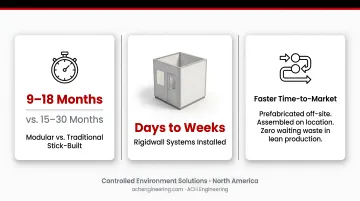
Modular cleanrooms can be installed in weeks rather than months because components are prefabricated off-site and assembled on location. While traditional stick-built projects often span 15 to 30 months from concept to commissioning, prefabricated modular installations reach completion in 9 to 18 months, with rigidwall systems installable in as little as a few days to a few weeks.
This speed eliminates the "waiting" waste in lean manufacturing by getting production lines operational faster. For life sciences companies launching products with $2 billion in peak revenue, a six-month delay can erode over $750 million in Net Present Value, making rapid deployment a critical competitive advantage.
KPIs impacted:
- Time-to-market
- Production uptime
- Capital deployment speed
- Revenue realization timeline
- Opportunity cost reduction
When this benefit matters most: New product launches, facility expansions, emergency capacity additions, contract manufacturing startups, or responding to sudden market demand shifts.
Benefit 2: Flexibility and Reconfigurability Enable Continuous Improvement
Modular panels can be easily relocated, expanded, or reconfigured to support kaizen events, layout optimization, and product changeovers without major disruption. This supports lean's continuous improvement philosophy by allowing manufacturers to test and implement layout changes based on value stream mapping insights.
Research in the pharmaceutical sector demonstrates that integrating lean practices in reconfigurable environments can reduce batch changeover time by up to 50%, while increasing Overall Equipment Effectiveness (OEE) by 25%. Unlike fixed facilities, modular systems allow for "scale-out" strategies where processing modules can be added as production demands increase from clinical trials to commercial scale.
KPIs impacted:
- Changeover time (SMED)
- Overall equipment effectiveness (OEE)
- Space utilization rate
- Production flexibility index
- Setup time reduction
When this benefit matters most: Multi-product facilities, contract manufacturing operations, companies practicing frequent kaizen events, or organizations scaling production up and down based on demand.
Benefit 3: Cost Efficiency Through Waste Reduction
Modular construction attacks waste on three fronts: precise prefabrication cuts material waste, faster installation reduces labour hours, and optimized layouts eliminate wasted floor space. Research indicates modular construction can reduce waste materials — timber, cardboard, plastics, and concrete — by up to 90% compared to traditional methods.
Reusable components also eliminate "overproduction" waste when facilities need to be modified or relocated. While upfront capital expenditure is often comparable, the Total Cost of Ownership typically favours modularity through reduced indirect costs and faster revenue realization.
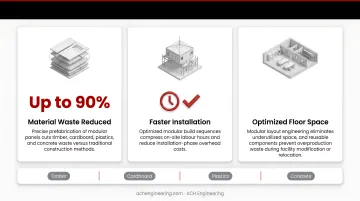
The tax treatment adds another layer of savings: modular cleanrooms typically qualify as tangible personal property, eligible for accelerated depreciation over 5 to 7 years versus 39 years for traditional construction, improving near-term cash flow.
KPIs impacted:
- Total project cost
- Cost per square foot
- Material waste percentage
- Labour hours per square foot
- Return on investment timeline
- Total cost of ownership
When this benefit matters most: Budget-constrained projects, facilities planning for future expansion, organizations with multiple sites requiring standardized solutions, or companies prioritizing capital efficiency.
Benefit 4: Quality Consistency Through Standardized Prefabrication
Factory-controlled prefabrication ensures consistent quality and eliminates the variability inherent in on-site construction. This supports lean's "quality at the source" principle by reducing defects and rework. In traditional pharma facility builds, rework can account for up to 30% of on-site activity, often due to poor coordination and variable workmanship.
Modular systems undergo Factory Acceptance Testing (FAT) before shipment, arriving on-site as a validated system kit that streamlines commissioning.
This pre-validation shortens qualification timelines and removes uncertainty — modular projects routinely pass Performance Qualification (PQ) on the first attempt, a direct result of their pre-designed design.
KPIs impacted:
- First-pass yield
- Rework rate
- Validation timeline
- Compliance audit results
- Quality cost as percentage of revenue
When this benefit matters most: Highly regulated industries (pharmaceutical, biotech, medical devices), facilities requiring multiple identical cleanrooms, or organizations with stringent quality requirements.
Benefit 5: Space Optimization for Lean Layout Principles
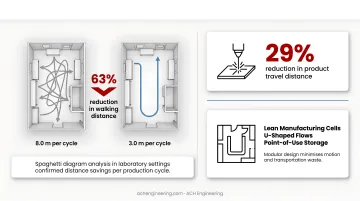
Modular design allows for optimized layouts that support lean manufacturing cells, U-shaped flows, and point-of-use storage. Compact, efficient designs reduce the "motion" and "transportation" wastes by minimizing travel distances. Spaghetti diagram analysis in laboratory settings showed that improved layouts reduced walking distance per cycle from 8.0 metres to 3.0 metres — a 63% reduction.
A redesign of a laser cleanroom facility resulted in a 29% reduction in product travel distance and a 23% increase in productivity. By reducing operator travel distance and optimizing the placement of shared equipment, modular designs directly address non-value-added activities.
KPIs impacted:
- Space utilization rate
- Operator travel distance
- Material handling time
- Throughput per square foot
- Inventory turns
When this benefit matters most: Facilities with limited floor space, operations implementing cellular manufacturing, or organizations focused on maximizing output per square foot.
What Happens When Modular Design Is Ignored in Lean Manufacturing Environments
Traditional fixed cleanroom construction works against lean manufacturing at nearly every stage. Three consequences stand out:
- Revenue delays: Construction timelines of 15–30 months push back production start dates and increase opportunity costs. For high-margin regulated products, that gap can represent hundreds of millions in lost NPV.
- Layout rigidity: Fixed structures make product changeovers costly and slow. Accessing utilities buried behind permanent walls typically requires full-area shutdowns — halting production to perform what should be a straightforward reconfiguration.
- Stranded capital: Traditional construction carries zero residual value if a facility relocates or repurposes space. When modifications are needed, the entire investment is written off rather than reconfigured and redeployed.
How to Get the Most Value from Modular Cleanroom Design
Modular cleanrooms work best when integrated into an overall lean manufacturing strategy from the planning stage. A few practical approaches make a measurable difference:
- Map material and personnel movement patterns before finalizing the layout — this prevents costly reconfiguration by identifying flow inefficiencies upfront
- Work with providers who understand lean manufacturing principles and can deliver turnkey solutions tailored to your operational requirements; ACH Engineering's process starts with your specific controlled environment needs, then builds an optimized solution around them
- Design for expansion and reconfiguration from the start, so the system can absorb growth, product mix changes, and process improvements without major reconstruction
Conclusion
Modular cleanroom design is a strategic enabler of lean manufacturing — one where each advantage reinforces the next. The benefits stack: faster deployment shortens time-to-market, flexibility sustains continuous improvement, and cost efficiency frees capital for other value-adding investments.
For manufacturers operating in regulated industries, that combination is hard to replicate with conventional construction:
- Faster deployment reduces time-to-market and opportunity costs
- Built-in flexibility supports Kaizen and ongoing process improvement
- Lower lifecycle costs through waste reduction and accelerated depreciation
Treated as an operational capability rather than a one-time build decision, a modular cleanroom becomes a durable source of competitive advantage — one that adapts as your production requirements evolve.
Frequently Asked Questions
What are the benefits of modular cleanroom design for lean manufacturing?
Modular cleanroom design supports lean manufacturing by enabling rapid deployment, flexible reconfiguration for product changeovers, and significant cost reduction. These capabilities directly align with lean's core goal: eliminating waste while sustaining product quality.
What is the primary purpose of cleanroom design in pharmaceutical manufacturing?
Cleanroom design in pharmaceutical manufacturing ensures contamination control to maintain product quality, protect patient safety, and achieve regulatory compliance with FDA, cGMP, and ISO standards. Proper environmental control prevents particulate and microbial contamination during critical manufacturing processes.
What is a modular cleanroom?
A modular cleanroom is a prefabricated controlled environment built from interlocking panels and components that can be assembled, modified, and expanded as operational needs change. These systems offer the same contamination control as traditional cleanrooms but with significantly greater flexibility and faster installation timelines.
How long does it take to install a modular cleanroom compared to traditional construction?
Modular cleanrooms typically install in 4-8 weeks (with some rigidwall systems ready in days), compared to 6-12 months for traditional stick-built construction. This speed advantage minimizes production downtime and accelerates revenue realization—critical factors for lean manufacturing operations focused on eliminating waiting waste.
Can modular cleanrooms be reconfigured after initial installation?
Yes. Modular panels are designed for disassembly and reassembly, so manufacturers can relocate, expand, or reconfigure their cleanroom to support layout changes and product changeovers. This flexibility supports continuous improvement without major reconstruction costs.
What is the cost difference between modular and traditional cleanroom construction?
Modular cleanrooms typically deliver 30-40% cost savings through reduced labor, faster installation, and less material waste. These systems also qualify for accelerated depreciation (5-7 years vs. 39 years for traditional construction), improving cash flow from the outset.