Introduction
Cleanroom facilities face mounting pressure from regulatory bodies like the FDA and EMA, which now enforce stricter contamination control standards—including the revised EU GMP Annex 1 (2022). Meeting these requirements demands validated controlled environments across pharmaceutical, biotech, semiconductor, and food processing operations.
Hermetic doors have become critical infrastructure for maintaining ISO classification standards and preventing contamination events. Door seal failures contribute to over 30% of contamination incidents, putting compliance certifications and product quality at risk.
The real value of hermetic sealing shows in three areas: maintaining cleanroom integrity during personnel movement, reducing operational costs through better climate control, and ensuring regulatory compliance during audits.
With the global cleanroom technology market projected to reach $12.93 billion by 2031, the strategic importance of hermetic door sealing continues to grow across all controlled environment applications.
Key Takeaways
- Airtight seals prevent particle migration and maintain pressure differentials for cleanroom classification
- Reduces particle counts and prevents infiltration that causes costly batch failures
- Cuts HVAC costs by 50-75% through minimized air leakage and reduced makeup air needs
- Supports ISO 14644, cGMP, and EU GMP Annex 1 compliance requirements
- Lowers operational costs and reduces expensive re-certification failures
What Are Hermetic Doors in Cleanrooms
Hermetic doors are specialized airtight doors designed to create complete seals when closed, preventing air leakage and particle migration between cleanroom zones or between cleanrooms and adjacent spaces.
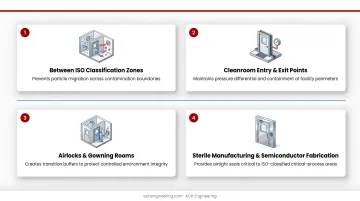
These doors are typically deployed at critical control points throughout cleanroom facilities:
- Between different ISO classification zones
- At cleanroom entry/exit points
- In airlocks and gowning rooms
- In critical areas like sterile manufacturing suites or semiconductor fabrication cleanrooms
Their placement is strategic—positioned wherever maintaining environmental separation is essential to facility operations and regulatory compliance.
Rather than a premium door option, hermetic doors function as critical infrastructure components that enable cleanrooms to maintain their designed environmental parameters including pressure differentials, particle counts, temperature, and humidity. Without proper hermetic sealing, even the most sophisticated HVAC systems and filtration equipment cannot consistently maintain the controlled conditions that define cleanroom performance.
Key Benefits of Hermetic Doors in Cleanrooms
The benefits below focus on measurable, operational outcomes specific to cleanroom environments, including impacts on contamination control, operational efficiency, validation success, energy consumption, and regulatory compliance.
Contamination Control and Particle Count Management
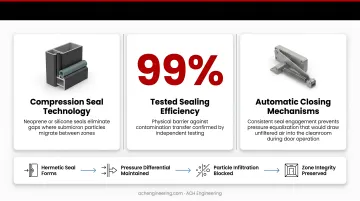
Hermetic doors prevent particle infiltration by creating compression seals—typically neoprene or silicone—that eliminate gaps where submicron particles could migrate between zones. These seals achieve tested sealing efficiencies exceeding 99%, creating a physical barrier against contamination transfer.
The airtight seal prevents pressure equalization that would otherwise draw unfiltered air and particles into the cleanroom during door operation.
Automatic closing mechanisms ensure consistent seal compression with every use, eliminating the human variability that compromises manual door systems.
This prevents contamination events that could compromise product batches, research outcomes, or manufacturing yields. The impact is particularly critical in pharmaceutical sterile manufacturing and semiconductor fabrication where even minor particle intrusion causes costly product failures. A documented case study revealed that an aging door gasket with a leakage rate of 0.8 m³/h caused a sterile batch to fail particle testing, resulting in losses exceeding $100,000.
Research demonstrates measurable differences in contamination control:
- Human movement through doorways at standard speeds results in cleanroom-to-airlock particle concentration ratios of 2.75% at low airflow rates
- Variable-speed automatic door operation (slow opening, fast closing) reduces contaminant levels by 21% compared to standard operation
- Over 30% of contamination incidents stem from door seal failures or improper operation
These improvements directly impact product quality assurance, batch rejection rates, cleanroom re-certification costs, and the ability to maintain ISO classification during operations.
Key performance indicators affected include:
- Particle counts per cubic meter (critical for ISO 14644 classification)
- Contamination event frequency
- Product batch rejection rates
- Cleanroom certification/validation success rates
- Cost per contamination incident
Maximum impact occurs in ISO Class 5 and cleaner environments, pharmaceutical sterile manufacturing (Grade A/B areas), semiconductor fabs where submicron particles cause defects, during aseptic processing operations, and in cleanrooms with frequent personnel or material transfer between zones.
Energy Efficiency and HVAC Load Reduction
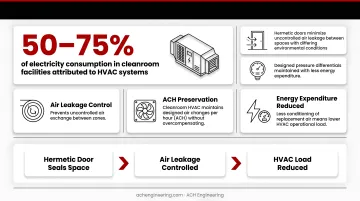
Hermetic doors minimize air leakage between spaces with different environmental conditions, reducing the load on HVAC systems that must continuously condition replacement air. HVAC systems typically account for 50-75% of electricity consumption in cleanroom facilities, making air leakage control a vital energy-saving strategy.
By preventing uncontrolled air exchange, cleanroom HVAC systems maintain designed pressure differentials and air changes per hour (ACH) with less energy expenditure. The airtight seal reduces the volume of conditioned air lost during door operations compared to standard cleanroom doors with gaps—a single standard door with a 0.5 mm gap can leak 0.3 m³/h at 15 Pa pressure differential.
Lower operational costs result from reduced energy consumption for heating, cooling, humidification, and HEPA filtration of makeup air. HVAC equipment lifespan extends through reduced runtime and system stress. Conditioning outdoor makeup air to replace leaked air can consume more than half of a cleanroom HVAC system's electricity.
Performance comparison across door types:
| Door Type | Leakage Rate | Impact |
|---|---|---|
| Standard Cleanroom Door (0.5 mm gap) | 0.3 m³/h @ 15 Pa | Disrupts localized airflow; increases HVAC load |
| Hermetic Sliding Door | >99% Sealing Efficiency | Maintains pressure; reduces cross-contamination |
| Inflatable Seal Door | 0.01 m³/h @ 50 Pa | Approaches "zero leakage" for high-risk zones |
These efficiency gains support sustainability goals, operational budget management, and the ability to scale cleanroom operations without proportional increases in utility costs.
Measurable metrics include:
- Energy consumption (kWh)
- HVAC operational costs
- Carbon footprint
- Air leakage rate (CFM)
- Makeup air volume requirements
- HEPA filter replacement frequency
Highest impact occurs in large cleanroom facilities with significant conditioned space, climate-controlled environments requiring precise temperature/humidity control, facilities with high door traffic volume, cleanrooms with extreme environmental differentials (e.g., battery dry rooms with very low humidity), and facilities where energy costs represent substantial operational expenses.
Pressure Differential Maintenance and Zone Integrity
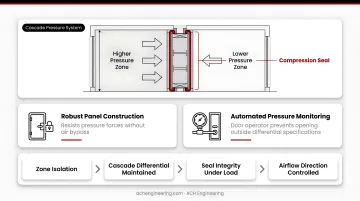
Hermetic doors are designed to maintain designed pressure differentials between adjacent spaces, supporting cascade pressure systems that prevent airflow from less clean to cleaner areas. The compression seal and robust door panel construction resist pressure forces without allowing air bypass.
Automatic door operators can be integrated with pressure monitoring systems to prevent door opening when pressure differentials are outside specifications.
The hermetic seal maintains zone separation even when HVAC systems experience temporary fluctuations, ensuring continuous environmental control.
Maintaining pressure differentials is fundamental to cleanroom design and regulatory compliance. Pressure cascades ensure directional airflow that protects critical zones, prevents cross-contamination during material/personnel transfer, and demonstrates environmental control during regulatory inspections and cleanroom certification.
The revised EU GMP Annex 1 (2022) requires a minimum air pressure difference of 10 Pascals between adjacent rooms of different grades. For standard cascades (e.g., Grade C to D), a total differential of at least 15 Pa is often required, distributed as 7.5 Pa across each door of an airlock.
Research shows that higher pressure differentials, supported by effective sealing, result in significantly shorter times for positive pressure to recover after door operation.
The FDA has issued Warning Letters for facilities where pressure differentials were not maintained or continuously monitored, citing insufficient separation between manufacturing and storage areas. Proper hermetic door sealing is essential for avoiding such regulatory findings.
Critical performance indicators:
- Pressure differential stability (Pascals)
- Pressure recovery time after door operation
- Cleanroom validation test results
- Regulatory inspection outcomes
- Cross-contamination incident rates
Critical applications include pharmaceutical manufacturing facilities subject to FDA/EMA inspection, multi-zone cleanroom layouts with different ISO classifications, isolation and containment applications (e.g., high-potency API manufacturing), hospital pharmacy compounding cleanrooms, and any facility where regulatory guidance mandates documented pressure control.
What Happens When Hermetic Doors Are Missing or Compromised
When hermetic sealing is inadequate or standard doors are used instead, cleanroom operations face serious consequences that directly impact compliance, costs, and product quality:
Classification failures during recertification testing occur when excessive particle infiltration prevents facilities from meeting ISO 14644-1 limits. Failures require costly remediation and production delays.
HVAC systems work overtime to compensate for air leakage, increasing energy consumption by 20-40%. Uncontrolled leakage forces frequent cycling, accelerating wear on fans and motors.
Product batch failures from contamination events cost over $100,000 per sterile batch, plus investigation burden and potential regulatory citations during inspections.
Pressure differential losses create cross-contamination pathways between zones. FDA Warning Letters frequently cite inadequate door sealing for failed aseptic simulations.
Environmental monitoring excursions become routine issues. Investigators have identified aging door gaskets as root causes of persistent particle exceedances in Grade C cleanrooms.
These failures compound over time, transforming minor sealing defects into major compliance and financial liabilities.
How to Maximize Value from Hermetic Doors in Cleanrooms
Hermetic doors deliver maximum value when integrated as part of a comprehensive cleanroom design. This includes strategic door placement, seal material selection appropriate for the chemical environment, and coordination with HVAC pressure control systems.
Critical success factors include:
- Proper installation with correct frame alignment and seal compression—even high-quality hermetic doors will underperform if installation tolerances are not met
- Regular preventive maintenance including seal inspection and replacement according to manufacturer schedules (typically 2-5 years depending on cycle frequency)
- Performance validation that door performance meets design specifications through smoke studies or pressure decay testing
- Integration with building automation to coordinate door operation with HVAC systems and access control
Achieving these outcomes requires partnering with the right team.
For facilities planning cleanroom construction or upgrades, working with experienced controlled environment specialists ensures optimal long-term performance and compliance. These specialists understand how hermetic doors integrate with modular cleanroom panels, HVAC systems, and building automation.
Companies like ACH Engineering provide turnkey cleanroom solutions across North America, offering flush design cleanroom doors as part of their GMP-compliant modular systems, backed by comprehensive engineering services and validation support.
Frequently Asked Questions
What are hermetic doors?
Hermetic doors are airtight doors with specialized compression seals (typically neoprene or silicone) that prevent air and particle transfer. They're designed for cleanrooms where maintaining pressure differentials and contamination control is critical.
What are the different types of cleanroom doors?
Main types include standard hinged doors, hermetic hinged doors (airtight seal), hermetic sliding doors (space-saving with seal), and roll-up doors (material transfer). Hermetic versions offer superior contamination control and pressure maintenance.
What are the advantages of automatic sliding hermetic doors in cleanrooms?
Automatic sliding hermetic doors eliminate manual contact, save floor space in compact layouts, and ensure consistent seal compression through automated closing. They integrate with access control systems and minimize air exchange through optimized opening/closing speeds.
How do hermetic doors help maintain cleanroom classification?
Hermetic doors prevent particle infiltration and maintain pressure differentials required by ISO 14644 standards. The airtight seals eliminate gaps where submicron particles could migrate, directly supporting compliance with particle count limits for each ISO class.
What is the typical lifespan of hermetic door seals?
Seal lifespan varies based on door cycle frequency and environmental factors but typically ranges from 2-5 years. Some high-performance automatic door bottom seals are rated for 5 million cycles. Regular inspection and timely seal replacement is critical to maintaining hermetic performance and cleanroom integrity.
Can hermetic doors be retrofitted into existing cleanrooms?
Hermetic doors can often be retrofitted into existing cleanroom openings, though proper evaluation of frame compatibility, structural support, and HVAC integration is essential. Professional assessment ensures the retrofit achieves intended sealing performance and regulatory compliance.
How much do hermetic doors cost compared to standard cleanroom doors?
Hermetic doors typically cost 40-80% more than standard cleanroom doors initially, with hermetic sliding doors often 3-5 times more expensive than basic systems. However, this premium is offset by energy savings (reducing HVAC costs that represent 50-75% of cleanroom electricity), reduced contamination risk, and lower total cost of ownership over the door's operational life.