Introduction
Choose the wrong cleanroom wall system and you may face contamination events, failed audits, or a costly mid-project rebuild. The choice between hardwall and softwall construction shapes everything downstream: ISO classification achievability, maintenance burden, scalability, and capital cost.
The cleanroom technology market is projected to grow from $10.04 billion USD in 2025 to $14.88 billion USD by 2031, driven by tightening regulatory standards across pharma, biotech, and medical device manufacturing. Yet facilities still get it wrong — receiving regulatory citations for lacking "easily cleanable surfaces" or discovering their softwall setup can't hold the ISO classification their process requires.
Many of those problems trace back to a single early-stage decision made without a full picture of what each system can and cannot do.
This guide breaks down hardwall vs. softwall cleanrooms across construction, cost, cleanliness classification, regulatory compliance, and long-term flexibility — so you can match the right system to your actual requirements before a single panel gets installed.
Key Takeaways
- Hardwall cleanrooms use rigid panel construction to meet ISO Class 1-8 requirements — the go-to for heavily regulated industries
- Softwall cleanrooms deploy faster with flexible vinyl curtains and lower upfront costs, suited for ISO Class 5-9 applications
- Key decision factors: regulatory requirements, budget, installation timeline, and future expansion plans
- Hardwall systems account for the majority of the market due to structural integrity and easier regulatory validation; softwall options can reduce initial costs by 40-60%
Hardwall vs Softwall Cleanrooms: Quick Comparison
| Feature | Hardwall Cleanroom | Softwall Cleanroom |
|---|---|---|
| Initial Cost | Higher upfront investment due to rigid materials and complex installation | Lower initial cost—typically 40-60% less than hardwall alternatives |
| Durability & Lifespan | Permanent structure designed for long-term use (15-20+ years) | Moderate durability (5-10 years); vinyl curtains require periodic replacement |
| ISO Classification | Achieves ISO Class 1-8 with superior particle control | Typically suitable for ISO Class 5-9; challenging for stricter classifications |
| Installation Timeline | 4-12 weeks depending on size and complexity | 1-4 weeks; some systems deployable within hours |
| Customization | Highly customizable with various panel materials, finishes, and integrated systems | Limited customization but easily expandable and reconfigurable |
| Maintenance | Lower maintenance; non-porous surfaces prevent contamination and simplify cleaning | Higher maintenance; curtains require regular inspection and replacement |
| Pressure Control | Maintains stable positive or negative pressure differentials | Difficulties maintaining strict pressurization due to flexible walls |
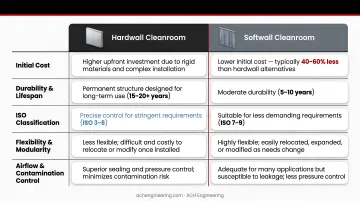
Hardwall systems suit permanent, high-compliance operations; softwall systems work best where speed, budget, and flexibility take priority over stringent classification requirements.
What is a Hardwall Cleanroom?
Hardwall cleanrooms are controlled environments constructed with rigid, non-flexible wall panels made from materials such as stainless steel, powder-coated steel, acrylic, aluminum, or high-density polyethylene (HDPE). These panels are prefabricated offsite in controlled manufacturing conditions and assembled onsite, creating permanent, stable environments that deliver superior contamination control.
Despite their rigid structure, hardwall cleanrooms use modular construction approaches that allow for demountability and relocation when needed. This methodology combines the durability of permanent construction with the flexibility of prefabricated systems — a practical advantage for facilities planning long-term controlled environments.
The core benefits of hardwall cleanrooms directly impact operational performance. They provide superior environmental control over temperature, humidity, and pressure, while non-porous surfaces minimize particle generation and facilitate thorough cleaning. The structural integrity supports heavy equipment mounting and ceiling-mounted HVAC systems, and the robust construction simplifies validation for regulatory compliance—a critical advantage for FDA-regulated industries.
Key Advantages of Hardwall Cleanrooms
Structural Stability and Durability
Rigid panels withstand physical impact, maintain dimensional stability over decades, and support ceiling-mounted equipment without sagging or deformation. The solid construction handles the weight of complex HVAC systems, fan filter units (FFUs), and integrated utilities that would be impossible to mount on flexible walls.
That structural integrity ensures consistent performance throughout the facility's lifespan — typically 15–20+ years with minimal degradation.
Superior Contamination Control
Non-porous, seamless surfaces prevent particle shedding, resist microbial growth, and facilitate the thorough cleaning protocols required for ISO Class 3-5 environments. Surface roughness (Ra) for pharmaceutical applications typically achieves ≤0.5 µm, with electropolishing reaching ≤0.1 µm for critical sterile areas. An operational ISO Class 5 hardwall facility recorded average particle counts of 1,835 particles/m³ (0.5 µm)—well within the ISO limit of 3,520 particles/m³—demonstrating the robust control these systems provide.
Customization Capabilities
Hardwall cleanrooms offer extensive customization options:
- Wall finishes: Stainless steel for pharmaceutical applications, powder-coated steel for electronics manufacturing
- Integrated services: Electrical, gas, and vacuum systems built into wall panels
- Vision panels: Crystal-clear transparent panels for visibility and supervision
- Specialized features: Pass-throughs, air showers, and seamless coving for cGMP compliance
Long-Term Value Proposition
While hardwall cleanrooms require higher initial investment, lifecycle cost analysis shows favorable total cost of ownership (TCO):
| Cost Component | Amount |
|---|---|
| Initial investment (500 sq. ft. @ $150/sq. ft.) | $75,000 |
| Annual operating costs | $25,000/yr |
| 5-year total cost | $200,000 |
Durability, energy efficiency through recirculating HVAC systems, and reduced maintenance translate to lower operational expenditure over the facility's lifespan.
Industries and Applications for Hardwall Cleanrooms
Pharmaceutical and Biotechnology Manufacturing
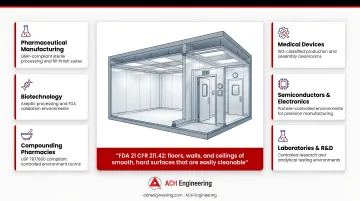
GMP compliance, sterile processing, and FDA validation requirements all require hardwall construction for production areas, fill-finish suites, and aseptic processing. FDA 21 CFR 211.42 explicitly mandates that aseptic processing facilities have "floors, walls, and ceilings of smooth, hard surfaces that are easily cleanable" — a standard hardwall systems are built to meet.
Non-porous surfaces and superior sealing prevent contamination that could compromise product sterility and patient safety.
Medical Device Manufacturing
Class II and Class III device production requires hardwall cleanrooms to meet ISO 13485 and FDA 21 CFR Part 820 standards. Maintaining ISO Class 5–7 environments consistently ensures devices meet quality requirements and avoids contamination that could trigger recalls or regulatory action.
Real-World Effectiveness
A pharmaceutical manufacturer facing door maintenance issues and contamination risks installed specialized hardwall cleanroom doors that maintained full seals under negative pressure. This eliminated repair costs and restored FDA compliance — a direct example of how hardwall construction prevents the contamination events that lead to batch rejections. Industry data indicates modular hardwall systems now account for over 56% of the cleanroom market, reflecting their recognized reliability for regulatory validation.
What is a Softwall Cleanroom?
Softwall cleanrooms (also called portable or flexible cleanrooms) are controlled environments featuring flexible, transparent vinyl curtains or strips instead of rigid walls. These curtains are typically mounted on aluminum or steel frames, often with caster wheels for mobility, creating adaptable contamination control solutions.
Softwall cleanrooms suit industries needing temporary contamination control, rapid deployment for seasonal production increases, R&D projects with changing layouts, or budget-constrained operations. They provide accessible cleanroom technology for organizations that cannot justify the capital investment of permanent hardwall construction but still require controlled environments for quality production.
Core benefits include significantly lower capital investment—often 40–60% less than hardwall alternatives—rapid installation and commissioning (days instead of weeks), easy reconfiguration as processes change, and minimal facility modifications required. This makes softwall cleanrooms a practical fit for startups, research facilities, and organizations testing processes before committing to permanent infrastructure.
Key Advantages of Softwall Cleanrooms
Softwall designs deliver four practical advantages over permanent construction:
- Lower upfront cost: Simple design, fewer materials, and faster installation reduce capital expenditure by 40–60% compared to hardwall alternatives — making cleanroom technology accessible to startups and smaller operations
- Fast deployment: Prefabricated curtain systems and modular frames allow installation in 1–4 weeks; some portable units are operational within hours for emergency needs
- Easy reconfiguration: Vinyl curtains move, expand, or condense without major reconstruction — useful when equipment layouts change or production volumes shift
- Minimal facility impact: Lightweight construction works with existing HVAC or portable filtration units, requiring little structural modification and no major footprint changes
Industries and Applications for Softwall Cleanrooms
Research and Development Laboratories
R&D environments benefit from softwall flexibility when testing new processes, prototyping products, or conducting experiments requiring contamination control without permanent facility modifications. When research protocols shift, spaces can be reconfigured within a day rather than a week — keeping project timelines intact.
Electronics Assembly and Testing
Component assembly, PCB manufacturing, and quality control testing where ISO Class 5-9 cleanliness is sufficient often use softwall cleanrooms. Production lines that frequently change or require temporary contamination control benefit from the rapid deployment and reconfiguration capabilities these systems provide.
Practical Application Example
Electronics manufacturers commonly deploy softwall cleanrooms for short-term projects or to scale production during peak seasons while maintaining quality standards. The rapid installation timeline allows them to respond quickly to market demands without the extended downtime associated with permanent cleanroom construction. That said, softwall systems use single-pass airflow, which limits precision environmental control — a trade-off worth weighing against their speed and cost advantages.
Hardwall vs Softwall: Which is Better for Your Application?
The "better" choice depends entirely on matching cleanroom characteristics to your specific operational requirements. Several critical decision factors determine which system best serves your needs.
Critical Decision Factors
Regulatory Requirements and ISO Classification Needs
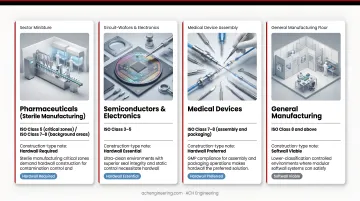
- Pharmaceuticals (sterile manufacturing) typically require ISO Class 5 for critical zones and ISO Class 7/8 for background areas—necessitating hardwall construction
- Semiconductors demand ultra-clean environments, often ISO Class 3-5, requiring the superior seal and static control of hardwall systems
- Medical devices often require ISO Class 7-8 for assembly and packaging, where hardwall is preferred for GMP compliance
- General manufacturing/R&D commonly operates at ISO Class 7-8, where softwall solutions work well
Budget Allocation
Consider both initial investment and lifecycle costs. Softwall cleanrooms reduce upfront capital expenditure by 40-60%, but hardwall systems may deliver lower total cost of ownership over 15-20 years through reduced maintenance, better energy efficiency, and longer lifespan.
When calculating payback periods, factor in your specific revenue context. For example, a $500,000 CAD cleanroom investment that enables $1 million CAD in annual gross profit produces a payback period of roughly 6 months and an annual ROI of 200% — making upfront cost a secondary concern at that scale.
Facility Constraints
- Space limitations and existing infrastructure
- Structural load-bearing capacity for equipment mounting
- Expansion plans and future scalability needs
- Ability to make permanent facility modifications
Project Timeline and Urgency
Softwall cleanrooms can be operational in 1-4 weeks (some within hours), while hardwall systems typically require 4-12 weeks depending on size and complexity. If rapid deployment is critical for market entry or seasonal production, softwall may be the only viable option despite potential limitations.
These factors rarely point in a single direction on their own. The clearest path forward comes from mapping each one against your industry's compliance requirements and operational priorities.
Situational Recommendations
Choose Hardwall Cleanrooms If:
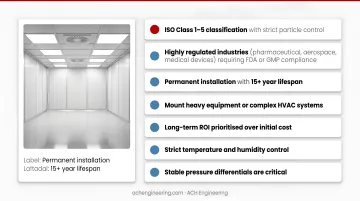
- You need ISO Class 1-5 classification with strict particle control
- You operate in highly regulated industries (pharmaceutical, aerospace, medical devices) requiring FDA or GMP compliance
- You require permanent installation with 15+ year lifespan
- You need to mount heavy equipment or complex HVAC systems
- You prioritize long-term ROI over initial cost
- Strict temperature and humidity control is essential
- Maintaining stable pressure differentials is critical
Choose Softwall Cleanrooms If:
- You need ISO Class 5-9 classification
- You have budget constraints or are a startup/small operation
- You require rapid deployment for temporary or seasonal production
- You anticipate frequent layout changes or facility relocation
- You need to test processes before committing to permanent infrastructure
- Strict environmental control is not critical
- Visibility throughout the cleanroom is important
Real World Applications and Industry Insights
Consider a pharmaceutical manufacturer planning a new sterile manufacturing suite — facing the challenge of balancing FDA compliance requirements with budget constraints and an aggressive launch timeline. The company needed to achieve ISO Class 5 for aseptic filling operations while managing capital expenditure.
Four factors drove the decision toward hardwall construction:
- ISO Class 5 contamination control required the superior sealing and non-porous surfaces hardwall provides
- 15-20 year facility lifespan made the lifecycle cost analysis favor hardwall despite higher upfront investment
- FDA 21 CFR 211.42 explicitly mandated smooth, easily cleanable surfaces for validation and qualification
- 20-year total cost of ownership — accounting for maintenance, energy efficiency, and regulatory risk — reinforced the hardwall case
The manufacturer selected hardwall construction, and the results justified the decision. Measured outcomes included:
- Particle counts held at 52% of the ISO Class 5 limit (1,835 vs. 3,520 particles/m³)
- FDA inspection passed on first audit with zero citations for construction materials or cleaning capability
- Post-contamination recovery averaged 25 minutes back to baseline, minimizing production downtime
ACH Engineering's turnkey cleanroom approach — spanning initial design through installation and validation — helps clients work through decisions like these by matching construction type to process requirements, regulatory obligations, and operational timelines.
The right cleanroom choice comes down to matching construction type to your specific requirements — not defaulting to one format. A partner who understands both the technical specs and the regulatory context will get you to a defensible, validated facility faster than starting from a generic template.
Conclusion
Neither hardwall nor softwall cleanrooms are universally "better"—the right choice depends on your industry requirements, ISO classification needs, budget, timeline, and long-term operational goals. Hardwall solutions excel in highly regulated, permanent installations requiring maximum contamination control and ISO Class 1-8 capabilities. Softwall options deliver cost-effective flexibility for ISO Class 5-9 applications or temporary needs.
Your cleanroom choice has real downstream consequences across four areas:
- Product quality — contamination rates and batch success
- Operational efficiency — maintenance downtime and energy costs
- Regulatory compliance — audit readiness and validation ease
- Financial performance — upfront investment, lifecycle costs, and ROI
Evaluating your application against the factors covered in this guide—durability requirements, cleanliness standards, customization needs, pressure control, and future scalability—positions you to make a decision that serves both immediate production needs and long-term growth.
The cleanroom technology market is projected to reach $14.88 billion by 2031—a figure that signals just how critical controlled environments have become to modern manufacturing and compliance. Whatever direction you go, working with a provider who handles cleanroom design and build under one roof reduces risk and speeds up validation. ACH Engineering offers exactly that: tailored cleanroom solutions built around your process requirements, managed end-to-end from concept through commissioning.
Frequently Asked Questions
What is the typical cost difference between hardwall and softwall cleanrooms?
Softwall cleanrooms typically cost 40-60% less initially than hardwall solutions due to simpler materials and faster installation. However, consider total lifecycle costs including maintenance, energy efficiency, and lifespan—hardwall systems often deliver lower total cost of ownership over 15-20 years despite higher upfront investment.
How long does it take to install a hardwall versus a softwall cleanroom?
Softwall cleanrooms can be installed in 1-4 weeks (some operational within hours), while hardwall cleanrooms typically require 4-12 weeks depending on size and complexity. The longer hardwall installation timeline is offset by extended lifespan (15-20+ years) and lower maintenance requirements.
Can softwall cleanrooms achieve the same ISO classifications as hardwall cleanrooms?
Softwall cleanrooms typically achieve ISO Class 5-9, while hardwall cleanrooms can consistently maintain stricter classifications (ISO Class 1-8) due to superior sealing, non-porous surfaces, and better environmental control. The flexible vinyl curtain construction in softwall systems makes consistent room pressurization difficult to sustain.
Which cleanroom type is better for pharmaceutical manufacturing?
Pharmaceutical manufacturing typically requires hardwall cleanrooms. Health Canada and FDA GMP regulations both mandate smooth, non-porous, easily cleanable surfaces — and sterile processing generally requires ISO Class 5 or better. Softwall systems may work for R&D or non-sterile applications, but rarely meet full-scale production validation requirements.
Are hardwall cleanrooms more energy-efficient than softwall cleanrooms?
Yes. Hardwall cleanrooms offer better energy efficiency due to superior insulation, tighter seals, and more precise environmental control. This translates to lower HVAC operating costs over the facility's lifespan compared to softwall alternatives.
Can I upgrade from a softwall to a hardwall cleanroom later?
Softwall and hardwall cleanrooms are distinct systems with different structural foundations. Many companies start with softwall for initial operations or R&D, then invest in separate hardwall construction for full-scale production as their business grows and requirements become more stringent. Modular hardwall systems support phased expansion and reconfiguration, making them a practical choice when longer-term growth is anticipated.