Introduction
Selecting the right cleanroom classification directly impacts product quality, regulatory compliance, and operational costs. For pharmaceutical manufacturers, medical device producers, and biotech facilities, the choice between ISO Class 7 and ISO Class 8 environments determines not just particle control, but the viability of entire production lines and the safety of end products.
These two classifications are the most common controlled environments in North American manufacturing: ISO 8 cleanrooms captured 29% of the market in 2024, while ISO 7 facilities held 23%.
That split reflects a deliberate division of purpose. ISO 8 serves broader packaging and support needs, while ISO 7 provides the tightly controlled background environment required for sterile processing and sensitive medical device assembly.
Key Takeaways
- ISO Class 8 allows 3,520,000 particles (≥0.5 µm) per cubic meter with 10-25 air changes per hour
- ISO Class 7 caps at 352,000 particles (≥0.5 µm) per cubic meter with 30-60 air changes per hour — 10x stricter than Class 8
- Class 8 covers non-sterile pharmaceutical packaging and components with external patient contact
- Class 7 is required for sterile compounding, surgical equipment, and products contacting sensitive patient areas
- Class 7 costs 30-50% more to build and operate than Class 8
ISO Class 7 vs Class 8: Quick Comparison
| Aspect | ISO Class 8 | ISO Class 7 |
|---|---|---|
| Particle Count (≥0.5 µm) | 3,520,000 particles/m³ | 352,000 particles/m³ |
| Particle Count (≥1.0 µm) | 832,000 particles/m³ | 83,200 particles/m³ |
| Air Changes Per Hour | 10-25 ACH | 30-60 ACH |
| Airlock Requirements | Can enter directly from unclassified space | Requires ISO 8 ante-room |
| Build Cost (Modular) | $75-$250/sq ft | $120-$350/sq ft |
| Build Cost (Stick-Built) | $200-$450/sq ft | $250-$500/sq ft |
| HEPA Coverage | 5-15% ceiling coverage | 15-25% ceiling coverage |
| Typical Applications | Non-sterile packaging, equipment cleaning | Sterile compounding, aseptic background zones |
Particle Count Comparison
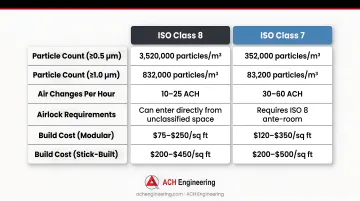
ISO Class 8 permits a maximum of 3,520,000 particles per cubic meter for particles ≥0.5 µm and 832,000 particles/m³ for particles ≥1.0 µm. ISO Class 7 reduces those limits to 352,000 particles/m³ (≥0.5 µm) and 83,200 particles/m³ (≥1.0 µm), a 10-fold tightening across both particle sizes.
Air Changes Per Hour Comparison
ISO Class 8 environments typically operate with 10-25 air changes per hour using non-unidirectional airflow patterns. ISO Class 7 requires 30-60 ACH to achieve the necessary particle removal rate, which typically requires 2–3× the HVAC capacity and drives noticeably higher energy costs.
Airlock and Gowning Requirements
ISO Class 8 cleanrooms can be entered directly from unclassified spaces, though a gowning room is recommended depending on the process. ISO Class 7 environments require an ISO Class 8 airlock or ante-room to maintain proper cascading pressure differentials, typically 10-15 Pascals between adjacent zones.
HVAC and Filter Requirements
ISO Class 8 facilities use standard HEPA filtration (99.97% efficiency at 0.3 µm) with moderate air velocity and 5-15% ceiling coverage. ISO Class 7 demands enhanced HEPA filtration with higher air velocity and more frequent filter replacements. Key differences include:
- Ceiling HEPA coverage: 15-25% (vs. 5-15% for Class 8)
- Filter replacement frequency: Higher turnover to sustain stricter particle limits
- Air velocity: Elevated to support the 30-60 ACH requirement
What is an ISO Class 8 Cleanroom?
ISO Class 8 cleanrooms—formerly known as Class 100,000 under Federal Standard 209E—permit maximum particle concentrations of 3,520,000 particles per cubic meter for particles ≥0.5 µm, as defined by ISO 14644-1:2015. These environments provide cost-effective contamination control for applications where products have external patient contact or will undergo further processing in higher-grade rooms.
The air filtration system requires HEPA filters that remove 99.97% of particles ≥0.3 microns, with 10–25 air changes per hour to maintain classification. This moderate airflow rate balances particle control with energy efficiency, making ISO 8 the most economical cleanroom option for many manufacturing operations.
Standard construction features include:
- Non-particle-shedding wall panels with sealed joints
- Epoxy or vinyl flooring with coved transitions to walls
- Easily cleanable surfaces that resist microbial growth
- Flush-mounted fixtures to minimize particle traps
- Controlled temperature (18–25°C) and humidity (30–65% RH)
Maintaining ISO 8 classification requires ongoing monitoring across several areas:
- Particle counting per ISO 14644-2 at scheduled intervals
- Pressure differential monitoring (minimum 5 Pa positive pressure)
- HEPA filter integrity testing annually or after maintenance
- Pre-filter replacement every 3–6 months to extend HEPA life
- Surface sampling and environmental monitoring based on process risk
Use Cases of ISO Class 8 Cleanrooms
ISO 8 suits processes where products have external patient contact in non-sensitive areas or will move to higher-grade rooms for final sterile assembly. Common applications include:
- Non-sterile pharmaceutical packaging and labeling operations
- Orthopedic device component manufacturing
- Medical device assembly for products with external patient contact
- Electronics manufacturing and semiconductor support areas
- Equipment cleaning and preparation zones
A typical example is a pharmaceutical contract packaging line: pill packaging doesn't require sterile conditions, but particle control during filling and labeling is still a regulatory requirement. ISO 8 delivers that control at a lower construction and operating cost than Class 7 or above.
What is an ISO Class 7 Cleanroom?
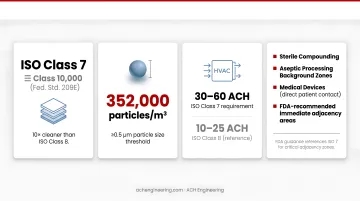
ISO Class 7 cleanrooms—equivalent to Class 10,000 under Federal Standard 209E—are 10 times cleaner than Class 8, with maximum particle concentrations of 352,000 particles/m³ (≥0.5 µm). This stricter standard is essential for sterile compounding, aseptic processing background zones, and medical devices with direct sensitive-area patient contact.
Enhanced HVAC requirements include 30-60 air changes per hour, compared to ISO 8's 10-25 ACH. The FDA recommends ISO 7 standards for areas immediately adjacent to aseptic processing lines, and facilities must maintain cascading pressure differentials of 10-15 Pascals from ISO 7 zones to adjacent ISO 8 ante-rooms.
Gowning protocols are correspondingly stricter:
- Single or two-piece trouser suits with high necks
- Complete hair and beard coverage
- Dedicated cleanroom shoes or overshoes
- Sterile gloves for direct product contact
- Gowning qualification and annual retraining
Environmental monitoring requirements include:
- Continuous particle counting during production shifts
- Temperature control within ±1°C (±2°F)
- Humidity control within ±5% RH (typically 30-60%)
- Real-time pressure differential monitoring with alarm systems
- Comprehensive documentation of all environmental parameters
These monitoring demands reflect the range of high-risk applications ISO 7 is built to support.
Use Cases of ISO Class 7 Cleanrooms
Primary applications requiring ISO 7:
- USP <797> sterile compounding pharmacy buffer rooms
- Surgical instrument and implantable device manufacturing
- Advanced wound dressings and drug-eluting medical devices
- Diagnostic equipment assembly for invasive procedures
- Cell and gene therapy production facilities
These applications share a common thread: direct patient contact or biological materials that leave no margin for contamination error. Sterile compounding pharmacies, for example, must use ISO 7 buffer rooms under USP <797> regulations — the controlled environment prevents microbial contamination that can cause life-threatening infections in immunocompromised patients.
The financial stakes reinforce the case. Pharmaceutical recalls cost $10–100 million on average, making proper ISO 7 infrastructure a risk mitigation investment, not just a compliance checkbox.
ISO Class 7 vs ISO Class 8: Which is Better for Your Application?
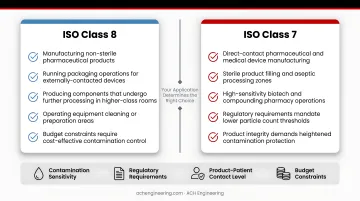
Neither classification is universally "better"—the right choice depends on product-patient contact level, regulatory requirements, contamination sensitivity, and budget constraints.
Choose ISO Class 8 if:
- Manufacturing non-sterile pharmaceutical products
- Running packaging operations for externally-contacted devices
- Producing components that undergo further processing in higher-class rooms
- Operating equipment cleaning or preparation areas
- Budget constraints require cost-effective contamination control
Choose ISO Class 7 if:
- Performing sterile compounding per USP <797> requirements
- Manufacturing products with direct sensitive-area patient contact
- Operating aseptic processing background zones per FDA guidance
- Producing implantable medical devices or surgical instruments
- Working with cell therapy or other biological materials
Cost-benefit considerations:
Class 7 runs 30-50% higher upfront (approximately USD $250–$500/sq ft stick-built vs. $200–$450/sq ft for Class 8), with ongoing operational costs elevated by increased HVAC energy demand — which accounts for 36-67% of total facility energy use. That premium, however, buys the compliance headroom that regulated products require.
The alternative is costly. Medical device recalls cost the industry up to $5 billion annually, and a single contamination event can wipe out $600 million in sales. Choosing the wrong classification isn't just a compliance gap — it's a financial exposure.
Real-World Applications and Case Studies
Compounding Pharmacy USP <797> Compliance
A hospital compounding pharmacy needed to upgrade from a non-classified space to meet USP <797> requirements for sterile preparation. They selected ISO Class 7 for the buffer room where sterile compounding occurs, with an ISO Class 8 ante-room for gowning and material staging. The regulatory driver was clear: USP <797> explicitly mandates ISO 7 buffer rooms for sterile compounding operations.
The cascading pressure differential (ISO 7 buffer room at +15 Pa relative to ISO 8 ante-room) prevented contaminated air from entering the critical preparation zone. Operational outcomes included reduced contamination risk, regulatory compliance that prevented potential closure, and improved workflow through proper material flow design.
Medical Device Manufacturer's Tiered Approach
A medical device manufacturer producing orthopedic implants implemented a tiered cleanroom strategy: ISO Class 8 for final packaging operations and ISO Class 7 for implant assembly and inspection. Matching environmental control to actual contamination risk drove measurable savings:
- Packaging area: 15 ACH vs. 45 ACH in the assembly zone
- HVAC capital costs reduced by approximately 35%
- Ongoing energy costs reduced by comparable margins
Packaged devices in sealed sterile barriers don't require the same particle control as open assembly operations. This let the facility concentrate ISO 7 resources where contamination risk is highest, while using cost-effective ISO 8 for lower-risk packaging work.
ACH Engineering's Modular Cleanroom Solution
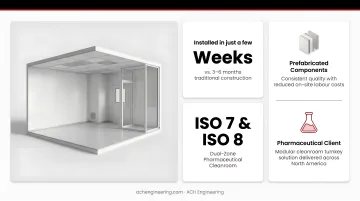
ACH Engineering recently delivered a modular cleanroom solution for a pharmaceutical client requiring both ISO 7 and ISO 8 zones, demonstrating the value of modular cleanroom devices and systems in real-world pharmaceutical applications. The modular approach provided installation in just a few weeks compared to 3-6 months for traditional construction, allowing the client to begin production faster. The prefabricated components ensured consistent quality and reduced on-site labor costs by approximately 40%.
That adaptability paid off six months later when the client needed to expand their ISO 7 zone. The modular panels were reconfigured without disrupting ongoing operations in adjacent areas — something traditional stick-built construction simply can't accommodate mid-production.
ACH Engineering provides cleanroom design and build, installation, and compliance support for ISO Class 7 and Class 8 cleanroom projects across North America. Reach out to the ACH team to discuss the right classification and configuration for your application.
Conclusion
The choice between ISO Class 7 and Class 8 depends on your specific application, regulatory requirements, and product-patient interaction level. Class 8 offers cost-effective contamination control for less-sensitive applications like non-sterile packaging and component manufacturing, while Class 7 provides the stringent environment necessary for sterile compounding, aseptic processing, and sensitive medical devices.
Before finalizing your classification, weigh these factors:
- Operational costs: The 30-50% construction premium and higher energy costs for ISO 7 are justified when contamination risks could result in recalls costing $10–100 million
- Compliance requirements: Regulatory mandates often determine your classification ceiling — especially in sterile compounding and aseptic processing
- Future expansion: Designing for a higher classification now can reduce costly retrofits later
Many facilities use both classifications in a tiered approach, investing in ISO 7 where contamination risk is highest and relying on ISO 8 for support areas.
Frequently Asked Questions
What is a Class 7 cleanroom?
ISO Class 7 is a controlled environment allowing a maximum of 352,000 particles (≥0.5 µm) per cubic meter. It is commonly used for sterile compounding and medical device manufacturing involving direct patient contact. The classification requires 30–60 air changes per hour and an ISO 8 ante-room to maintain proper pressure cascades.
What is a Class 8 cleanroom?
ISO Class 8 is a controlled environment allowing a maximum of 3,520,000 particles (≥0.5 µm) per cubic meter, typically used for pharmaceutical packaging and medical device components with external patient contact. It requires 10–25 air changes per hour and is the least expensive cleanroom classification to build and operate.
How much does it cost to build an ISO Class 7 vs Class 8 cleanroom?
ISO Class 8 modular cleanrooms cost $75–$250/sq ft, while stick-built options range from $200–$450/sq ft. ISO Class 7 facilities cost $120–$350/sq ft for modular and $250–$500/sq ft for stick-built construction—typically 30–50% more due to enhanced HVAC systems, increased air changes, and stricter construction requirements.
Can I upgrade an ISO Class 8 cleanroom to ISO Class 7?
Yes, upgrades are possible. Key changes include increasing air changes from 10–25 ACH to 30–60 ACH, expanding HEPA ceiling coverage from 5–15% to 15–25%, and adding an ISO 8 ante-room if not already present. A professional engineering assessment is required to confirm HVAC capacity, ductwork adequacy, and feasibility.
What industries require ISO Class 7 cleanrooms?
Pharmaceutical sterile compounding, medical device manufacturing (implants and surgical instruments), cell and gene therapy production, biotech research involving open sterile operations, and certain semiconductor applications all commonly require ISO Class 7 environments to meet regulatory standards and contamination control needs.
How do I maintain compliance in ISO Class 7 and Class 8 cleanrooms?
Compliance relies on five core practices: regular particle count testing per ISO 14644-2, scheduled HEPA filter replacements (annually or after maintenance events), continuous pressure differential monitoring with documented alarm responses, personnel gowning qualification, and thorough documentation of all environmental parameters and cleaning procedures.