Introduction: The Cost of Downtime in Manufacturing Facilities
Manufacturing downtime is one of the costliest pressures facing regulated industries. General industrial facilities lose an average of $260,000 per hour when production stops, while pharmaceutical operations can exceed £1 million per hour in losses.
Traditional cleanroom construction compounds the problem. Projects routinely halt operations for 6-12 months, generating opportunity costs that cascade across production schedules, revenue timelines, and customer commitments.
Instant cleanroom solutions address all three pressure points. These pre-designed systems compress deployment timelines from months to weeks, maintain full regulatory compliance, and are built for easy expansion or reconfiguration as your operation grows.
TLDR: Quick Takeaways on Instant Cleanroom Solutions
- Deploy operational cleanrooms in 8-16 weeks versus 6-12 months for traditional construction
- Achieve 50-70% reduction in on-site labor costs through prefabricated components
- Maintain full ISO Class 5-8 compliance with integrated HVAC and filtration systems
- Qualify for favourable CCA treatment as depreciable equipment rather than long-term building capital
- Suited for regulated industries including pharmaceutical, medical device, semiconductor, food & beverage, and laboratory environments
What Are Instant Cleanroom Solutions?
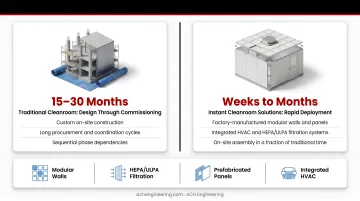
Instant cleanroom solutions are pre-designed, rapidly deployable controlled environments designed for quick installation without sacrificing quality or compliance. These systems use factory-manufactured components — modular walls, integrated HVAC systems, HEPA/ULPA filtration, and prefabricated panels — assembled on-site in a fraction of the time traditional construction requires.
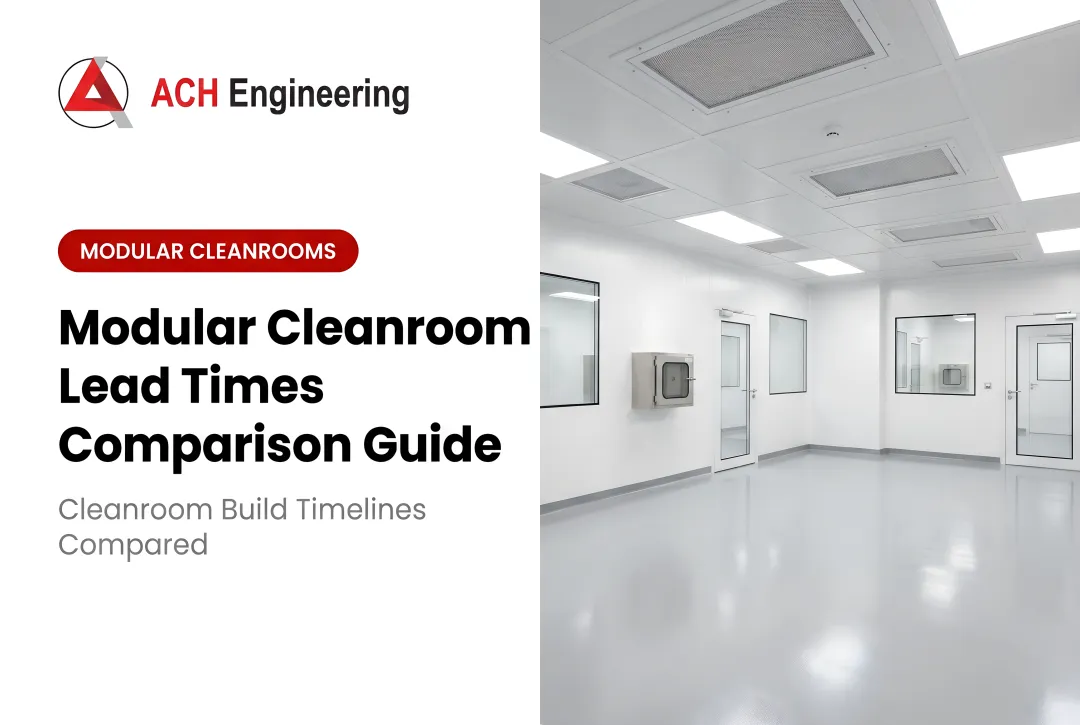
The timeline contrast is striking: traditional cleanroom projects require 15-30 months from design through commissioning, while modular systems deploy in 8-16 weeks. This acceleration stems from parallel processing — site preparation occurs simultaneously with off-site component fabrication.
Faster deployment doesn't mean lower standards. Instant solutions meet the same rigorous ISO 14644-1:2015 requirements as permanent builds:
ISO Classification Compliance
| ISO Class | Max Particles/m³ (≥0.5 µm) | Typical Application |
|---|---|---|
| ISO 5 | 3,520 | Aseptic filling, semiconductor lithography |
| ISO 6 | 35,200 | Sterile packaging, optics assembly |
| ISO 7 | 352,000 | Pharmacy compounding, medical device assembly |
| ISO 8 | 3,520,000 | General clean manufacturing, CNC machining |
Filtration systems use HEPA filters meeting EN 1822 standards, with H14 filters achieving 99.995% efficiency at the Most Penetrating Particle Size (MPPS). With proper maintenance, these systems reliably support 10+ years of continuous operation — making them a viable long-term infrastructure choice, not just a stopgap.
Types of Instant Cleanroom Solutions for Manufacturing
Instant cleanroom solutions come in three main configurations—each suited to different timelines, budgets, and classification requirements. Here's how they compare.
Modular Cleanrooms
Modular systems use pre-designed wall panels with standardized components that connect together using aluminum honeycomb or uPVC construction, offering durability and easy sanitization. Installation typically runs 2–12 weeks depending on size and complexity — an ISO 5 biologics filling suite was completed in 22 weeks using custom aluminum hardwall systems.
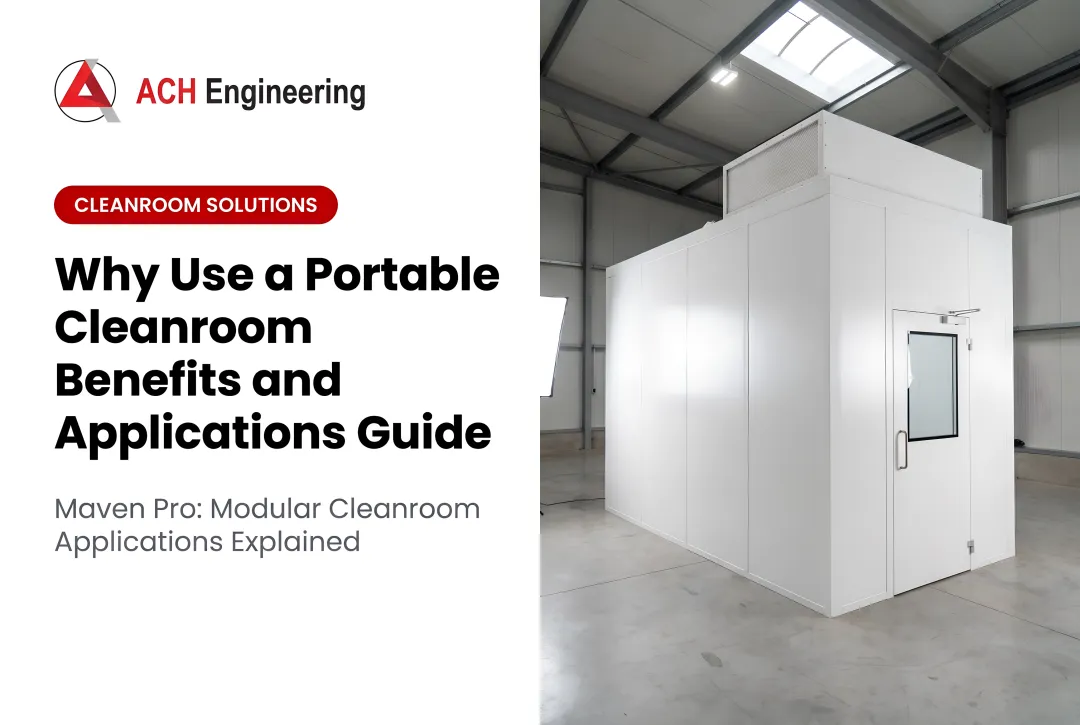
The modular design supports future expansion, layout changes, or complete relocation as your operation evolves. ACH Engineering offers turnkey modular solutions with prefabricated wall panels in standard and custom sizes, reconfigurable as your manufacturing needs change.
Mobile and Portable Cleanrooms
These trailer-based or skid-mounted cleanrooms arrive fully equipped and operational, requiring only utility connections.
Use cases:
- Temporary production capacity during facility renovations
- Equipment testing and validation
- Emergency capacity expansion
- Geographic expansion pilots
From delivery to operation takes 3–5 days, making them the practical choice for urgent needs or short-term projects.
Softwall and Inflatable Cleanrooms
For the fastest possible deployment, flexible curtain-based systems and inflatable beam structures are hard to beat.
Advantages:
- Same-day to 1-week setup
- Lowest initial capital investment
- High portability for frequently changing layouts
Limitations: Lower static pressure control compared to hardwall options, making them more suitable for ISO 7–8 classifications. They're also harder to clean and sanitize than solid panels, which rules them out for ISO 4–5 environments.
Key Benefits of Instant Cleanroom Solutions
Rapid Deployment and Minimal Downtime
Manufacturing facilities can maintain production during installation because fabrication happens off-site in controlled factory environments.
Timeline comparison:
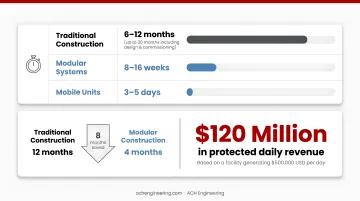
- Traditional construction: 6-12 months (up to 30 months with design/commissioning)
- Modular systems: 8-16 weeks
- Mobile units: 3-5 days
Revenue protection example: A facility generating $500,000 (USD) daily that chooses modular construction (4 months) over traditional (12 months) saves 8 months of downtime—protecting $120 million in revenue.
Significant Cost Savings
Modular construction reduces on-site labor by 50-70% compared to stick-built methods, thanks to factory efficiency, parallel workflows, and fewer weather-related delays.
Cost breakdown:
- Material costs: Comparable or slightly lower
- Labor costs: 50-70% reduction
- Waste reduction: Up to 90% less construction waste versus traditional methods
- Financing costs: Lower due to compressed timelines
Depreciation advantage: Modular cleanrooms often qualify as tangible personal property, allowing 7-year accelerated depreciation versus 39 years for traditional buildings—significantly improving Net Present Value.
Flexibility and Scalability
Modular components can be expanded, reconfigured, or relocated as business needs change — without the demolition costs or lost asset value that come with fixed construction.
Reconfiguration costs: Retrofitting a modular system costs 40-60% less than renovating traditional construction due to component reusability.
Capital preservation: Modular systems retain residual value through resale or rental options. Traditional cleanrooms are fixed assets with zero value if facilities relocate.
Energy Efficiency and Sustainability
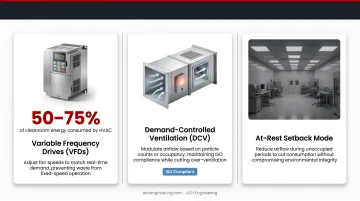
HVAC systems account for 50-75% of cleanroom energy consumption, making efficiency critical for both operational costs and sustainability goals.
Efficiency technologies:
- Adjust fan speeds to match real-time demand using Variable Frequency Drives (VFDs), preventing waste from fixed-speed operation
- Modulate airflow based on particle counts or occupancy with Demand-Controlled Ventilation (DCV), maintaining ISO compliance while cutting over-ventilation
- Reduce airflow during unoccupied "at-rest" periods per ISO 14644-16:2019 guidance, without compromising classification
Environmental impact: Prefabrication reduces embodied carbon by up to 54% compared to traditional methods, supporting corporate sustainability initiatives.
Maintained Compliance and Quality Standards
Instant cleanroom solutions meet the same ISO 14644 classifications and GMP requirements as traditional construction — the difference is how quickly you get there.
Pre-validation advantage: Modular units often undergo Factory Acceptance Testing (FAT) before shipment, verifying airflow, pressure differentials, and particle counts. This reduces on-site failure risk and accelerates Installation Qualification (IQ) and Operational Qualification (OQ) phases.
Monitoring requirements: ISO 14644-2:2015 mandates continuous monitoring of:
- Particle counts (continuous or periodic based on risk)
- Pressure differentials (maintaining positive pressure)
- Temperature and humidity (process stability and personnel comfort)
Because FAT is completed before delivery, on-site PQ timelines are typically compressed by weeks — reducing the gap between installation and production-ready status.
Industries and Applications That Benefit Most
Instant cleanroom solutions serve a wide range of regulated industries, each with distinct cleanliness standards and compliance requirements. Here's how the most common sectors apply them.
Pharmaceutical / Nutraceutical
- Applications: Sterile compounding, aseptic filling, packaging
- Requirements: ISO Class 5 (EU GMP Grade A) for critical zones; ISO Class 7/8 for background areas
- Compliance: EU GMP Annex 1, FDA cGMP
Biotechnology
- Applications: Cell and gene therapy (ATMPs), fermentation, biologics production
- Requirements: Segregated ISO Class 5 environments to prevent cross-contamination in autologous therapies
- Trend: Modular "pods" are increasingly deployed for rapid scale-out without major facility disruption
Medical Devices
- Applications: Assembly and packaging of sterile devices
- Requirements: Typically ISO Class 7 or 8
- Compliance: ISO 13485, FDA 21 CFR Part 820
Semiconductor / Electronics
- Applications: Wafer fabrication, lithography, assembly, testing
- Requirements: ISO Class 3–5 for nanometer-scale features — among the most stringent in any industry
- Key controls: Molecular contamination management and electrostatic discharge (ESD) mitigation
Aerospace
- Applications: Precision manufacturing, coating, component assembly
- Requirements: ISO Class 6–8 depending on component sensitivity
- Critical factors: Particle control for hydraulics, avionics, and propulsion systems
Beyond industry-specific builds, instant cleanrooms address operational challenges that cut across all sectors:
- Expand capacity quickly during demand surges without committing to permanent construction
- Test new product lines before full-scale capital investment
- Support R&D projects that need flexible, reconfigurable layouts
- Maintain production continuity during facility renovations
- Enter new markets with lower upfront risk through modular geographic expansion
Implementation Timeline and Process
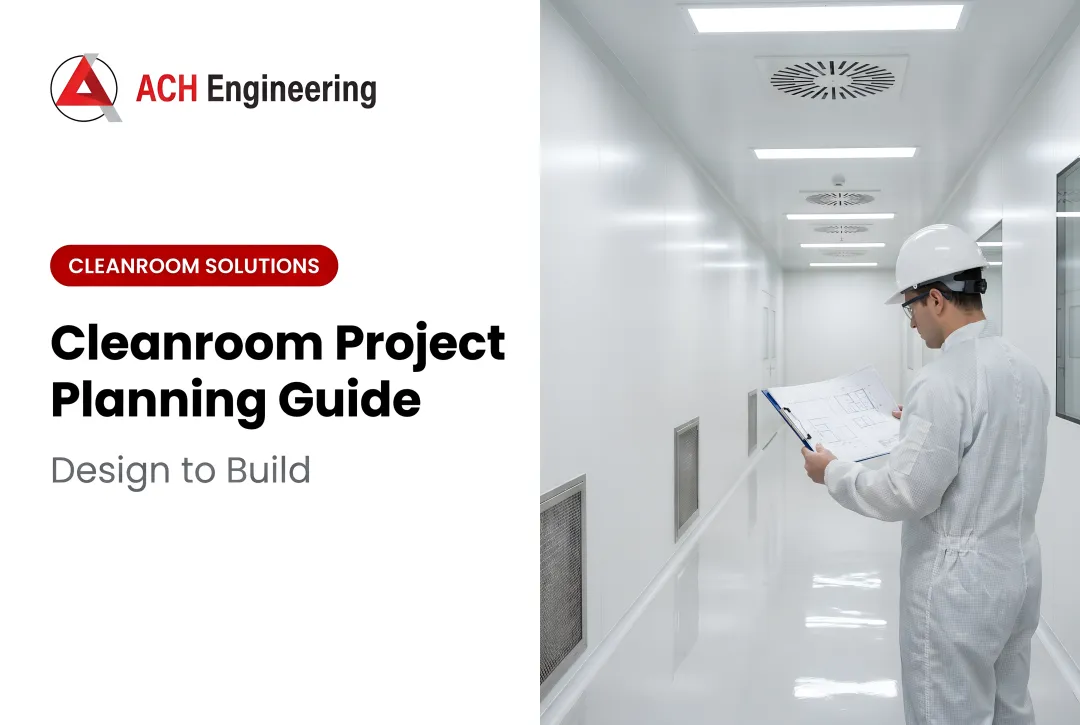
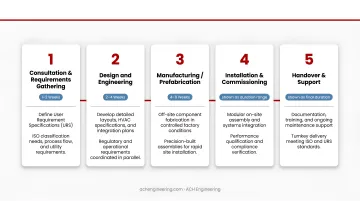
- Consultation & Requirements Gathering (1-2 weeks) — Define User Requirement Specifications (URS), ISO classification needs, process flow, and utility requirements.
- Design and Engineering (2-4 weeks) — Develop detailed layouts, HVAC specifications, and integration plans. ACH Engineering's project team coordinates regulatory and operational requirements in parallel, keeping this phase on schedule.
- Manufacturing/Prefabrication (4-8 weeks) — Off-site component fabrication in controlled factory environments. Use this window to complete site preparation — flooring, utilities, and structural modifications — so both tracks finish together.
- On-Site Installation (1-4 weeks) — Component assembly, utility connections, and system integration.
- Validation and Commissioning (1-2 weeks) — Execute IQ/OQ/PQ protocols and verify particle counts, pressure differentials, and environmental parameters.
Timeline variation factors:
- Cleanroom size and complexity
- Solution type (mobile units deploy faster than large modular systems)
- Customization requirements
- Site readiness and utility availability
Instant Cleanroom Solutions vs. Traditional Construction
The differences between instant (modular) cleanroom solutions and traditional construction go well beyond build time. Cost structure, operational flexibility, and long-term ownership economics all shift considerably depending on which path you choose.
| Factor | Instant Solutions | Traditional Construction |
|---|---|---|
| Timeline | 8–16 weeks | 6–12 months (up to 30 months) |
| Cost (USD) | $200–$400/sq ft | $400–$700/sq ft |
| Labor | 50–70% lower | Standard construction labor |
| Flexibility | Highly reconfigurable | Permanent, fixed layout |
| Disruption | Minimal (off-site fabrication) | Significant (on-site work) |
| Depreciation | 7-year accelerated | 39-year straight-line |
| Waste | 90% reduction | Standard construction waste |
When traditional construction makes sense:
- Permanent facilities with no anticipated changes over 20+ years
- Highly specialized custom geometries that don't fit modular standards
- Extremely large-scale projects (100,000+ sq ft) where modular logistics become complex
- Buildings requiring unique structural integration with existing architecture
For a 5,000 sq ft facility, the 10-year total cost of ownership for a modular system runs approximately $2.5M–$4M (USD) — compared to $4M–$6M for traditional construction. That gap reflects lower operational expenses, reduced reconfiguration costs, and the retained value of a layout you can actually change as your process evolves.
Frequently Asked Questions
How quickly can an instant cleanroom be operational in a manufacturing facility?
Mobile cleanrooms can be operational in 24-48 hours after delivery and utility connection. Softwall and inflatable systems typically require 1-2 weeks for complete installation. Modular hardwall systems take 2-12 weeks depending on size and complexity, typically 3-5x faster than traditional construction.
Do instant cleanrooms meet ISO 14644 cleanliness standards?
Yes. Properly designed instant cleanrooms achieve ISO Class 5-8 classifications with appropriate HVAC systems, HEPA/ULPA filtration, and continuous monitoring. They undergo the same validation processes (IQ/OQ/PQ) as traditional cleanrooms and must meet identical regulatory requirements.
What is the cost difference between instant and traditional cleanroom construction?
Instant solutions typically cost 30-50% less in total project costs due to reduced labor (50-70% lower), shorter timelines, prefabrication efficiencies, and minimized waste. Additional savings come from accelerated depreciation schedules and lower financing costs from compressed project duration.
Can instant cleanrooms be expanded or reconfigured later?
Modular systems are specifically designed for reconfiguration, expansion, and relocation. Components can be disassembled and reassembled in new configurations or entirely different locations. Retrofitting costs are 40-60% lower than renovating traditional construction, making modular systems ideal for growing or evolving operations.
What industries use instant cleanroom solutions most frequently?
Instant cleanrooms serve a wide range of regulated industries:
- Pharmaceutical and nutraceutical companies — sterile compounding and packaging
- Biotech firms — cell therapy and fermentation
- Medical device manufacturers — assembly and sterile packaging
- Semiconductor companies — fabrication and testing
- Aerospace manufacturers — precision component production
Are instant cleanrooms suitable for long-term use or only temporary needs?
Modern instant cleanrooms are designed for long-term operation (10+ years) with proper maintenance, not just temporary solutions. They use durable materials, professional-grade HVAC systems, and robust construction methods. Many facilities use modular cleanrooms as permanent installations, benefiting from their flexibility and lower total cost of ownership.
Ready to explore instant cleanroom solutions for your manufacturing facility? ACH Engineering manages every phase — from initial design and engineering through validation, commissioning, and handover — for clients across North America. Contact their team at +1 647-406-5721 or sales@achengineering.com to discuss your specific requirements and timeline.