Modular cleanroom construction delivers operational facilities in 8-16 weeks from initial consultation to certification—a stark contrast to the 24-52 weeks required for traditional stick-built construction. This 50-70% timeline reduction stems from parallel processing: while site preparation occurs, cleanroom components are manufactured off-site in controlled factory environments.
This guide breaks down the complete timeline, identifies factors that impact lead times, compares modular versus traditional construction approaches, and provides strategies to accelerate your project without compromising quality or compliance.
TLDR: Modular Cleanroom Lead Times at a Glance
- Total timeline: 8–16 weeks from initial consultation to operational cleanroom
- Design and approval: 2–4 weeks for engineering drawings and specifications
- Manufacturing: 4–8 weeks for off-site component fabrication
- Installation: 1–2 weeks for on-site assembly
- Testing and certification: 1–2 weeks for validation and ISO classification
- Modular builds run 50–70% faster than traditional construction — with no compromise on quality or compliance
Understanding Modular Cleanroom Construction Phases
Phase 1: Initial Consultation and Needs Assessment (1-2 weeks)
This critical phase establishes project foundations through comprehensive site evaluation and requirements analysis. Experienced cleanroom providers conduct facility assessments examining space constraints, utility availability, and integration requirements with existing operations.
Key assessment areas include:
- ISO classification determination (Class 1-9 requirements)
- Industry-specific compliance needs (GMP, FDA, USP 797/800)
- Facility infrastructure evaluation (electrical capacity, HVAC systems, structural support)
- Process workflow analysis to optimize cleanroom layout
- Budget parameters and timeline constraints
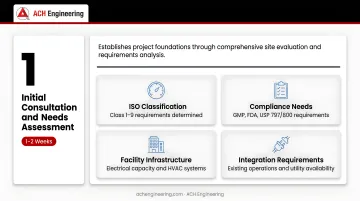
ACH Engineering's approach begins with understanding client process requirements, conducting thorough needs analysis to identify optimal solutions before design work begins. This front-loaded assessment minimizes design revisions and prevents mid-project changes.
Phase 2: Design and Engineering (2-4 weeks)
The design phase transforms requirements into detailed construction documentation, including CAD drawings, airflow modeling, material specifications, and system integration plans for HVAC, electrical, and specialized equipment.
Timeline variables:
- Simple projects with clear requirements: 2 weeks
- Complex multi-room facilities: 3-4 weeks
- High-customization projects: 4 weeks
Design complexity directly impacts duration. Projects requiring specialized features like pass-through chambers, integrated furniture, or custom door configurations require additional engineering time. Companies with well-defined specifications and minimal revision requests consistently complete this phase faster.
Prefabricated components use standardized engineering, which shortens design timelines considerably compared to site-built construction.
Phase 3: Manufacturing and Prefabrication (4-8 weeks)
Once design is finalized, all modular components are manufactured off-site in controlled factory environments. This includes wall panels (HPL, powder-coated galvanized iron, or u-PVC), ceiling systems, doors, windows, and specialized features.
Manufacturing timeline depends on:
- Material availability: Standard materials ship faster than specialized options like stainless steel or epoxy resin
- Manufacturing capacity: Current production schedules and facility workload
- Order complexity: Simple ISO 7-8 rooms versus complex ISO 5-6 facilities
- Customization level: Standard configurations versus highly customized designs
According to industry data, specialized components for ultra-clean environments can face lead times exceeding six months during supply chain disruptions. Working with manufacturers who maintain inventory of standard components mitigates this risk.
One key time advantage: site preparation runs in parallel with manufacturing, something traditional construction simply cannot do.
Phase 4: Delivery and Installation (1-2 weeks)
Prefabricated components arrive ready for rapid assembly. Installation speed represents one of modular construction's most significant advantages over traditional methods.
Installation timeline factors:
- Cleanroom size: Under 500 sq ft installs in days; over 2,000 sq ft may require 2 weeks
- Complexity: Single-room facilities versus multi-room configurations with airlocks
- Site readiness: Pre-prepared sites enable faster assembly
- Installation team: Experienced crews complete assembly faster and with fewer callbacks than first-time installers
ACH Engineering's installation expertise enables assembly in just a few weeks once components arrive on-site, with minimal disruption to existing facility operations. The modular approach allows for phased installations when operational areas need to come online progressively.
Phase 5: Testing, Certification, and Commissioning (1-2 weeks)
All cleanrooms require the same ISO certification testing—but modular builds tend to move through this phase faster, since factory-controlled manufacturing produces more consistent results from the start.
Required testing protocols:
- Particle count testing: 10-15 minutes per sampling location
- Airflow velocity verification: 10-15 minutes per location
- HEPA filter integrity testing: 7-10 minutes per filter
- Recovery time testing: Verification that rooms return to baseline in under 20 minutes
- Pressure differential verification: Ensuring proper room pressurization
ISO 14644-3:2019 testing typically requires one to two days per room, though ISO 5-6 environments may require longer due to higher filter density and additional sampling points.
For pharmaceutical and medical device applications, third-party certification adds time but provides essential regulatory compliance documentation. Full pharmaceutical validation (IQ/OQ/PQ) can add 6-12 months to traditional construction projects.
Modular systems reduce this burden through Factory Acceptance Testing (FAT) performed off-site before delivery, compressing the on-site commissioning window significantly.
Key Factors That Impact Modular Cleanroom Lead Times
Cleanroom Size and Complexity
Size directly correlates with timeline. Larger facilities require more components, longer manufacturing runs, and extended installation periods.
Timeline by size:
- Under 500 sq ft: Fastest completion, often 6-8 weeks total
- 500-2,000 sq ft: Standard 8-12 week timeline
- Over 2,000 sq ft: 12-16 weeks, may benefit from phased installation
Multi-room configurations with specialized zones (gowning rooms, airlocks, material pass-throughs) add complexity that extends both design and installation phases.
ISO Classification Requirements
Stricter ISO classifications demand more sophisticated systems, directly impacting timeline.
Air change rates by classification:
- ISO 5 (Class 100): 240-360 air changes per hour (ACH)
- ISO 7 (Class 10,000): 40-60 ACH
- ISO 8 (Class 100,000): 20-40 ACH
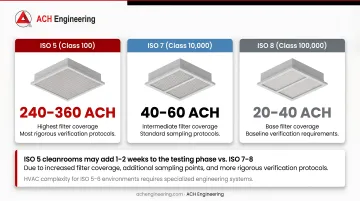
ISO 5 cleanrooms may add 1-2 weeks to the testing phase compared to ISO 7-8 due to increased filter coverage, additional sampling points, and more rigorous verification protocols.
The HVAC complexity for ISO 5-6 environments requires specialized engineering and more extensive commissioning, affecting both design and testing phases. Material selection compounds this — what you build with can shift timelines just as much as what classification you're building to.
Material Selection and Availability
Material choices directly affect lead times, particularly during supply chain disruptions.
Standard materials (readily available):
- HPL (High Pressure Laminate) panels
- Standard powder-coated galvanized panels
- u-PVC wall systems
Specialized materials (extended lead times):
- Stainless steel panels for pharmaceutical applications
- Epoxy resin countertops and work surfaces
- Custom finishes for specific regulatory requirements
The North American air filter market has experienced surging demand for HEPA filters, though manufacturers have expanded capacity to reduce lead times. Working with suppliers who maintain inventory of critical components helps avoid delays.
Customization and Special Features
Each custom element adds engineering time and potentially extends manufacturing schedules.
Common customizations and their impact:
- Pass-through chambers: Add 1-2 weeks to design and manufacturing
- Specialized lighting systems: Minimal impact with standard LED options
- Integrated furniture: 1-2 weeks additional manufacturing time
- Cleanroom cranes or specialized equipment: 2-4 weeks depending on complexity
- Custom door configurations: 1 week additional manufacturing
When timeline is tight, sequence non-critical features — integrated furniture and custom door configurations are among the easiest to retrofit after initial commissioning.
Regulatory Compliance and Documentation
Industries with stringent regulatory requirements face additional documentation and validation time.
Pharmaceutical GMP compliance requires a comprehensive Contamination Control Strategy (CCS) and formal validation protocols. EU GMP Annex 1 mandates specific qualification activities including filter integrity testing, airflow visualization, and recovery testing — each adding time to the commissioning phase.
Medical device FDA compliance requires alignment with Quality Management Systems (QMS) and bioburden control documentation for sterile device manufacturing.
Providers with active memberships in bodies like ISPE (International Society for Pharmaceutical Engineering) and PEO (Professional Engineers Ontario) are well-positioned to handle this documentation without repeated back-and-forth — which is where much compliance-related delay actually originates.
Site Preparation and Infrastructure Readiness
Inadequate site preparation ranks among the most common causes of installation delays.
Critical requirements:
- Floor flatness: Most cleanroom installations require FF 45/FL 35 to FF 60/FL 40 per ASTM E1155 standards
- Electrical capacity: Permanent connections from supply panel to cleanroom junction boxes
- HVAC infrastructure: Adequate capacity for required air change rates
- Structural support: Ceiling load capacity for FFU (Fan Filter Unit) installation
- Utility connections: Water, compressed air, vacuum, nitrogen (as required)
Unlevel floors represent a primary cause of installation failure or delay, preventing proper assembly of walls and ceiling grids. Conducting pre-installation site assessments identifies and addresses these issues before manufacturing begins, preventing costly delays.
Modular vs Traditional Cleanroom: Timeline Comparison
Phase-by-Phase Timeline Breakdown
| Phase | Modular Construction | Traditional Construction | Time Savings |
|---|---|---|---|
| Design | 2-4 weeks | 4-8 weeks | 50% faster |
| Permitting | Minimal (equipment vs. construction) | 2-6 weeks | 2-6 weeks saved |
| Manufacturing/Construction | 4-8 weeks (off-site) | 12-24 weeks (on-site) | 60-70% faster |
| Installation | 1-2 weeks | 8-16 weeks | 75-85% faster |
| Testing & Commissioning | 1-2 weeks | 1-2 weeks | Equivalent |
| Total Timeline | 8-16 weeks | 24-52 weeks | 50-70% faster |
The gap comes down to one core advantage: modular builds run site prep and component manufacturing at the same time, while traditional construction waits for each phase to finish before the next begins.
Why Modular Construction Is Faster
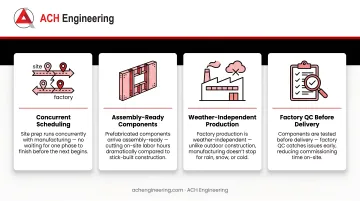
- Site prep runs concurrently with manufacturing — no waiting for one phase to finish before the next begins
- Prefabricated components arrive assembly-ready — cutting on-site labor hours dramatically compared to stick-built construction
- Factory production is weather-independent — unlike outdoor construction, manufacturing doesn't stop for rain, snow, or cold
- Components are tested before delivery — factory QC catches issues early, reducing commissioning time on-site
An ISPE-documented case study demonstrated this in practice: an ISO 7 fill-finish facility deployed in just 90 days to meet an urgent contract deadline — a timeline impossible with traditional construction.
When Traditional Construction Might Be Necessary
Modular isn't the right fit for every project. Some scenarios still call for traditional construction:
- Permanent facilities with complex architectural integration into existing building structures
- Extremely large facilities (over 10,000 sq ft) where modular economics become less favorable
- Buildings requiring extensive structural modifications that must occur before cleanroom installation
Even in these cases, hybrid approaches using modular components for the cleanroom itself while integrating with traditional building construction can reduce overall timelines.
Cost Implications of Timeline Differences
Earlier revenue generation: A 30-60% timeline reduction means production starts months sooner. For high-volume pharmaceutical products, that head start can represent millions in additional revenue.
Reduced carrying costs: Shorter construction periods mean fewer months of loan interest, temporary facility costs, and overhead expenses during the build phase.
Avoided delay costs: Construction rework can consume up to 20% of total project costs. Modular construction's factory quality control reduces rework risk.
Accelerated depreciation: Modular cleanrooms often qualify as tangible personal property (equipment) rather than real property, allowing for accelerated depreciation over 7 years versus 39 years for traditional builds, improving cash flow and NPV.
Industry-Specific Timeline Considerations
Pharmaceutical and Biotech Cleanrooms
GMP compliance and FDA documentation requirements add complexity but don't eliminate modular advantages.
Additional timeline factors:
- Validation protocols (IQ/OQ/PQ) add 2-4 weeks to testing phases
- Contamination Control Strategy (CCS) documentation requires comprehensive engineering records
- Grade A/B areas require requalification every 6 months; Grade C/D every 12 months
Despite these requirements, modular pharmaceutical facilities still achieve 50% faster completion than traditional builds. One CDMO completed a 200 sqm ISO 7 facility for mRNA vaccine component production in just 14 weeks.
Medical Device and Electronics Manufacturing
These industries typically require ISO 6-7 classifications with ESD (electrostatic discharge) protection.
Timeline considerations:
- Specialized ESD materials may have 2-3 week lead times
- Humidity control systems (critical for electronics) require additional engineering
- Bioburden control for implantable devices demands specialized testing protocols
The modular advantage remains significant, with most medical device cleanrooms completing in 10-14 weeks versus 6-9 months for traditional construction.
Research Laboratories and Universities
Academic institutions present unique scheduling challenges beyond standard cleanroom construction timelines.
Additional factors:
- Institutional procurement processes may add 2-4 weeks to project initiation
- Facility access restrictions during academic terms may require installation during breaks
- Semester-based budgeting cycles can delay project starts
Planning around summer breaks or winter recesses keeps disruption minimal — and at 1-2 weeks for installation, the modular timeline is short enough to complete within most academic break windows.
How ACH Engineering Streamlines Modular Cleanroom Lead Times
Turnkey Project Management Approach
ACH Engineering's end-to-end project management eliminates coordination delays that plague multi-contractor projects. Rather than clients managing separate relationships with designers, manufacturers, installers, and testing firms, ACH provides single-point accountability.
That single point of accountability covers the full project scope:
- Design and engineering coordination
- Material sourcing and vendor management
- Manufacturing oversight
- Construction management
- Installation supervision
- Validation and certification support
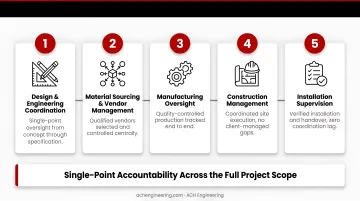
This turnkey approach particularly benefits clients across pharmaceutical, biotech, medical device, and other regulated industries from Ontario to Alberta and across North America. By managing all phases internally, ACH eliminates the communication gaps and scheduling conflicts that occur when multiple contractors work independently.
Optimized Design and Engineering Process
ACH's engineering team—including members of PEO, ISPE, and PMI—accelerates the design phase through deep regulatory and technical expertise.
Design efficiency drivers:
- Understanding client requirements quickly through structured needs assessment
- Minimizing revision cycles by incorporating regulatory requirements from the start
- Leveraging standardized modular components that reduce custom engineering time
- Providing clear documentation that prevents manufacturing delays
Design drawings typically complete within 2–4 weeks depending on project complexity, establishing the foundation for rapid progression through manufacturing and installation.
Proven Installation Efficiency
ACH's installation expertise enables rapid on-site assembly with minimal disruption to existing operations. Prefabricated components arrive ready for installation, with assembly typically completing in 3–5 weeks.
Installation advantages:
- Experienced teams familiar with modular assembly techniques
- Pre-tested components that reduce on-site troubleshooting
- Minimal disruption to ongoing facility operations
- Flexibility for phased installations when operational areas need to come online progressively
The modular approach also supports long-term adaptability. Components reconfigure, relocate, or expand as your operation grows—a level of flexibility that poured concrete and fixed walls simply can't match.
Frequently Asked Questions
How long does it take to install a modular cleanroom from start to finish?
Typical modular cleanroom projects require 8-16 weeks total: 2-4 weeks for design and engineering, 4-8 weeks for manufacturing, 1-2 weeks for installation, and 1-2 weeks for testing and certification. Timeline varies based on cleanroom size, ISO classification requirements, and customization level.
What is the fastest possible timeline for a modular cleanroom?
Simple, small cleanrooms (under 500 sq ft) with standard specifications and ISO 7-8 classifications can be completed in as little as 6-8 weeks while maintaining all quality and compliance standards. This accelerated timeline requires defined specs, standard materials, and a site that's ready to go.
How does modular cleanroom timeline compare to traditional construction?
Modular construction is typically 50-70% faster, requiring 8-16 weeks versus 24-52 weeks for traditional stick-built cleanrooms. The speed advantage comes from parallel site preparation and manufacturing, weather-independent factory production, and fast on-site assembly.
What factors can delay my modular cleanroom project?
Top delay factors include design changes during manufacturing, specialized material lead times (particularly for stainless steel or custom finishes), inadequate site preparation (especially unlevel floors), and extended regulatory approval processes. Ensuring site readiness and locking in requirements before manufacturing begins keeps the project on track.
Can I accelerate the timeline if I have an urgent need?
Yes — having clear requirements upfront, choosing standard materials over specialized options, and ensuring complete site readiness can reduce your timeline by 2-4 weeks. Some providers offer expedited manufacturing for urgent projects, though this typically affects cost.
Do modular cleanrooms require less testing time than traditional cleanrooms?
Testing requirements are identical regardless of construction method—both need ISO certification following the same protocols. However, modular cleanrooms often pass testing faster due to quality-controlled factory manufacturing that produces cleaner initial builds with fewer particulate issues requiring remediation.