Introduction
Contamination-related recalls, tightening standards like EU GMP Annex 1 and FDA 21 CFR revisions, and growing pressure across regulated industries have made controlled environments non-negotiable. Yet traditional cleanroom construction — with 3-6 month timelines and capital costs exceeding $400 per square foot — creates bottlenecks that many organizations cannot afford.
Portable cleanrooms are often dismissed as a "quick fix." In practice, they solve specific, high-stakes business problems:
- Eliminate production downtime during facility transitions
- Preserve capital for R&D rather than infrastructure
- Enable multi-site operations without stranded assets
- Deliver regulatory-compliant capacity when improvised solutions would fail an audit
What follows covers the measurable advantages, real-world applications, and decision factors that determine when portable cleanrooms outperform permanent construction.
Key Takeaways
- Portable cleanrooms are pre-fabricated controlled environments built into shipping containers or modular frames, deployable in days rather than months
- Cut upfront costs by 50-70% versus traditional construction, install in hours to days, and achieve ISO 6-8 compliance (select configurations reach ISO 5)
- Best suited for temporary capacity expansion, emergency contamination response, R&D projects, and sites where production downtime is not an option
- Widely used across pharmaceuticals, biotech, medical devices, aerospace, electronics, food processing, and cannabis cultivation
What Is a Portable Cleanroom (Brief Context)
A portable cleanroom is a pre-designed, self-contained controlled environment that delivers ISO-classified air cleanliness, temperature and humidity control, and contamination barriers. These systems are built into transportable structures—typically shipping containers or modular panel assemblies—so they can be deployed where and when they're needed.
Organizations choose portable cleanrooms when they need contamination control without the capital expenditure, construction timelines, or facility modifications that traditional stick-built cleanrooms demand. Common deployment scenarios include:
- Temporary production expansions during peak demand or facility renovations
- Remote manufacturing sites lacking existing cleanroom infrastructure
- Emergency capacity during contamination events requiring immediate response
- Pilot projects and R&D initiatives testing cleanroom processes before permanent investment
- Regulatory inspection readiness when compliance timelines are tight
Portable cleanrooms meet the same ISO 14644-1 particulate cleanliness standards as permanent facilities. The difference is delivery: prefabricated systems skip the construction phases, architectural fees, building permits, and structural modifications—getting operations running months faster.
Key Advantages of Portable Cleanrooms
Portable cleanrooms deliver measurable operational impact across the metrics that matter: capital expenses, installation timelines, production throughput, and compliance risk. Here's where that impact shows up.
Faster Deployment and Reduced Downtime
Portable cleanrooms arrive as plug-and-play units, pre-fabricated off-site and requiring only power connection and minimal site preparation. Installation takes hours to days versus 3-6 months for traditional cleanrooms.
This speed eliminates production downtime. Manufacturing can continue in existing spaces while the portable unit is positioned nearby, avoiding weeks of lost output during construction. For high-value manufacturing, this matters enormously: pharmaceutical production interruptions cost between $500,000 and $1 million per day in lost revenue, while high-containment environments can lose $10,000 to $50,000 per hour during unscheduled downtime.
Why this advantage matters:
- Clinical trial timelines don't flex — a mobile BSL-2 cGMP facility deployed in under 21 days during COVID-19 kept a pharmaceutical program on track when any delay would have jeopardized the entire study
- Contamination events demand immediate response; portable units provide compliant capacity within days, not months
- Shorter installations reduce labor hours for installation crews and project management oversight
KPIs impacted:
Time-to-operation, production downtime days, project completion timeline, labor costs for installation, revenue loss during facility transitions
When this advantage matters most:
Temporary capacity needs during peak demand, emergency response to contamination events, facility renovations requiring cleanroom relocation, startups needing to launch production quickly, organizations preparing for regulatory audits with tight deadlines
Lower Capital Investment and Predictable Costs
Portable cleanrooms cost 50-70% less than permanent construction because they eliminate expenses like architectural design, building permits, HVAC integration, structural modifications, and long-term contractor fees.
Cost benchmarks reveal the financial gap:
| Cleanroom Type | Cost Range | Cost Drivers |
|---|---|---|
| Portable/Modular | $100-$150/sq ft | Pre-manufactured components, reduced on-site labor |
| Traditional Stick-Built | $400-$1,500/sq ft | Custom engineering, extensive on-site trades, longer duration |
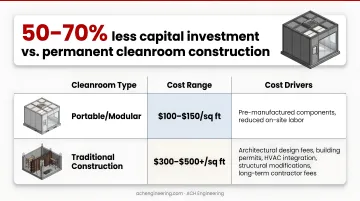
Portable units offer predictable, all-inclusive pricing. The cost covers the cleanroom structure, HVAC/filtration, environmental controls, and often furniture and equipment—avoiding the budget overruns common in custom construction projects where change orders and unforeseen site conditions inflate final costs.
Why this advantage matters:
- Lower upfront costs free capital for R&D, equipment upgrades, or workforce expansion rather than locking it into construction
- Modular investment models let organizations phase spending as project scope clarifies, reducing financial exposure on uncertain-duration projects
- Portable units may qualify as tangible personal property (equipment) rather than real property, allowing accelerated depreciation — 7 years vs. 39 years — which improves net present value
KPIs impacted:
Capital expenditure (CapEx), cost per square foot of cleanroom space, budget variance, return on investment timeline, cash flow availability
When this advantage matters most:
Startups or small-to-mid-sized companies with limited budgets, organizations testing cleanroom processes before committing to permanent facilities, projects with uncertain duration or future facility plans, companies needing to preserve cash reserves for core operations
Mobility and Scalability for Changing Needs
Portable cleanrooms can be relocated to different sites, expanded by adding units, or reconfigured to meet changing production requirements. Permanent cleanrooms offer none of these options once construction is complete.
This mobility supports multi-site operations, seasonal production peaks, contract manufacturing projects, and organizations testing cleanroom processes at different locations before finalizing facility investments. A PortaFab case study highlights a client who installed a cleanroom for e-liquid manufacturing that was later relocated to a new facility as business needs changed, with the full asset value intact.
Why this advantage matters:
- Pharmaceutical companies can deploy compliant manufacturing capacity to different trial sites as projects move between locations
- Capacity can be added incrementally without committing to fixed square footage that may sit underutilized
- If business needs shift, the cleanroom moves with the business, gets sold, or gets redeployed — rather than becoming stranded infrastructure
KPIs impacted:
Facility utilization rate, capacity flexibility, capital asset depreciation, project ROI, ability to respond to demand fluctuations
When this advantage matters most:
Contract manufacturing organizations serving multiple clients, companies with seasonal production cycles, organizations expanding into new geographic markets, pilot projects or R&D initiatives with uncertain long-term needs, businesses operating in leased facilities where permanent construction is restricted
What Happens When Portable Cleanrooms Are Missing or Ignored
Organizations that attempt to meet cleanroom needs without portable solutions face predictable, costly consequences:
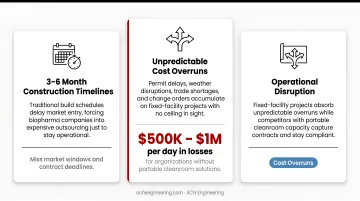
- Miss market windows and contract deadlines when traditional construction timelines stretch 3-6 months; biopharma companies often resort to expensive outsourcing just to stay operational.
- Absorb unpredictable cost overruns from permit delays, weather disruptions, trade shortages, and change orders that accumulate on fixed-facility projects.
- Lose $500,000 to $1 million per day in pharmaceutical revenue when existing cleanrooms go offline for renovations or expansion work.
- Turn away orders or outsource at a margin-eroding premium when demand surges faster than permanent capacity can scale.
- Risk failed audits and regulatory action from makeshift "temporary" setups. An FDA warning letter cited one firm for "large, partially dirty gaps" and inadequate pressure differentials in a non-designed environment.
How to Get the Most Value from a Portable Cleanroom
Portable cleanrooms work best when organizations clearly define their ISO class requirements, production workflows, and integration needs upfront. Avoid over-specification (unnecessary features that inflate costs) or under-specification (missing critical controls that require expensive retrofits).
Site preparation essentials:
- Verify adequate power supply — North American units typically require 208V or 480V/60Hz/3-phase electrical connections
- Confirm a level foundation capable of supporting the unit's load; trailer-mounted cleanrooms also need accessible parking and leveling clearance
- Coordinate delivery and installation access early to minimize disruption to existing facility operations
Specification best practices:
- Size HVAC accurately — ISO 7 rooms require 40–60 air changes per hour (ACH), while ISO 5 requires 250–300 ACH. Precise heat load calculations prevent costly under-performance
- Match ISO class to actual process needs — requesting ISO 5 when ISO 7 suffices exponentially increases energy costs and upfront capital expenditure
Validation and compliance:
Validation must follow ISO 14644-1 (classification) and ISO 14644-3 (test methods). Required tests include:
- Particle counting
- Airflow velocity measurement
- Pressure differential testing
- Room recovery tests — which verify how quickly the cleanroom returns to baseline cleanliness after a contamination event, a key metric under EU Annex 1 and FDA standards
Navigating these validation requirements alongside equipment selection and commissioning is where project management expertise matters most. ACH Engineering's turnkey services cover design, supply, construction, and commissioning — so portable cleanrooms are built to meet compliance requirements from the start, with no costly surprises at qualification.
Conclusion
Portable cleanrooms deliver measurable value through faster deployment, lower costs, and operational flexibility—addressing the real-world constraints of budget, time, and facility limitations that traditional cleanrooms cannot solve as readily. Organizations that treat portable cleanrooms as long-term infrastructure investments rather than temporary fixes gain compounding returns: faster market entry, scalable production capacity, and lower-stakes validation of new processes before committing to permanent builds.
The right decision comes down to operational fit: production continuity, capital efficiency, regulatory readiness, and adaptability. When those factors align with what portable cleanrooms offer, the case for permanent construction weakens considerably. The result is controlled environment capability that grows with your operation—not one that locks it in place.
Frequently Asked Questions
What are the benefits of using a portable cleanroom?
The top benefits include faster deployment (days vs. months), 50-70% lower capital costs compared to traditional construction, and mobility for multi-site or temporary applications. For facilities managing budget constraints or uncertain timelines, that combination is hard to match with permanent construction.
How much does a portable cleanroom cost compared to traditional construction?
Portable cleanrooms typically cost $100-$150 per square foot, while traditional stick-built cleanrooms cost $400-$1,500 per square foot. Portable units avoid expenses like permits, HVAC integration, and structural modifications that drive up traditional construction costs.
What ISO classes can portable cleanrooms achieve?
Most portable cleanrooms meet ISO 6–8 standards, with select designs achieving ISO 5 through high-coverage ULPA/HEPA filtration and 240–480 air changes per hour. ISO 7–8 configurations suit general manufacturing and compounding applications.
When should a company choose a portable cleanroom instead of a permanent modular cleanroom?
Portable cleanrooms fit temporary needs (under 2 years), uncertain facility plans, tight budgets, or multi-site operations. Permanent modular cleanrooms are better suited to large-scale, long-term operations with complex process equipment integrated into an existing building structure.
Can portable cleanrooms be rented instead of purchased?
Some suppliers offer short-term rental arrangements, which convert capital expenses to operational expenses and reduce financial risk for projects with uncertain durations. For most applications, purchasing or procuring a turnkey portable cleanroom offers greater flexibility, customization, and long-term value — particularly when the unit needs to meet specific ISO classifications or process requirements.
How long does it take to install a portable cleanroom?
Installation takes hours to days depending on size and complexity, compared to 3-6 months for traditional construction. Pre-configured systems can be assembled on-site in 2-3 days, while turnkey mobile units can be fully commissioned in under 21 days.