
Introduction
Cleanroom facilities consume massive resources—HVAC systems alone account for 50-70% of operating costs, with annual electricity bills often exceeding $500,000 to $1,000,000 USD for production environments. Traditional stick-built cleanrooms lock organizations into oversized, inflexible footprints that drive operational expenses for decades.
Reducing cleanroom footprint means optimizing layout efficiency, improving workflow patterns, and using modular technology to maintain ISO compliance while cutting costs. Organizations that apply modular systems strategically can shrink facility footprints by 20-40% through precise classification zoning, vertical space utilization, and integrated HVAC design that eliminates wasted corridor space.
That kind of reduction doesn't happen by accident. This guide walks through how to assess your current footprint, implement modular solutions that meet ISO Class 1-9 requirements, and sidestep the common pitfalls that undermine both compliance and efficiency.
Key Takeaways
- Modular systems cut cleanroom footprints by 20-40% using optimized layouts and vertical space
- Zone-based classification limits expensive high-grade areas to only critical processes
- Flexible wall systems and integrated HVAC eliminate wasted corridor and mechanical chase space
- Proper planning — workflow mapping, regulatory review, and expert design — determines whether footprint savings hold up under compliance scrutiny
Assessing Your Current Cleanroom Footprint
Before implementing modular solutions, conduct a thorough audit of your existing space. Map your entire cleanroom square footage, including production areas, gowning rooms, airlocks, corridors, and support spaces. Document which areas maintain which ISO classifications and why.
Common inefficiencies to look for:
- Underutilized areas that sit empty during normal operations
- Redundant corridors connecting similar classification zones
- Oversized buffer zones maintained "just in case"
- Areas classified at higher ISO levels than your process actually requires
- Material transfer routes that force excessive personnel movement
Analyze workflow patterns by tracking how personnel and materials move through your facility during typical production cycles. Excessive zone crossings, backtracking to retrieve supplies, and airlock wait times all point to layout inefficiencies that waste both space and time.
Once you've mapped those patterns, the next step is quantifying the problem.
Calculate the ratio of your "net clean" production area to total facility footprint. If support spaces, corridors, and mechanical rooms consume more than 40% of your total area, modular optimization will deliver measurable savings.
Key Strategies to Reduce Cleanroom Footprint with Modular Systems
Optimize Classification Zoning
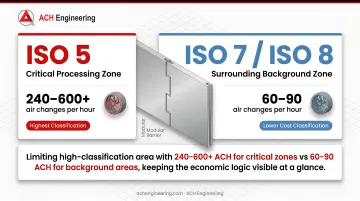
Modular walls enable precise segregation of different ISO classes, ensuring only critical areas maintain the highest—and most expensive—classification levels. Rather than conditioning an entire room to ISO 5 (Class 100), modular barriers create appropriately classified micro-environments for critical processing, surrounded by less stringent ISO 7 or ISO 8 backgrounds.
The cost impact is direct. ISO 5 environments require 240–600+ air changes per hour; ISO 7 spaces need only 60–90. Limiting high-classification volumes to exactly what each process demands cuts the cubic footage of air requiring intensive conditioning and filtration.
ACH Engineering's modular cleanroom solutions — including wall systems (panels) — support all ISO Class 1–9 requirements, with options including:
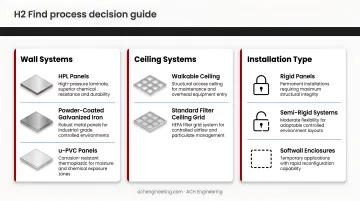
- HPL panels, powder-coated galvanized iron, and u-PVC configurations
- Pressure differentials of 10–15 Pascals between adjacent zones to prevent contamination migration
- Zone-specific classifications that eliminate over-classified space
Vertical Space Utilization
Traditional cleanrooms often waste vertical volume. Modular systems maximize usable space within existing building envelopes through mezzanines, elevated walkways, and multi-level designs.
Walkable ceiling systems allow mechanical equipment placement directly overhead rather than in adjacent mechanical rooms. These load-bearing ceilings support maintenance personnel access from above, eliminating the need for perimeter service corridors that consume valuable floor area. In facilities with adequate ceiling height, vertical integration typically reduces gross floor area requirements by 15–25%.
Eliminate Unnecessary Corridors
Long connecting corridors between cleanroom zones represent dead space: expensive square footage maintained at controlled classifications but contributing nothing to production. Modular airlock and pass-through systems integrated directly into wall panels eliminate these corridors.
Material transfer airlocks built into modular walls allow materials to move between zones without dedicated transfer corridors. Personnel airlocks positioned strategically reduce travel distances. In traditionally designed cleanrooms, eliminating these corridors can recover 10–20% of total facility footprint.
Flexible Reconfigurable Layouts
Modular panel systems enable future reconfigurations without demolition. As production needs change, walls can be relocated, spaces expanded, or entire cleanrooms moved to different facilities. This adaptability lets you right-size for current needs rather than building excess capacity for anticipated but uncertain future demand.
ACH's scalable cleanroom components can be expanded, relocated, repurposed, or removed as requirements evolve. Features like airlocks or biological safety cabinets can be added to existing rooms without major reconstruction.
Integrated HVAC and Utility Distribution
Modular systems incorporate HVAC, electrical, and plumbing within wall and ceiling panels, reducing or eliminating separate mechanical chases. Fan Filter Units (FFUs) integrate directly into ceiling grids, providing localized laminar flow only where needed rather than conditioning entire room volumes to the highest standard.
Consolidating utilities within the building envelope shrinks gross floor area requirements — freeing up more production space without expanding the facility footprint.
Step-by-Step Implementation Guide for Modular Cleanroom Footprint Reduction
Step 1: Conduct Space and Workflow Analysis
Perform a detailed assessment of current operations. Create process flow diagrams showing how materials and personnel move through your facility. Map personnel movement patterns during shift changes, production cycles, and material deliveries.
Document material handling requirements including delivery frequencies, package sizes, and staging area needs. Identify regulatory requirements that must be maintained—ISO classifications, cGMP compliance, FDA standards, or industry-specific regulations like USP 797 for pharmaceutical compounding.
Then calculate space utilization metrics: production area per employee, square footage per production unit, and the ratio of classified space to total facility area. These numbers become your baseline for measuring footprint reduction.
Step 2: Develop Optimized Layout Design
Work with cleanroom design specialists to create 3D models showing proposed modular configurations with reduced footprints. These models demonstrate how zone-based classification, vertical utilization, and corridor elimination reduce total area while maintaining compliance.
Ensure designs incorporate appropriate airlocks, gowning areas, and contamination control measures while minimizing circulation space. Verify that pressure cascades between adjacent zones meet the 10–15 Pascal differential standard, and position material transfer points to minimize personnel movement distances.
ACH Engineering's design team handles layout optimization and produces detailed drawings, typically within a couple of weeks.
Step 3: Select Appropriate Modular Components
Choose wall panel types based on classification requirements and budget. Options include rigid panels for permanent installations, semi-rigid systems for moderate flexibility, or softwall enclosures for temporary applications.
Select components that meet your specifications:
- Wall systems: HPL panels, powder-coated galvanized iron, or u-PVC panels depending on chemical resistance and durability needs
- Ceiling systems: Walkable ceilings for maintenance access or standard filter ceiling grids
- Flooring: Raised floors for underfloor air distribution or sealed epoxy for standard applications
- Doors and windows: Flush-design doors maintaining pressure differentials, vision panels for monitoring
- Integrated HVAC: FFUs, HEPA filtration systems, and pressure control equipment
Verify all components meet relevant standards and include necessary certifications for your industry. ACH's modular systems are built to comply with cGMP, FDA, USP 797, ISO, and NAPRA standards across ISO Class 1–9 classifications.
Step 4: Plan Installation with Minimal Disruption
Develop a phased installation schedule that maintains ongoing operations in unaffected areas. Modular systems support phased activation—you can validate and operate an initial suite while expanding adjacent zones.
Coordinate utility connections, HVAC integration, and validation testing timelines. Modular installations typically take 4–12 weeks compared to 6–18 months for traditional construction, cutting operational downtime considerably.
Because modular components are manufactured in controlled environments, they require less time for initial cleaning and particulate "pull-down" compared to drywall construction that generates substantial dust.
Step 5: Validate and Commission
Perform required testing aligned with ISO 14644-2 (Monitoring) and ISO 14644-3 (Test Methods). Essential tests include:
- Particle counts at operational and at-rest conditions
- Air velocity measurements verifying laminar flow patterns
- Pressure differential verification between adjacent zones
- HEPA filter integrity testing confirming no leaks
- Temperature and humidity verification within specified ranges
Complete documentation for regulatory compliance and obtain necessary certifications before operational use. ACH provides validation services including operational testing and certification to ensure environments meet all applicable regulatory standards.
When Modular Systems Are the Right Choice for Footprint Reduction
Modular solutions work best when facilities need flexibility for future expansion, process changes, or product line additions. Modular components reconfigure as requirements evolve, so your investment adapts rather than becoming obsolete.
Footprint reduction is critical when you face:
- High real estate costs in biotech hubs or urban manufacturing centers
- Limited available space preventing traditional expansion
- Need to increase production capacity without building additions
- Leased facilities where permanent construction isn't justified
- Potential tax classification advantages — modular systems may qualify as equipment rather than real property (consult your tax advisor for jurisdiction-specific rules)
Traditional construction might be preferred for permanent facilities with no anticipated changes, extremely large-scale operations where modular cost advantages diminish, or specific architectural requirements that modular systems can't accommodate.
Tax considerations matter: Modular cleanrooms may qualify as equipment or personal property under applicable tax rules, rather than permanent structures — a classification that can meaningfully improve capital recovery timelines. Confirm the treatment with your accountant based on your jurisdiction.
Common Mistakes When Reducing Cleanroom Footprint with Modular Systems
Three planning errors account for most failed footprint-reduction projects. Catching them early saves significant time, cost, and compliance headaches.
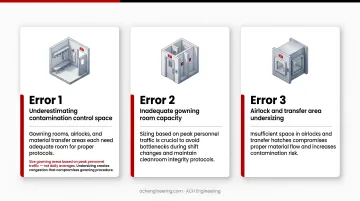
Underestimating contamination control space is the most frequent error. Gowning rooms, airlocks, and material transfer areas each need adequate room for proper protocols. The critical detail most planners miss: size gowning areas based on peak personnel traffic, not daily averages. Undersizing creates congestion that compromises gowning procedures; oversizing wastes expensive classified space.
Cost-driven component selection is the second common trap. Evaluating wall systems, HVAC components, and airlocks on upfront price alone ignores what matters long-term:
- Maintenance requirements and ease of access
- Energy efficiency at your specific airchange rate
- Reconfiguration capability when you expand or repurpose the space
A cheaper wall system that can't be relocated has hidden costs that surface quickly. Components with higher upfront costs but lower operational expenses often deliver better total cost of ownership.
The third mistake — and the most expensive to fix — is excluding operations and quality teams from early design decisions. Operations staff understand daily workflow realities that drawings never fully capture. Quality teams identify regulatory requirements that must be designed in from the start. Retrofitting compliance after installation is both costly and, in some cases, structurally impossible.
Frequently Asked Questions
How much can modular cleanrooms reduce total facility footprint compared to traditional construction?
Modular systems typically reduce footprints by 20–40% through optimized zoning, walkable ceilings that eliminate dedicated mechanical rooms, and integrated pass-throughs that replace corridors. For example, a facility running 2,000 sq ft at ISO 5 might consolidate to 1,200 sq ft of ISO 5 micro-environments surrounded by ISO 7 buffer space.
What are the upfront costs of implementing modular cleanroom systems?
Despite comparable or slightly higher material costs, total project costs are typically 30–40% lower due to faster installation and reduced labor. Traditional construction runs $400–$700 USD per square foot; modular systems range from $100 to over $1,000 USD per square foot depending on ISO classification and complexity.
Can modular cleanrooms meet ISO classification requirements for pharmaceutical manufacturing?
Yes. Properly designed modular systems achieve any ISO classification from ISO 1 to ISO 9 with appropriate HVAC, filtration, and construction materials. ACH Engineering's modular cleanrooms meet cGMP, FDA, and USP 797 standards with HEPA filtration systems and controlled pressurization. High-end configurations utilize 100% ULPA filter ceiling coverage for the most stringent requirements.
How long does it take to install a modular cleanroom system?
Installation typically takes 4–12 weeks depending on size and complexity, compared to 6–18 months for traditional construction. Design development requires two to three weeks, followed by component manufacturing and delivery, then onsite assembly. This acceleration can reduce time-to-market by up to 70%.
Can existing cleanrooms be retrofitted with modular systems to reduce footprint?
Yes. ACH Engineering's modular components integrate into existing facilities — replacing fixed walls with modular panels, reconfiguring layouts, and upgrading HVAC — through phased transitions that keep unaffected areas operational throughout.
What maintenance requirements do modular cleanroom systems have?
Routine maintenance covers filter replacements (quarterly to annually by classification), seal inspections, and periodic recertification testing. Walkable ceiling designs allow filter changes from above without entering the controlled environment, reducing contamination risk and operational downtime.
Ready to reduce your cleanroom footprint while maintaining compliance? ACH Engineering designs and builds modular cleanroom systems across North America, covering everything from initial assessment through validation and certification. Contact our team at +1 647-406-5721 or sales@achengineering.com to discuss your footprint optimization project.