Introduction
Get the air change rate wrong in a cleanroom and you face one of two problems: too little airflow compromises sterile conditions and puts you offside with ISO and GMP requirements; too much wastes energy and inflates operating costs unnecessarily. Engaging cleanroom engineering services during the design phase prevents both problems by right-sizing systems to your ISO classification from the outset. For most facility operators, finding the right number starts with understanding what air change rate actually measures.
Air change rate (ACH) represents the number of times per hour the entire volume of air in a cleanroom is replaced with HEPA-filtered supply air. This metric determines how quickly contamination is diluted and removed, affecting everything from particle counts to recovery time after contamination events.
This guide covers how to calculate ACH for different ISO classifications, size your HEPA filter array correctly, and sidestep the design mistakes that cause cleanrooms to fail qualification testing.
Whether you're designing a new facility, validating an existing space, or troubleshooting persistent contamination issues, the calculations here give you a concrete starting point.
Key Takeaways
- ACH measures how many times per hour filtered air replaces the total room volume
- ISO 8 cleanrooms typically require 10-20 ACH; ISO 7 needs 30-60 ACH
- ISO 5 uses unidirectional flow measured in velocity (0.36–0.54 m/s), not ACH
- Calculate ACH using: (CFM × 60) ÷ Room Volume (cubic feet)
- Design requirements depend on ISO classification, occupancy levels, contamination load from processes, and pressure differential needs
- Personnel activity generates 100,000 to 5,000,000 particles per minute depending on movement level
What Air Change Rate Represents in Cleanrooms
Air change rate (ACH or ACR) quantifies how many times per hour the entire volume of air within a cleanroom is replaced with HEPA or ULPA-filtered supply air. This volume-based metric works on two levels: as a design specification that determines required airflow capacity, and as an operational parameter that measures contamination control effectiveness.
ACH functions as the primary contamination control mechanism in ISO 6-9 cleanrooms through dilution. Higher air change rates mean faster replacement of contaminated air with clean filtered air, reducing particle concentration and shortening recovery time after contamination events. Research shows that 10 ACH may suffice for ISO 8 environments to meet "in operation" regulatory limits, suggesting opportunities for energy optimization beyond traditional minimums.
Volume vs. Velocity Metrics
The distinction between air change rate and air velocity is critical:
- Air Change Rate (ACH): Volume-based metric for ISO 6-9 cleanrooms using non-unidirectional (turbulent mixing) airflow
- Air Velocity (m/s): Speed-based metric for ISO 5 and cleaner rooms using unidirectional (laminar) airflow, typically 0.36-0.54 m/s
How ACH Controls Contamination
ACH directly controls particle dilution and removal rates. The relationship between airflow and contamination is expressed as: Required Airflow = Particle Emission Rate ÷ (Ventilation Efficiency × Concentration Limit). In practice, this means ACH requirements rise with higher contamination generation and drop when air distribution improves.
ACH never operates alone. Its effectiveness depends on how well the surrounding system supports it:
- Airflow patterns (turbulent vs unidirectional)
- HEPA/ULPA filtration efficiency (99.97% minimum at 0.3 microns)
- Pressure differentials between adjacent spaces
- Room geometry and supply/return air placement
That last point — air distribution — is where many designs fall short. ISO 14644-16 guidance introduces Air Change Effectiveness (ACE) to measure how well air changes actually remove contamination. When air distribution is poor (ACE < 1), supply air short-circuits directly to return grilles without mixing through occupied zones. The result: higher ACH is required just to achieve the same cleanliness level.
ISO Classification and Required Air Change Rates
ISO 14644-1 Cleanroom Classification System
ISO 14644-1 defines nine cleanliness classes (ISO 1-9) based on maximum allowable particle concentrations at specified sizes. The standard establishes particle count limits but does not mandate specific ACH values—those are determined by contamination generation rates, occupancy, and operational conditions.
ISO 14644-1 Maximum Particle Concentrations (particles/m³)
| ISO Class | ≥0.5 µm | ≥1.0 µm | ≥5.0 µm |
|---|---|---|---|
| ISO 5 | 3,520 | 832 | — |
| ISO 6 | 35,200 | 8,320 | 293 |
| ISO 7 | 352,000 | 83,200 | 2,930 |
| ISO 8 | 3,520,000 | 832,000 | 29,300 |
Recommended Air Change Rates by ISO Class
While ISO standards don't specify ACH requirements, industry guidance and regulatory bodies provide ranges based on decades of validation data.
Typical Design ACH Ranges by ISO Classification
| ISO Class | Airflow Pattern | ACH Range | Common Applications |
|---|---|---|---|
| ISO 5 | Unidirectional | 240-480* | Critical aseptic zones, Grade A areas |
| ISO 6 | Mixed/Non-unidirectional | 150-240 | Sterile manufacturing, biotech production |
| ISO 7 | Mixed/Non-unidirectional | 30-90 | Pharmaceutical manufacturing, compounding |
| ISO 8 | Mixed/Non-unidirectional | 10-48 | Supporting rooms, packaging areas |
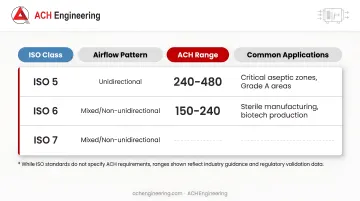
*ISO 5 typically specified by velocity (0.36-0.54 m/s) rather than ACH
ISO 6–9 cleanrooms rely on non-unidirectional (turbulent mixing) airflow, controlling contamination through dilution and high air change rates. ISO 5 and cleaner classes require unidirectional (laminar) airflow, measured in velocity rather than ACH, because the goal shifts from dilution to displacement — moving particles out in a uniform piston flow rather than mixing them away.
Published ACH ranges are guidelines, not absolute requirements. Actual design values depend on:
- Contamination generation rates from processes and equipment
- Occupancy levels and personnel activity
- Room geometry and ceiling height
- Equipment heat loads requiring cooling airflow
- Operational state (At-Rest vs. Operational classification)
At-Rest vs Operational Classification
ISO 14644-1 defines three occupancy states with significantly different contamination levels:
- As-Built: Empty completed facility with no equipment or personnel
- At-Rest: Installed equipment but no personnel present
- Operational: Normal production with personnel and active processes
Particle counts increase dramatically from At-Rest to Operational states. Personnel generate 100,000 to 5,000,000 particles per minute (≥0.5 µm) depending on activity level — sitting motionless versus active movement. This typically requires 20–40% higher ACH for Operational classification compared to At-Rest design minimums.
Industry-Specific Standards and Guidelines
Certain industries impose requirements beyond ISO standards. The three most commonly referenced in North American regulated manufacturing are:
FDA Aseptic Processing Guidance (2004)
- Minimum 20 ACH for ISO 8 (Class 100,000) supporting rooms in sterile drug manufacturing
- 0.45 m/s (±20%) face velocity for ISO 5 critical zones
USP <797> (Sterile Compounding)
- ISO 7 Buffer Rooms: Minimum 30 ACH (at least 15 ACH from HVAC system)
- ISO 8 Ante-Rooms: Minimum 20 ACH (at least 15 ACH from HVAC system)
USP <800> (Hazardous Drugs)
- HD Buffer Room (ISO 7): Minimum 30 ACH of HEPA-filtered supply air
- Containment Segregated Compounding Area: Minimum 12 ACH
In practice, these regulatory requirements set the true design floor — not ISO minimums — for any facility operating under FDA or USP oversight.
How to Calculate Air Change Rates
The Fundamental ACH Formula
Air change rate calculation uses a straightforward formula relating airflow volume to room volume:
ACH = (Supply Airflow in CFM × 60) ÷ Room Volume (cubic feet)
The factor of 60 converts per-minute airflow (CFM) to per-hour air changes (ACH).
In SI units: ACH = (Airflow in m³/s × 3,600) ÷ Room Volume (m³)
Step-by-Step Calculation Method
- Calculate room volume — multiply length × width × ceiling height (in feet) to get cubic feet.
- Determine total supply airflow — sum the CFM rating of all HEPA filter units supplying the room.
- Apply the formula — ACH = (Total CFM × 60) ÷ Room Volume.
- Compare to target — verify the result meets the required ACH for your ISO classification.
Worked Example
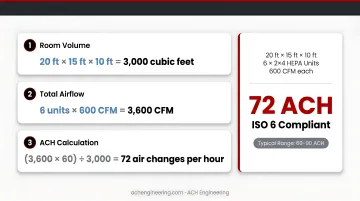
A 20 ft × 15 ft × 10 ft cleanroom, supplied by six 2×4 HEPA filter units each delivering 600 CFM:
- Room volume = 20 × 15 × 10 = 3,000 cubic feet
- Total airflow = 6 × 600 CFM = 3,600 CFM
- ACH = (3,600 × 60) ÷ 3,000 = 72 air changes per hour
72 ACH meets ISO 6 requirements (60–90 ACH typical range).
Calculating Required Airflow and Filter Quantity
Reverse the formula to determine required supply airflow when target ACH is known:
Required CFM = (Target ACH × Room Volume) ÷ 60
Then divide by CFM per filter unit to determine the number of filters needed.
To achieve 60 ACH in a 4,000 cubic foot cleanroom with 650 CFM filter units:
- Required CFM = (60 × 4,000) ÷ 60 = 4,000 CFM total
- Number of filters = 4,000 ÷ 650 = 6.15 → round up to 7 units
Always round up — undersized airflow risks classification failure during particle count testing.
Adjusting for Ceiling Height and Room Geometry
Calculated ACH values assume standard geometry — real rooms introduce variables that shift those numbers upward.
Ceiling Height
Rooms with ceiling heights above 10–12 feet require higher air change rates. Greater particle settling distances and the risk of thermal stratification mean a 15-foot ceiling room demands meaningfully more airflow than a 9-foot ceiling room of the same floor area.
Room Geometry Impact: Room shape affects air change effectiveness significantly:
- Long narrow rooms create longer airflow paths with more opportunity for dead zones
- Rooms with obstructions or large equipment interrupt airflow patterns
- Irregular layouts may need 10-20% higher ACH than calculated minimums
ISO 14644-16 recommends designing for an Air Change Effectiveness (ACE) of 0.7 rather than 1.0 to account for imperfect mixing in real installations. This means increasing calculated ACH by approximately 40% to compensate for air distribution inefficiencies.
Factors Affecting Air Change Rate Requirements
Occupancy Density and Personnel Activity
Each person in a cleanroom generates approximately 100,000 to 1,000,000 particles per minute depending on activity level and gowning protocol. Research demonstrates particle generation rates vary dramatically:
- Sitting motionless: ~100,000 particles/minute (≥0.5 µm)
- Moving head and arms: ~1,000,000 particles/minute
- Walking: ~5,000,000 particles/minute
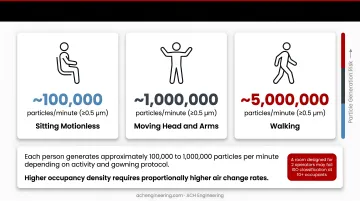
Higher occupancy density requires proportionally higher air change rates. A room designed for 2 operators may fail ISO classification when 10 people are present unless ACH is increased accordingly.
Process Contamination Generation
Manufacturing processes generate particles beyond personnel contributions:
- Powder handling and material transfer
- Equipment operation and mechanical movement
- Chemical reactions and aerosol generation
- Packaging and material manipulation
Processes involving high contamination generation require higher air change rates than passive activities like inspection or storage. Design calculations must account for peak contamination generation during normal operations, not just empty room conditions.
Pressure Differential Requirements
Maintaining required pressure differentials between adjacent spaces requires additional airflow beyond that needed for particle control alone:
- USP <797>: Minimum 0.020-inch water column (≈5 Pa) positive pressure
- FDA Aseptic Guidance: 10-15 Pa (0.04-0.06 inches w.g.) between adjacent rooms
- USP <800>: -0.01 to -0.03 inches w.g. negative pressure for hazardous drug areas
In practice, pressure control often sets the minimum airflow floor — meaning ACH is determined by pressure maintenance needs before particle dilution is even considered.
Equipment Heat Loads
Inadequate airflow for cooling can create temperature control problems even when particle counts are acceptable. Three heat sources typically drive this: process equipment, lighting systems, and personnel occupancy. When the combined thermal load is high, the required ACH for temperature control will exceed what particle dilution alone demands — making thermal analysis a required part of any cleanroom airflow calculation.
Technologies and Systems for Achieving Proper Air Change Rates
Cleanroom HVAC System Components
Cleanroom HVAC systems comprise several integrated components:
Air Handling Units (AHUs):
- Variable frequency drives (VFDs) for precise flow control
- HEPA/ULPA filtration sections
- Heating and cooling coils for temperature control
- Humidification/dehumidification systems
Supply Air Distribution:
- Ceiling-mounted HEPA filter modules (fan filter units or ducted filter banks)
- Filter coverage typically 15-35% of ceiling area for ISO 7-6 cleanrooms
- Higher coverage (35-70%) for ISO 5 unidirectional flow rooms
Return Air System:
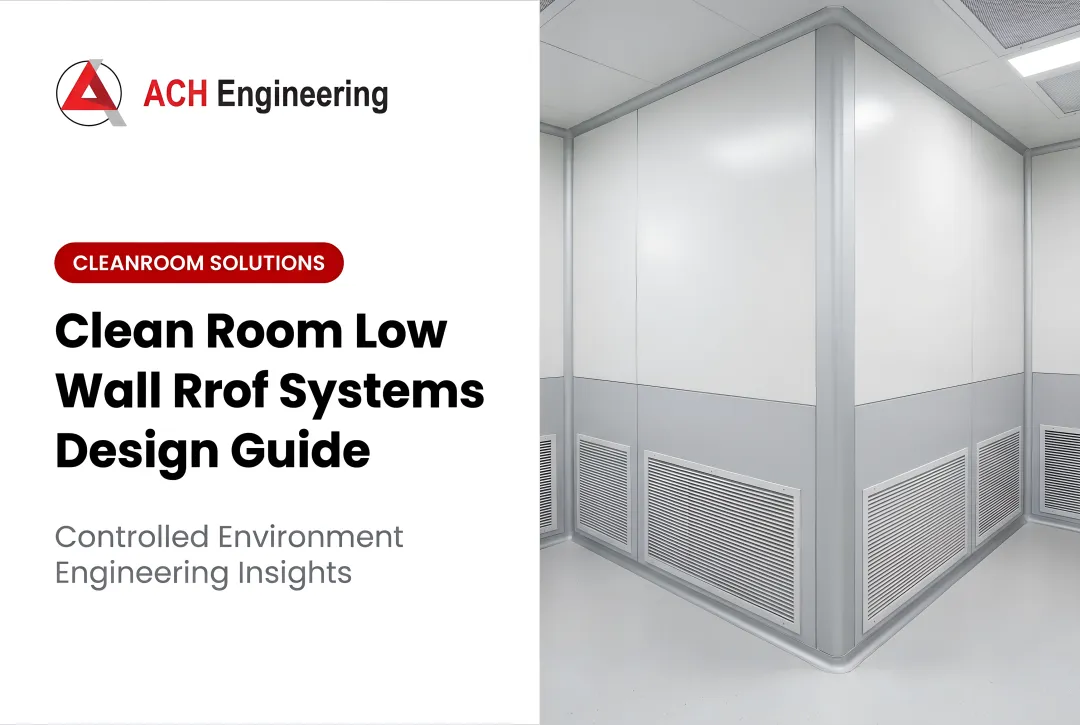
- Low-wall or floor-level return air grilles
- Creates top-to-bottom airflow patterns for effective particle removal
- Properly sized to prevent excessive velocity at return grille faces
HEPA Filter Specifications and Performance
Standard HEPA Specifications:
- Minimum efficiency: 99.97% at 0.3 micron particle size per IEST-RP-CC001
- Typical airflow capacity: 550-900 CFM per 2×4 foot filter unit
- Initial pressure drop: 0.25-0.45 inches w.g. at rated flow
- Final pressure drop at replacement: 2.0-3.0 inches w.g.
A standard 2×4 foot fan filter unit (FFU) typically delivers maximum flow of approximately 2,000 CFM at full speed, though operational setpoints are lower (600-800 CFM) to maintain target face velocity and extend filter life.
Filter Coverage Percentage: The percentage of ceiling area covered by HEPA filters directly determines achievable ACH and airflow pattern:
| ISO Class | Typical Ceiling Coverage |
|---|---|
| ISO 1-2 | 80-100% |
| ISO 3 | 60-100% |
| ISO 4 | 60-90% |
| ISO 5 | 35-70% |
| ISO 6 | 25-40% |
| ISO 7 | 15-20% |
| ISO 8 | 5-15% |
Single-Pass vs Recirculating Air Systems
Recirculating Systems:
- Recirculate 80-90% of return air through HEPA filters
- Condition only 10-20% outside air makeup
- Standard for ISO 7-8 pharmaceutical and biotech cleanrooms
- Significantly lower energy costs than single-pass systems
Single-Pass (100% Outside Air):
- Provides maximum contamination removal
- Required for hazardous fume or volatile compound handling
- Much higher energy costs due to conditioning 100% outside air
- Necessary for USP <800> containment areas and certain chemical processes
For most ISO 7-8 cleanrooms, recirculating systems are the practical default — they hit required ACH targets while keeping energy costs manageable. This matters because, as ISPE notes, fan power scales with the cube of airflow rate. Doubling your ACH doesn't double your energy draw — it roughly eightfolds it. That's why right-sizing air change rates from the start is as much an operational cost decision as a compliance one.
Common Mistakes in Air Change Rate Design and Operation
Using Nominal Filter Ratings Without Design Margins
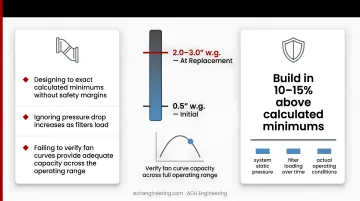
Filters rarely deliver full rated CFM in real installations. System static pressure, filter loading over time, and actual operating conditions reduce effective airflow significantly. Common errors include:
- Designing to exact calculated minimums without safety margins
- Ignoring pressure drop increases as filters load (0.5" w.g. initial to 2.0–3.0" w.g. at replacement)
- Failing to verify fan curves provide adequate capacity across the operating range
Build in 10–15% above calculated minimums to compensate for system losses and filter loading throughout the filter's service life.
Ignoring Air Change Effectiveness
High calculated ACH doesn't guarantee cleanliness if air distribution is poor. ISO 14644-16 emphasizes that poorly designed supply/return layouts create short-circuiting where clean air flows directly to returns without mixing through the occupied zone.
Consequences of poor air distribution:
- Localized contamination accumulation despite compliant overall ACH
- Air Change Effectiveness (ACE) < 1, requiring higher airflow to compensate
- Stagnant zones where particles settle rather than being removed
Proper supply/return placement, diffuser selection, and computational fluid dynamics (CFD) modeling during cleanroom design and build ensure ACE ≥ 1.0 and uniform particle distribution across the occupied zone.
Failing to Account for Equipment Heat Loads
Particle control and thermal management are inseparable. Specifying air change rates without considering equipment heat loads leads to:
- Temperature control problems during operation
- Uncomfortable working conditions affecting personnel performance
- Equipment overheating impacting process quality
Integrated design must address both contamination control and thermal management simultaneously, often requiring higher ACH than particle control alone demands.
Inadequate System Monitoring and Maintenance
HEPA filter loading increases pressure drop, reducing effective ACH if fans are not compensated. Without continuous monitoring:
- Airflow gradually decreases between validation intervals
- Cleanroom may operate out of specification for extended periods
- Pressure differentials drift, compromising contamination control
Continuous pressure differential monitoring catches airflow degradation early — before it shows up in particle counts and triggers a costly non-conformance event.
Frequently Asked Questions
What is the recommended air change rate for an ISO 7 cleanroom?
ISO 7 cleanrooms typically require 30-60 air changes per hour depending on occupancy, process contamination generation, and whether classification is needed At-Rest or Operational. For pharmaceutical and biotech applications with moderate occupancy, 40-50 ACH is common. USP <797> explicitly mandates a minimum of 30 ACH for ISO 7 buffer rooms used for sterile compounding.
How do I calculate the number of HEPA filters needed for my cleanroom?
First, determine required total CFM from your target ACH and room volume using: Required CFM = (Target ACH × Room Volume) ÷ 60. Then divide by the CFM rating per filter unit (typically 600-650 CFM for standard 2×4 fan filter units). Round up to ensure adequate coverage and account for proper spacing across the ceiling area.
What's the difference between air changes per hour and air velocity in cleanrooms?
ACH is used for ISO 6-9 non-unidirectional cleanrooms and measures how many times per hour the room volume is replaced. Air velocity (measured in m/s or fpm) is used for ISO 5 and cleaner unidirectional flow rooms where airflow speed and direction matter more than volume changes. ISO 5 typically requires 0.36-0.54 m/s velocity rather than a specific ACH value.
Can I reduce air change rates to save energy without compromising cleanliness?
ACH can be reduced during unoccupied or low-activity periods using setback modes, but only after validation confirms classification is maintained and the room recovers to operational status within an acceptable timeframe — typically 15-20 minutes. Particle counts must remain within limits throughout.
How often should air change rates be tested and validated?
Initial certification is required at installation. ISO 14644-2 recommends requalification every 6 months for ISO Class 5 and annually for ISO Classes 6-9; USP <797> also requires airflow certification every 6 months. Additional verification is needed after any HVAC modifications, filter changes, or equipment installations that affect airflow.
What factors can cause air change rates to decrease over time?
Common causes include:
- HEPA filter loading (pressure drop rising from ~0.5" w.g. to 2.0-3.0" w.g.)
- Fan belt wear or motor degradation
- Damper position shifts, ductwork leaks, or component failures
Regular airflow monitoring and preventive maintenance catch degradation before it affects cleanroom classification.
Need help with cleanroom air change rate design or validation? Contact ACH Engineering to discuss your specific requirements — our team works with pharmaceutical, biotech, semiconductor, and medical device facilities across North America to meet ISO 14644-1, USP <797>, and applicable regulatory standards.