Introduction
Cleanroom wall and ceiling panels form the critical barrier between controlled and uncontrolled environments, directly impacting contamination control, regulatory compliance, and operational efficiency.
Selecting the wrong panels can lead to costly failures including contamination events, failed inspections, premature replacement, and operational downtime that can halt production for days or weeks.
The stakes are high: the global cleanroom technology market is accelerating toward USD 14.88 billion by 2031, with industries from pharmaceuticals to semiconductors demanding increasingly sophisticated panel solutions.
With modular hardwall systems already accounting for over 56% of the market, the pressure to make informed panel selection decisions has never been greater.
Key Takeaways
- Cleanroom panels are specialized construction materials creating airtight, non-porous surfaces for controlled environments
- Panel selection depends on material composition, fire ratings, load capacity, cleanability, compliance needs, and total ownership costs
- Pharmaceutical facilities prioritize GMP compliance and chemical resistance; semiconductor fabs require static control and particle minimization
- ACH Engineering delivers modular cleanroom systems with engineering support tailored to North American standards
What Are Cleanroom Wall and Ceiling Panels?
Cleanroom panels are pre-fabricated or site-built structural components that form the walls and ceilings of controlled environments. They maintain specific cleanliness levels (ISO classifications), prevent particle generation, and withstand rigorous cleaning protocols.
These specialized barriers separate critical manufacturing or research spaces from ambient conditions, controlling airborne particles, temperature, humidity, and pressure differentials.
The two primary panel formats serve different project needs:
Modular prefabricated panels offer faster installation (3-6 months versus 12-18 months), consistent factory-controlled quality, can be relocated for future expansions, and minimal site disruption. These systems typically cost CAD$200-$400 per square foot and can reduce utility costs by up to 25% through superior sealing and insulation.
Stick-built systems provide greater customization for complex geometries, easier integration with existing structures, and flexibility for unique architectural requirements, though at higher costs (CAD$400-$700 per square foot) and longer construction timelines.
Core Panel Components
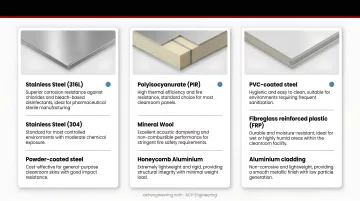
Understanding panel components helps you match materials to your specific cleanroom requirements. Cleanroom panels feature three-layer construction that determines overall performance:
Outer skins form the cleanroom-facing surface and must resist particle generation, chemical exposure, and physical impact:
- Stainless steel (316L): Superior corrosion resistance against chlorides and bleach-based disinfectants, ideal for pharmaceutical sterile manufacturing
- Stainless steel (304): Standard for many cleanrooms with good chemical resistance but less resistant to pitting in aggressive environments
- Powder-coated steel: Most common choice offering balance of cost and performance, available in antimicrobial finishes
- FRP (fiberglass-reinforced plastic): Strong moisture resistance, passes ASTM D3273 mold testing, cost-effective for ISO 6-8 applications
- Aluminum: Lightweight with non-outgassing properties, often used with honeycomb cores for semiconductor applications
The core material between outer skins provides structural integrity, insulation, and fire resistance:
- Rock wool (mineral wool): Non-combustible Class A1 rating, achieves up to 3-hour fire resistance, thermal conductivity ~0.035-0.040 W/m·K, expected service life of 40+ years
- PIR/PUR (polyisocyanurate/polyurethane): High insulation value (0.021-0.023 W/m·K), moderate fire performance, 25-40 year service life
- Aluminum honeycomb: High strength-to-weight ratio, non-shedding, anti-static properties for electronics manufacturing
- EPS (expanded polystyrene): Most economical option, moisture resistant, limited fire resistance
Benefits of Proper Panel Selection
Choosing the right panels delivers measurable operational benefits:
- Maintained ISO classification levels through non-shedding, sealed construction
- Reduced contamination risk from smooth, non-porous surfaces
- Lower energy costs—well-insulated panels can reduce environmental impact by 4.5% over 50 years
- Easier cleaning and maintenance with chemically resistant surfaces
- Extended facility lifespan through durable, corrosion-resistant materials
- Regulatory compliance meeting FDA, GMP, USP, and industry-specific standards
Industry-specific advantages include:
- Pharmaceutical/Biotech: GMP compliance and sterility assurance for injectable manufacturing
- Semiconductor: Static discharge control and ISO 4-5 environments for wafer processing
- Food/Beverage: FDA and USDA sanitation standards with washdown-capable surfaces
Key Factors for Selecting Cleanroom Wall and Ceiling Panels
Choosing the wrong cleanroom panels can trigger contamination events that destroy entire production batches, fail regulatory audits, or require costly replacements within years instead of decades.
The right selection balances six critical factors—each weighted differently based on your industry, regulatory environment, and operational demands. This framework connects technical specifications to measurable outcomes: compliance rates, uptime, maintenance costs, and product quality.
Material Composition and Surface Properties
Material selection determines panel cleanability, durability, chemical resistance, and particle generation over 15-20 year lifecycles.
Stainless steel panels serve pharmaceutical Grade A/B areas, sterile manufacturing suites, and facilities requiring frequent VHP/H2O2 sterilization.
The 316L grade contains 2-3% molybdenum, providing superior resistance to chlorides and bleach-based disinfectants compared to 304 grades. Surface roughness typically achieves Ra 0.38 µm (15 µin) with electropolishing, meeting ASME BPE SF4 standards for injectable manufacturing.
FRP (fiberglass-reinforced plastic) excels in high-moisture environments, chemical exposure zones, and cost-effective ISO 6-8 cleanrooms.
FRP panels resist mold and mildew per ASTM D3273 testing. They withstand thermal shock from hot water wash-downs, making them ideal for food processing and compounding pharmacy applications.
Powder-coated steel represents the most common choice for general cleanrooms, balancing cost and performance effectively. High-quality formulations exceed ASTM/ISO paint standards for chipping and scratching resistance. Available in antimicrobial finishes, powder-coated steel suits ISO 5-8 applications across pharmaceutical, biotech, and medical device manufacturing.
Specialty materials address unique requirements:
- CPVC: FM 4910 listed, resists broad chemical ranges, suitable for ISO 5 environments
- Polycarbonate/acrylic: Viewing panels for light transmission and visual monitoring
- Aluminum: Lightweight, non-outgassing for semiconductor fabs requiring static control
Fire Safety and Regulatory Ratings
Fire ratings are mandatory and non-negotiable. Local building codes and insurance requirements govern these ratings, directly affecting core material selection, panel thickness, and project costs.
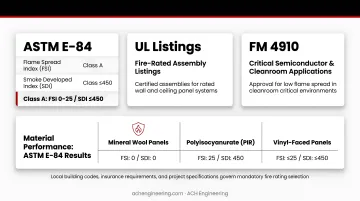
North American standards include ASTM E-84 testing for flame spread and smoke development, UL listings for fire-rated assemblies, and FM 4910 approval for critical semiconductor applications.
ASTM E-84 classifies materials as Class A (FSI 0-25, SDI ≤450). Mineral wool panels achieve FSI 0 / SDI 0 performance.
Fire resistance duration requirements vary by occupancy:
- 1-hour rating: Requires 4-inch thick mineral wool core panels
- 2-hour rating: Achieved with 6-inch thick mineral wool construction
- 3-hour rating: Requires 8-inch thick mineral wool panels
Core material selection directly impacts fire performance. Rock wool provides the only non-combustible core achieving Class A1 ratings and high hourly resistance without complex additives.
PIR/PUR cores offer improved ratings over EPS through charring behavior rather than melting, but remain combustible with limited hourly ratings. Intumescent coatings can enhance performance but add cost and complexity.
Fire safety must balance with insulation value, weight constraints, and budget. Rock wool delivers superior fire resistance but trails PIR cores in thermal performance.
Rock wool's thermal conductivity (~0.040 W/m·K) versus PIR cores (~0.022 W/m·K) can increase HVAC operating costs over the facility's lifespan.
Structural Integrity and Load-Bearing Capacity
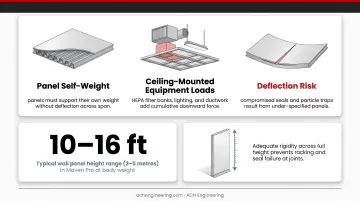
Panel thickness and structural design determine whether your ceiling can support HEPA filter banks, lighting, ductwork, and future equipment additions—or suffer deflection that compromises seals and creates particle traps.
Panels must support their own weight plus additional loads from ceiling-mounted equipment. Underestimating requirements leads to deflection, panel damage, or catastrophic failure.
Wall panels for typical 10-16 foot (3-5 meter) heights require adequate rigidity to prevent deflection. Panel thickness, core density, and edge reinforcement all affect performance.
Standard deflection limits specify L/120 for interior non-load-bearing walls.
Ceiling panel load calculations must account for:
- Static loads: Permanent equipment weight (HEPA housings, lights, utilities)
- Dynamic loads: Maintenance access and walk-on ceiling traffic
- Point loads: Concentrated equipment mounting (heavy filter banks)
Walk-on ceiling systems require specialized structural calculations per ICC-ES or EN 13964 standards. A typical 4-inch thick panel with 8-foot span can support 46.6 psf allowable live load, while some systems specify 200 kg/m² (41 psf) single/point load capacity.
These systems are essential for facilities needing above-ceiling maintenance access, extensive MEP systems, or future equipment flexibility.
Span limitations vary by system:
- Standard modular panels: Span 4-6 feet (1.2-1.8m) between supports
- Long-span systems: Achieve up to 10-foot (3m) spans while maintaining L/360 deflection limits
- Structural beam systems: Span 35+ feet for large open cleanrooms (requires additional engineering)
Trade-offs include increased panel thickness and cost for longer spans, additional support framing for heavy equipment zones, and coordination with MEP systems for structural integration points.
Cleanability, Surface Finish, and Maintenance Requirements
Surface finish directly impacts cleaning effectiveness, particle generation, microbial growth potential, and long-term appearance. The wrong finish creates particle traps, harbors contamination, or degrades under cleaning protocols.
Surface smoothness requirements vary by ISO classification:
- ISO Class 5 and below: Ra (surface roughness) ≤0.38 µm
- ISO Class 6-8: Ra 0.5-0.8 µm acceptable
- Food grade applications: Ra 0.5-0.8 µm meeting 3-A Sanitary Standards
Seamless integration features minimize particle traps. Flush-mounted panels with welded or gasketed joints eliminate crevices where contamination accumulates.
Coving at wall-floor and wall-ceiling junctions eliminates 90-degree corners that trap particles and resist cleaning, ensuring cGMP compliance.
Panels must withstand frequent application of:
- Alcohols: Ethanol and isopropyl alcohol for routine disinfection
- Quaternary ammonium compounds: Common sanitizers for general cleaning
- Bleach solutions: Require 316L stainless steel or compatible polymers
- Hydrogen peroxide vapor (VHP): Aggressive decontamination demanding compatible materials
- Sporicides: Harsh chemicals requiring chemical-resistant surfaces
Stainless steel 316L offers excellent resistance across all agents, while 304 grades may pit under chlorinated disinfectants. FRP panels provide high resistance to moisture and harsh chemicals, making them ideal for wash-down zones.
Long-term maintenance requirements vary significantly by material:
- Stainless steel: Minimal maintenance beyond routine cleaning, no refinishing required
- Powder-coated steel: Periodic touch-up in high-traffic areas, 25-40 year service life
- FRP panels: Highly durable, moisture-resistant, low maintenance requirements
Repair options differ significantly—modular systems allow full panel replacement in hours, while stick-built systems may require extensive patching and refinishing. Lifecycle maintenance costs should factor cleaning frequency (ISO 5 environments may require every-shift cleaning), material degradation rates, and replacement intervals over 15-20 year facility lifespans.
Compliance with Industry Standards and Classifications
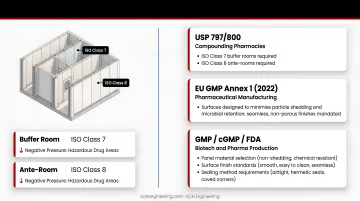
Different industries impose specific requirements beyond ISO 14644 cleanliness classifications, including GMP, FDA, USP, cGMP, and industry-specific guidelines that directly affect panel material selection, surface finishes, and sealing methods.
Pharmaceutical and biotech requirements include:
- USP 797/800: Compounding pharmacies require ISO Class 7 buffer rooms and ISO Class 8 ante-rooms, with hazardous drug areas demanding negative pressure
- EU GMP Annex 1 (2022): Mandates surfaces designed to prevent contamination and minimize particle generation
- FDA 21 CFR Part 211.42: Requires "smooth, hard surfaces that are easily cleanable" for aseptic processing
- Surface finish: Injectable manufacturing requires Ra 0.38 µm (ASME BPE SF4); solid dosage forms accept Ra 0.5 µm
Semiconductor and electronics standards focus on:
- SEMI F57: Addresses ultra-high purity polymer components preventing particle release
- Static dissipation: Materials must meet ANSI/ESD S20.20 to prevent electrostatic discharge damage
- Ultra-low outgassing: Aluminum honeycomb cores minimize contamination in ISO 4-5 environments
- Particle generation: Non-shedding surfaces essential for wafer fabrication cleanliness
Food and beverage compliance requires:
- USDA/FDA standards: Surfaces must be impervious, non-absorbent, and corrosion-resistant
- 3-A Sanitary Standards and NSF/ANSI 51: Benchmarks for food contact zones
- HACCP requirements: Washdown capability and antimicrobial surfaces
- Thermal shock resistance: Panels must withstand hot water wash-downs
Regional variations exist between North American and European standards. Panels must meet local requirements—ASTM E-84 in North America versus EN 13501 in Europe for fire testing, ICC-ES evaluation reports versus CE marking for structural validation.
Total Cost of Ownership and Long-Term Value
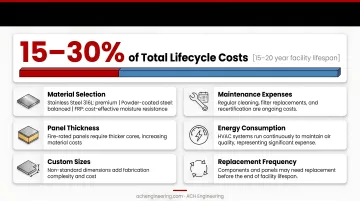
Initial panel cost represents only 15-30% of total lifecycle costs. Maintenance expenses, energy consumption, and replacement frequency significantly impact ROI over 15-20 year facility lifespans.
Upfront cost factors include:
- Material selection: Stainless steel 316L commands premium pricing; powder-coated steel balances cost and performance; FRP provides cost-effective moisture resistance
- Panel thickness: Fire-rated panels require thicker cores, increasing material costs
- Custom sizes: Non-standard dimensions add fabrication costs and lead time
- Fire ratings: Rock wool cores cost more than PIR/PUR but deliver superior fire resistance
- Installation complexity: Modular systems install faster, reducing labor costs and site disruption
Energy efficiency dramatically impacts operating costs. Insulation value (R-value/U-value) affects HVAC loads—facilities with 24/7 operation can spend significant amounts annually on temperature and humidity control.
Well-insulated panels with PIR cores (thermal conductivity ~0.022 W/m·K) reduce heating/cooling loads compared to rock wool (~0.040 W/m·K), potentially saving 25% on utilities over the facility's lifespan.
Maintenance and cleaning costs vary by material:
- Stainless steel: Minimal maintenance, no refinishing required
- Powder-coated steel: Periodic touch-up required, 25-40 year service life
- FRP: Low maintenance, excellent chemical resistance, cost-effective long-term
- Cleaning frequency: ISO 5 environments requiring every-shift cleaning generate higher labor costs than ISO 7-8 facilities
Modular systems simplify future modifications. Prefabricated panels allow easy reconfiguration for process changes, facility expansions, or equipment upgrades.
Stick-built systems may require extensive demolition, reconstruction, and recertification when modifications are needed.
Total cost of ownership methodology over 15-20 years should include:
- Initial capital expenditure: Panel materials, installation labor, engineering fees
- Energy costs: HVAC operating expenses based on insulation values and facility runtime
- Maintenance expenses: Routine cleaning, periodic inspections, coating touch-up, panel replacement
- Modification costs: Future expansions, process changes, equipment upgrades
- Downtime costs: Production losses during maintenance or modification activities
- Compliance costs: Recertification, validation, and regulatory inspection expenses
A comprehensive TCO analysis often reveals that mid-range materials with superior insulation and durability deliver better value than economy options requiring frequent replacement or premium materials offering marginal performance gains for specific applications.
How ACH Engineering Can Help
ACH Engineering specializes in controlled environment solutions for pharmaceutical, biotech, semiconductor, and other regulated industries throughout North America.
Operating from Ontario to Alberta, ACH delivers turnkey cleanroom solutions tailored to each client's operational needs.
End-to-end approach: ACH manages your entire project from initial requirements analysis through design, panel selection, installation, and final validation. This integrated approach ensures solutions aligned with regulatory requirements, operational priorities, and budget constraints.
Unique value propositions include:
- Modular systems that adapt to future expansions, process changes, or facility relocations with minimal disruption
- Single-source responsibility for all project phases, reducing your coordination burden
- Regulatory compliance expertise in FDA, USP, and cGMP requirements, backed by PEO and ISPE memberships
Expert panel consultation: ACH's team provides specialized guidance on material selection, helping you navigate trade-offs between performance, compliance, budget, and timeline. This expertise helps clients balance competing requirements such as fire ratings versus insulation values, or chemical resistance versus initial costs.
Industries Served
ACH serves diverse industries requiring controlled environments:
- Pharmaceutical/nutraceutical manufacturing and compounding pharmacies
- Biotech research and medical device manufacturing
- Semiconductor fabrication and aerospace component production
- Battery dry rooms and agricultural cultivation
- Hospitals, healthcare facilities, and laboratories
- Cosmetics, food & beverage, and medical cannabis operations
ACH's GMP-compliant modular cleanroom components include customizable wall panels, walkable ceiling systems, flush-design cleanroom doors, vision panels, and cleanroom coving that provides seamless wall-ceiling and wall-floor connections meeting cGMP requirements.
Conclusion
Selecting cleanroom wall and ceiling panels requires systematic evaluation of six key factors: material composition, fire ratings, structural capacity, cleanability, regulatory compliance, and total cost of ownership. Each factor directly impacts your facility's safety, performance, and long-term value.
The optimal panel solution isn't necessarily the most expensive or popular option—it's the one that matches your specific industry requirements, operational priorities, and long-term facility goals. A pharmaceutical sterile manufacturing suite demands different specifications than a semiconductor fab or food processing cleanroom—understanding these differences prevents costly mistakes.
Revisit your panel selection as processes evolve, regulations change, or facilities expand.
Working with experienced cleanroom specialists like ACH Engineering ensures your decisions reflect current best practices, proven performance data, and deep understanding of North American regulatory requirements. This expertise delivers facilities that maintain compliance, control contamination effectively, and provide measurable ROI over 15-20 year operational lifespans.
Frequently Asked Questions
What factors determine selection of cleanroom wall and ceiling panels?
Six primary factors drive selection: material composition, fire and safety ratings (ASTM E-84 compliance), structural load capacity, surface finish quality, industry-specific regulatory standards (GMP, FDA, USP), and total cost of ownership over 15-20 years.
What materials are used for cleanroom wall and ceiling panels?
Face materials include stainless steel (316L or 304), powder-coated steel, FRP, aluminum, CPVC, and specialty options like polycarbonate. Core materials include rock wool (superior fire resistance), PIR/PUR (excellent insulation), aluminum honeycomb (structural strength), and EPS (economical option).
What are the GMP guidelines for cleanrooms?
GMP guidelines vary by region: FDA 21 CFR Parts 210/211 (US) and EU GMP Annex 1 govern pharmaceutical manufacturing, requiring smooth, easily cleanable surfaces. These standards influence panel material selection, surface finishes (typically Ra 0.38-0.5 µm), and sealing methods including seamless coving at wall junctions.
What is the difference between modular and stick-built cleanroom panels?
Modular panels are prefabricated off-site, offering faster installation (3-6 months), consistent quality, and relocatability at $200-$400/sq ft. Stick-built panels are constructed on-site, providing greater design flexibility but requiring longer timelines and higher costs ($400-$700/sq ft).
How do fire ratings affect cleanroom panel selection?
Fire ratings (1-hour, 2-hour, or 3-hour per ASTM E-84) are mandatory and directly influence core material choice and panel thickness. Rock wool provides highest fire resistance, PIR/PUR offers moderate performance, and EPS has limited resistance. Ratings must be verified through third-party testing and ICC-ES evaluation reports.
What are the maintenance requirements for different cleanroom panel materials?
Stainless steel requires minimal maintenance (40+ year lifespan), powder-coated steel needs periodic inspections (25-40 years), and FRP offers high durability with low maintenance. All panels should be cleaned per manufacturer protocols with compatible agents. Inspection frequency depends on ISO classification and industry regulations.